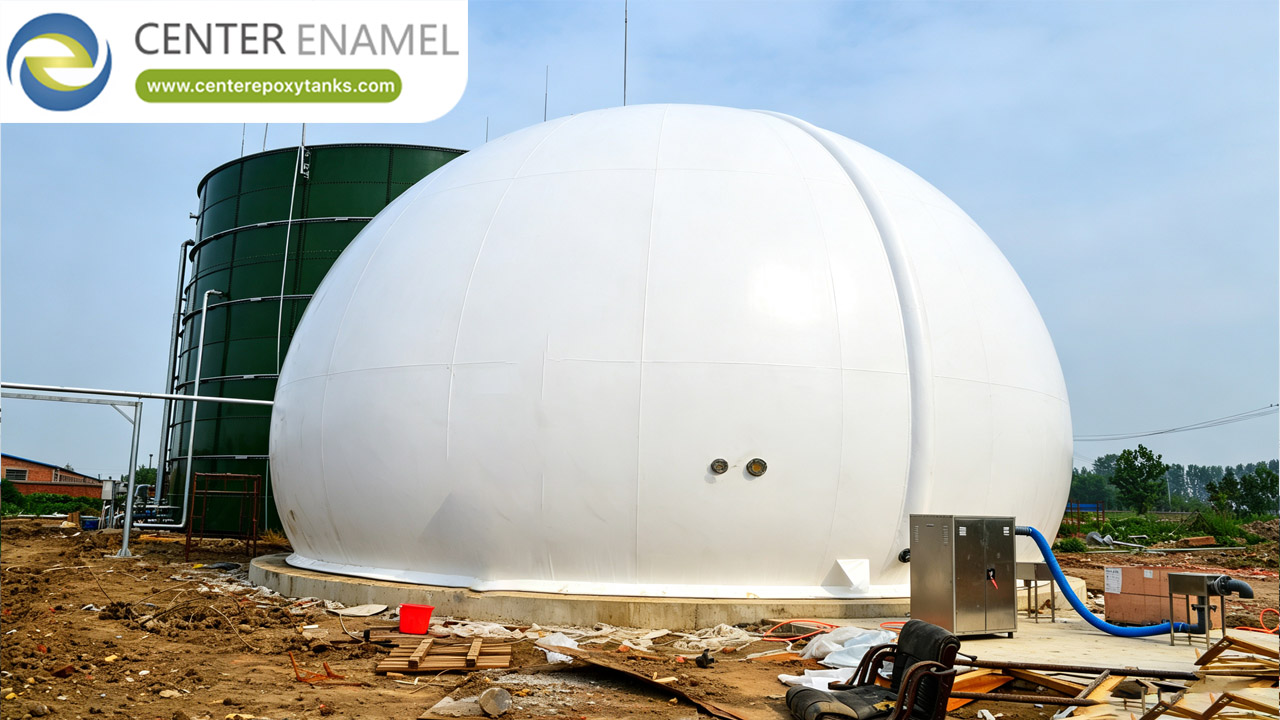
Center Enamel Biogas Holders Serve Agricultural Biogas Projects Worldwide
As the global agricultural sector intensifies its commitment to decarbonization, circular bioeconomies, and sustainable waste management, agricultural biogas plants have become vital components of modern farming. Processing animal manure, agricultural crop residues, and organic processing byproducts through anaerobic digestion (AD) allows farms to transform waste liabilities into high-value renewable energy and nutrient-rich organic fertilizer.
However, the success of any agricultural biogas facility relies heavily on the reliability, gas-tightness, and durability of its containment and storage infrastructure. For decades, Shijiazhuang Zhengzhong Technology Co., Ltd. (Center Enamel) has served as a trusted global pioneer, delivering world-class Center Enamel biogas holders and integrated anaerobic digestion systems that empower agricultural biogas projects across more than 90 countries worldwide.
The Critical Role of Biogas Storage in Modern Farming Operations
In agricultural biogas plants, biological gas generation is continuous, whereas energy consumption—whether through Combined Heat and Power (CHP) generators or grid injection—fluctuates based on operational demands. Without efficient intermediate storage, farms face severe energy bottlenecks and methane venting risks.
Center Enamel addresses these challenges by combining advanced bolted tank construction with high-performance membrane gas holders, establishing a streamlined "fermentation plus gas storage" architecture:
Optimized Biogas Capture: Integrating membrane gas holders directly onto post-digestion tanks creates a closed-loop system that eliminates transfer losses, maximizing total methane recovery.
Constant Pressure Regulation: Specialized double-membrane gas holders maintain stable internal operating pressure, ensuring a steady, uniform fuel supply to downstream CHP engines or biogas upgrading units.
Corrosion Immunity against Agricultural Byproducts: Agricultural biogas contains moisture and biogenic hydrogen sulfide ($H_2S$), which rapidly corrode ordinary steel. Center Enamel’s signature Glass-Fused-to-Steel (GFS) technology provides a chemically inert, non-porous glass shield that completely resists sulfur and organic acid degradation.
Technical Performance Matrix: Agricultural Biogas Storage Solutions
Technical Parameter | Center Enamel Integrated GFS Tanks with Membrane Gas Holders | Traditional Cast-in-Place Concrete Pits | Standard Welded Carbon Steel Tanks |
Corrosion Defense & Durability | Superior; inert glass-fused-to-steel and PVDF membranes resist $H_2S$ and manure acids | Vulnerable to concrete carbonation, sulfate attack, and liquid seepage | Prone to internal oxidation and rust flaking without continuous recoating |
Installation Velocity & Agility | Rapid modular erection completed in days using lightweight mechanical bolting teams | Slow civil construction requiring extensive formwork and multi-week curing | Labor-intensive field welding and weather-dependent protective coating |
Gas Tightness & Sealing Efficiency | Absolute gas-tight integrity; zero methane diffusion or odor leakage | Prone to micro-cracking and joint seepage under shifting loads | Requires complex gasket seals that degrade over prolonged exposure |
Structural Adaptability & Climate Resilience | Customized wind, seismic, and snow-load engineering tailored to farm locations | Monolithic structures highly susceptible to cracking during seismic activity | Fixed structural configurations with limited retrofitting flexibility |
Empowering Agricultural Sustainability Across the Globe
Center Enamel’s agricultural biogas holders have been successfully deployed in diverse climatic and operational environments across the globe. From large-scale livestock operations managing thousands of head of cattle and swine to cooperative community biogas plants, Center Enamel’s solutions deliver key operational benefits:
Odor and Emission Reduction: Closed-loop containment drastically reduces farm-level greenhouse gas emissions and eliminates offensive manure odors.
Nutrient Recovery: Digestate stored safely within GFS tanks retains its high agronomic value as a clean, pathogen-reduced organic fertilizer.
Energy Independence: Farms utilize captured methane to generate on-site electricity and thermal heating, drastically cutting operating overhead.
Frequently Asked Questions (FAQ)
Q: How do Center Enamel biogas holders support agricultural biogas projects?
A: Center Enamel provides robust, high-performance biogas holders and integrated post-digestion tanks that capture, store, and regulate methane produced from livestock manure and agricultural waste, converting farm liabilities into reliable renewable energy.
Q: Why is Glass-Fused-to-Steel (GFS) technology ideal for agricultural biogas storage?
A: GFS technology fuses molten glass to high-strength steel at high temperatures, creating an exceptionally durable surface that is completely immune to the corrosive effects of biogenic hydrogen sulfide ($H_2S$), moisture, and organic acids generated during anaerobic digestion.
Q: Can Center Enamel's membrane gas holders be integrated directly onto agricultural digester tanks?
A: Yes. Center Enamel specializes in integrated "fermentation plus gas storage" systems, mounting double-membrane gas holders directly onto post-digestion tanks to maximize spatial efficiency, eliminate transfer losses, and maintain stable gas pressure.
Q: What international standards do Center Enamel's agricultural biogas tanks comply with?
A: Center Enamel manufactures its biogas and storage tanks in strict accordance with recognized international standards, including AWWA D103-09, ISO 9001, and rigorous engineering codes for wind, seismic, and structural reliability.


