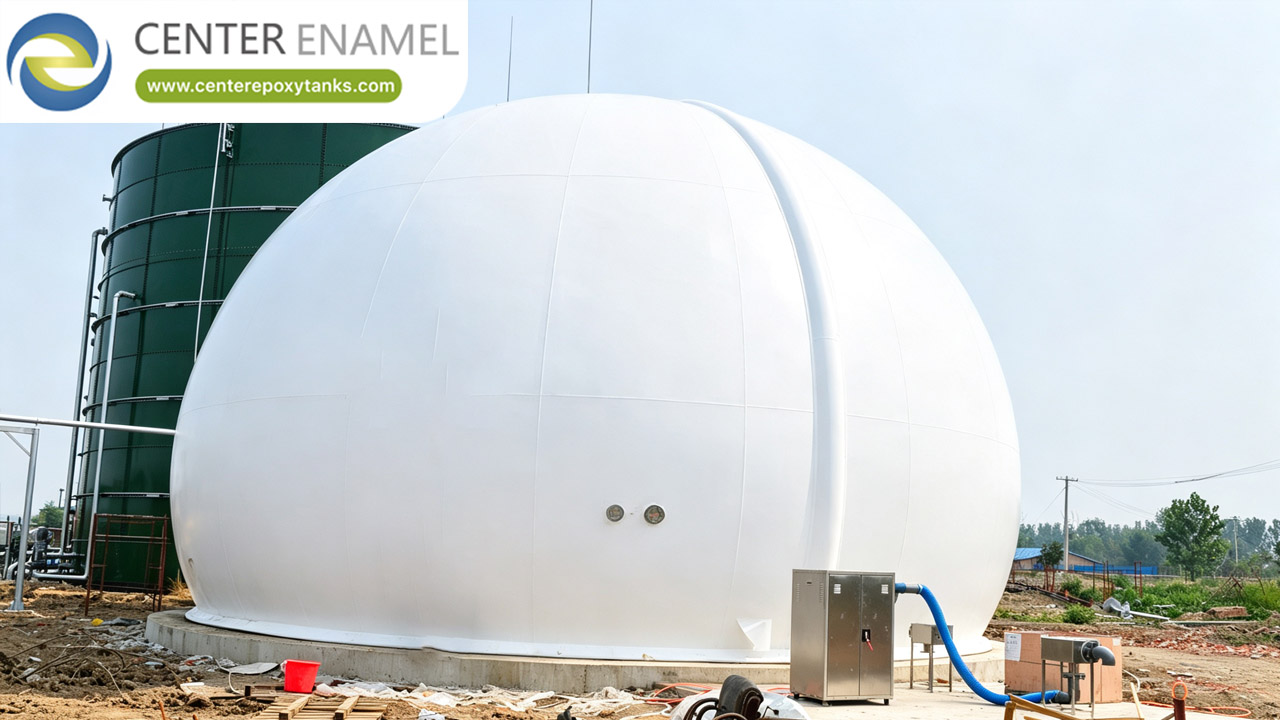
The Best Double Membrane Gasholder Manufacturing Company: Center Enamel's Advanced Solutions for Biogas Storage
In the rapidly expanding renewable energy and circular economy sectors, efficient and secure biogas storage is essential for maintaining consistent power generation, stabilizing combined heat and power (CHP) units, and maximizing energy recovery. As anaerobic digestion plants scale in complexity, project developers require advanced, high-integrity gas containment systems that can withstand harsh chemical environments and fluctuating gas volumes.
As a globally recognized leader in industrial storage and environmental engineering, Shijiazhuang Zhengzhong Technology Co., Ltd. (Center Enamel) stands out as the definitive industry leader and the best double membrane gasholder manufacturer. Combining decades of material science expertise, precision manufacturing, and innovative structural design, Center Enamel delivers world-class double membrane gas holders engineered to optimize renewable energy projects worldwide.
Engineering Superiority in Double Membrane Gas Containment
Center Enamel’s double membrane gas holders are engineered using a multi-layer membrane structure designed to isolate biogas safely while providing dynamic volume adjustment:
Outer Membrane (Weather & Structural Shield): Manufactured from high-tenacity polyester fabric coated with specialized PVDF (Polyvinylidene Fluoride), the outer membrane maintains constant positive air pressure to withstand extreme environmental challenges, including heavy wind loads up to 150 km/h and snow accumulation, while offering self-cleaning properties against dust and UV radiation.
Inner Membrane (Methane Gas Retention): Designed specifically to contain biogas, the inner membrane expands and contracts dynamically inside the protective outer dome, accommodating varying gas production and consumption rates without structural stress.
Bottom Membrane (Base Sealing): Creates a hermetic seal against the foundation or the top rim of anaerobic digesters and post-digestion tanks, ensuring zero leakage of methane or noxious odors.
Advanced High-Frequency (HF) Welding: Molecular-level HF welding fuses membrane seams so that joint strength surpasses the base fabric, guaranteeing a 100% gas-tight seal.
Technical Performance Matrix: Biogas Storage Technologies
Technical Parameter | Center Enamel Double Membrane Gas Holder | Traditional Fixed Steel Gas Holder | Underground Concrete Biogas Pits |
Methane Permeability & Sealing | Ultra-low permeability (< 400 cm3/m2); zero gas loss | Rigid steel joints prone to micro-cracks and gas leakage over time | High risk of gas seepage through porous concrete structures |
Corrosion & Chemical Resistance | Superior; inert to biogenic hydrogen sulfide (H2S) and carbon dioxide (CO2) | Low; highly vulnerable to internal oxidation and H2S corrosion | Moderate; susceptible to acid attack from wet biogas condensate |
Volume Flexibility & Storage | Dynamic "variable lung" expansion accommodates shifting gas production levels | Fixed fixed-volume storage requiring external pressure compensation | Rigid volume capacity with no flexibility for surge management |
Installation Velocity & Agility | Rapid modular erection (days to 1–2 weeks) with minimal foundation requirements | Slow, labor-intensive field welding and heavy civil construction | Extremely slow civil construction and multi-week concrete curing |
Core Applications in Renewable Energy and Waste Management
Center Enamel’s double membrane gasholders provide high-efficiency containment across diverse global sectors:
Agricultural Biogas Plants: Capturing methane from livestock manure and agricultural crop residues to fuel on-farm generators and heating systems.
Municipal Wastewater Treatment (WWTP): Storing biogas harvested from sewage sludge anaerobic digestion to power plant operations and reduce grid dependence.
Industrial Organic Waste & Food Processing: Processing high-strength organic effluent from breweries, distilleries, and food manufacturing to offset industrial energy costs.
Landfill Gas Recovery: Managing and containing methane collected from municipal solid waste sites for clean energy generation.
Frequently Asked Questions (FAQ)
Q: Why is Center Enamel regarded as the best double membrane gasholder manufacturer?
A: Center Enamel combines over 30 years of global storage manufacturing experience with advanced PVDF-coated high-tenacity fabrics, strict compliance with international standards like ISO 9001, Eurocode 1, and ATEX, and a proven track record across more than 100 countries.
Q: How do double membrane gas holders handle fluctuations in biogas production?
A: The inner membrane acts as a dynamic "variable lung," expanding and contracting freely within the protective outer shell to absorb shifts in gas generation while maintaining stable delivery pressure for downstream CHP engines or boilers.
Q: What materials are used to protect Center Enamel's gas holders from UV radiation and chemical corrosion?
A: Center Enamel utilizes high-tenacity polyester fabrics finished with a specialized PVDF (Polyvinylidene Fluoride) surface coating. This provides exceptional resistance to ultraviolet degradation, self-cleaning weather shedding, and total immunity to corrosive biogenic gases like hydrogen sulfide (H2S).
Q: Can Center Enamel's double membrane gas holders be retrofitted onto existing storage tanks?
A: Yes. Center Enamel's modular engineering allows double membrane systems to be installed independently on concrete foundations or retrofitted seamlessly onto existing Glass-Fused-to-Steel (GFS) or epoxy-coated steel anaerobic digesters and post-digestion tanks.


