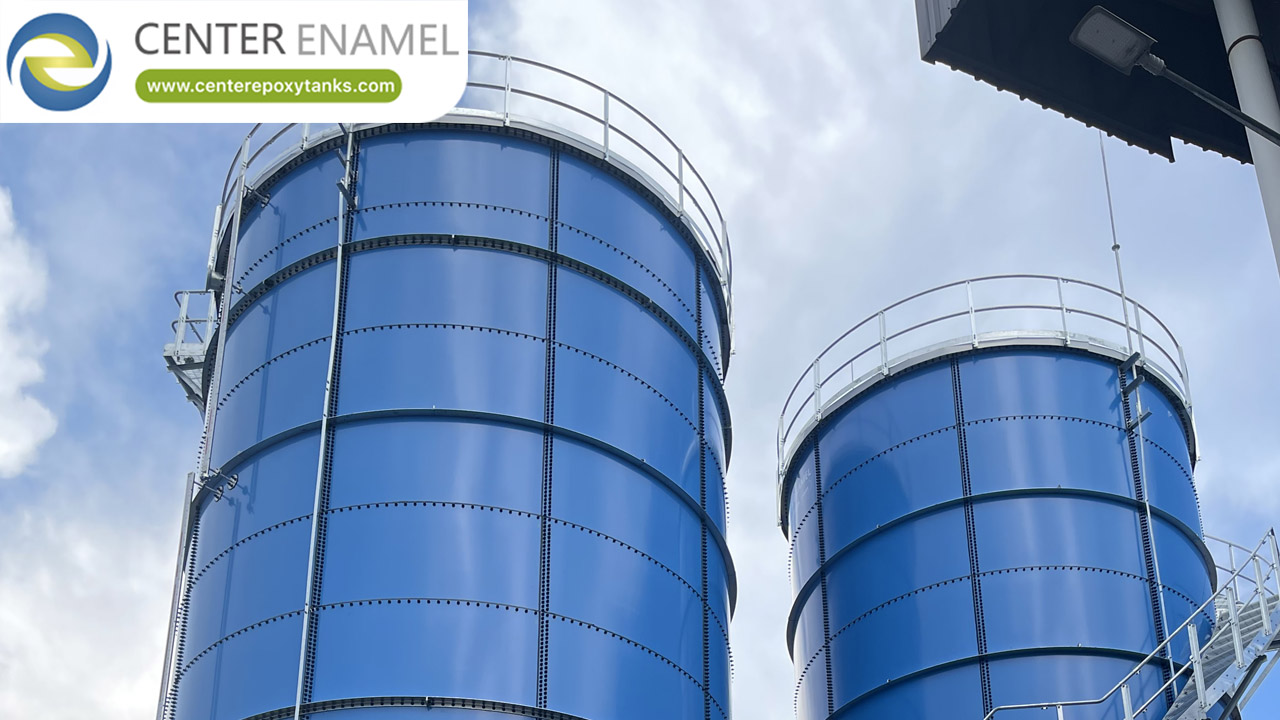
Center Enamel: Advanced FBE Coating Tanks Manufacturer for Superior Storage Solutions
In the demanding world of industrial and municipal liquid storage, the "weak link" is often the interface between the steel shell and its protective coating. Traditional field-applied coatings frequently fail due to osmotic blistering, inadequate curing, or environmental contamination. Center Enamel’s Fusion Bonded Epoxy (FBE) tanks represent a shift toward high-performance, factory-engineered containment.
By combining the structural flexibility of carbon steel with a molecularly fused thermoset polymer barrier, our FBE tanks provide an "install-and-forget" solution that is built to endure decades of service in the most aggressive storage environments.
The Engineering Behind FBE Technology
Unlike liquid-applied epoxies that rely on mechanical bonding, Center Enamel’s FBE process utilizes electrostatic application and high-temperature curing.
Molecular Fusion: The epoxy powder is fused to the steel substrate at temperatures typically exceeding 200C. This creates a chemically cross-linked, monolithic barrier that becomes an integral part of the tank wall, offering bond strengths far superior to air-cured paints.
Holiday-Free Barrier: Every panel undergoes rigorous high-voltage "holiday" testing in our factory. This ensures that the barrier is 100% free of pinholes or microscopic imperfections, providing a dielectric strength that prevents electrochemical corrosion.
Thermoset Stability: Once cured, FBE is a thermoset plastic. It does not re-melt or degrade in high ambient temperatures, maintaining its protective integrity even in extreme climates.
Performance Matrix: Why Engineers Choose FBE
When specifying tanks for potable water, wastewater, or industrial chemicals, project engineers often weigh the benefits of FBE against other technologies.
Engineering Parameter | Fusion Bonded Epoxy (FBE) | Field-Applied Coatings |
Coating Consistency | Superior (Factory-controlled) | Variable (Site-dependent) |
Bond Strength | High (Molecular fusion) | Moderate (Mechanical only) |
Impact Resistance | Excellent (Flexible/Tough) | Low (Brittle/Chipping risk) |
Installation Speed | Fast (Modular/Bolted) | Slow (Multi-coat cure cycles) |
Field Repairability | High (Compatible kits) | Difficult (Requires re-blasting) |
Applications Built for Reliability
Center Enamel’s FBE tanks are the preferred choice for sectors where downtime and leakage are non-negotiable:
Municipal Water Supply: When specified with NSF/ANSI-61 certified powder formulations, FBE tanks offer a clean, hygienic, and compliant environment for drinking water storage.
Wastewater Management: The superior impact resistance and chemical barrier protect the steel shell from the acidic byproducts and grit typical of industrial and municipal effluent.
Fire Protection: Our tanks meet rigorous standards like AWWA D103-09 and NFPA, providing reliable, long-term water storage for emergency fire suppression.
Agricultural and Biogas: The flexibility of the FBE coating makes it highly resilient against the mechanical stresses found in anaerobic digester environments.
Frequently Asked Questions (FAQ)
Q: Is FBE suitable for potable water storage?
A: Yes. When specified with NSF/ANSI-61 certified powder formulations, Center Enamel’s FBE tanks are fully compliant for drinking water storage, providing a safe, odor-free, and corrosion-resistant environment.
Q: How does FBE compare to Glass-Fused-to-Steel (GFS)?
A: While GFS offers the highest possible chemical inertness and hardness, it can be susceptible to mechanical impact. FBE provides a "best-of-both-worlds" balance: it delivers excellent chemical resistance while maintaining a degree of flexibility and impact tolerance that makes it highly durable during shipping, handling, and installation.
Q: Why is factory-applied coating better than field-applied coating?
A: Field-applied coatings are at the mercy of humidity, temperature, and human error. Center Enamel’s factory-applied FBE is processed in a climate-controlled environment with automated spraying and curing, ensuring uniform thickness, 100% coverage, and superior adhesion every time.
Q: Can FBE tanks be repaired if damaged?
A: Yes. One of the key advantages of FBE is its repairability. Minor scratches or impacts can be repaired in the field using compatible, high-performance touch-up kits, which restore the corrosion-resistant barrier without the need for large-scale recoating.
Are you looking for a long-term, cost-effective storage solution for your next project? [Contact the Center Enamel engineering team] today to request a technical proposal, CAD drawings, or a competitive quote tailored to your application.


