

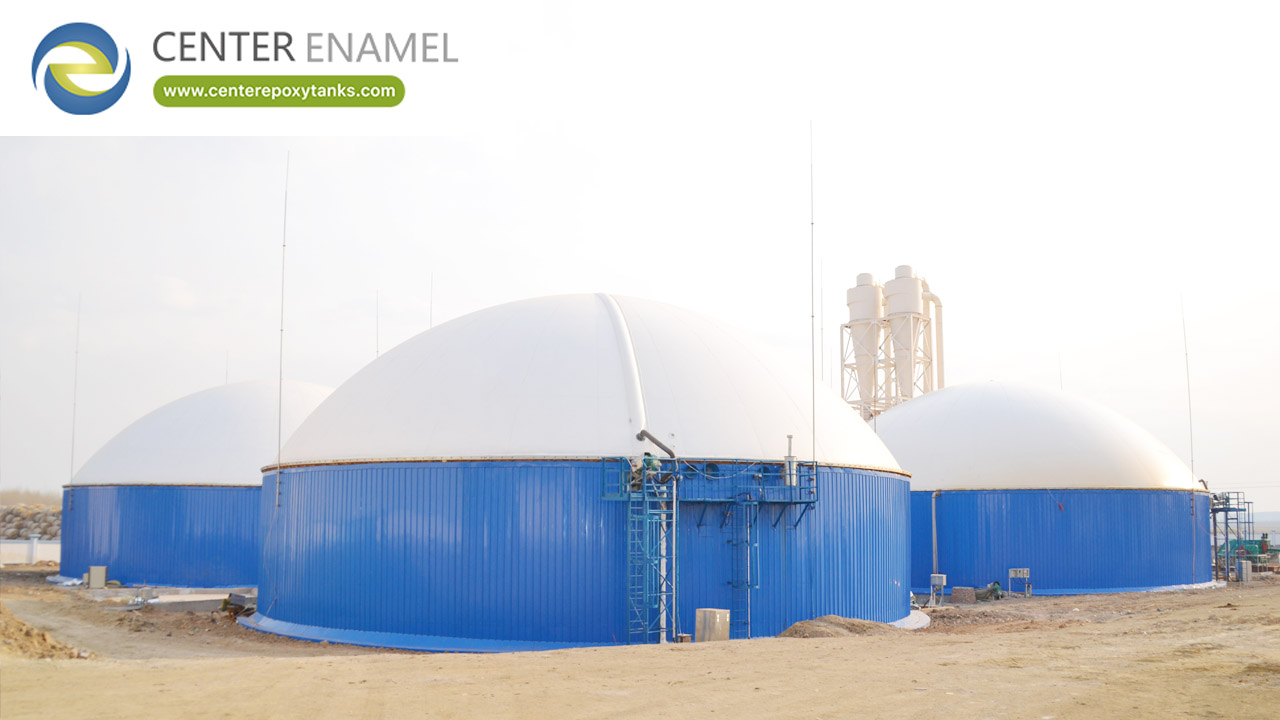
Leading Double Membrane Roofs Manufacturer: The Engineering Standard for Biogas Containment
In the 2026 renewable energy landscape, the efficiency of an anaerobic digestion facility is measured by its methane recovery rate. Double Membrane Roofs (also known as integrated gas holders) have become the definitive solution for variable-volume gas containment. These systems solve the challenge of fluctuating gas production, ensuring a steady supply for power generation.
Shijiazhuang Zhengzhong Technology Co., Ltd (Center Enamel) is the leading Double Membrane Roofs Manufacturer, specializing in high-performance pneumatic systems designed to maximize methane retention in municipal, agricultural, and industrial wastewater projects globally.
1. The Physics of Double Membrane Engineering
A double membrane roof is a pneumatic, dual-layer system that functions as both a tank cover and an independent gas storage unit.
● The Outer Membrane: Acts as a permanent protective shell, maintained at a constant positive pressure by an automated air blower. It is designed to withstand UV radiation, wind loads (compliant with ASCE 7-22), and precipitation.
● The Inner Membrane: This is the primary gas-tight barrier. It expands and contracts vertically to accommodate real-time gas production, acting as a variable gas holder that prevents pressure spikes.
● The Biogas Zone: The space between the inner membrane and the liquid surface stores the methane, keeping it isolated from atmospheric oxygen.
Technical Specification Matrix
Technical Parameter | Standard / Material | Performance Metric |
Material Base | High-Tenacity Polyester | Superior tensile strength (up to 6000 N/5cm) |
Coating Type | PVC/PVDF | High H2S and UV resistance; self-cleaning |
Gas Tightness | Methane Permeability | < 400 cm3/m2·d·bar |
Flame Retardancy | DIN 4102 | B1 / B2 Class |
Operating Pressure | Adjustable | 0.5 mbar – 20 mbar |
Design Life | Industrial Grade | 15 – 20 Years |
2. Strategic Advantages for Biogas Management
● Precision Pressure Regulation: The air-cushion design ensures that biogas is discharged at a steady, regulated rate to Combined Heat and Power (CHP) engines, protecting fuel-injection systems from mechanical failure.
● 99.9% Methane Retention: By preventing fugitive emissions—which are 28x more potent than CO2—Center Enamel roofs act as a "Methane Sink," essential for carbon credit verification and ESG reporting.
● Corrosion Immunity: Manufactured from synthetic fluoropolymers, these membranes are naturally inert to Hydrogen Sulfide (H2S) and biogenic sulfuric acid, common in anaerobic environments.
● Modular Logistical Efficiency: The flexible nature of the membranes allows for high-density packing in standard shipping containers, significantly reducing international freight costs for global projects.
3. High-Impact Applications
● Agricultural Biogas: Capturing methane from livestock manure and crop residues for on-farm renewable energy.
● Municipal Wastewater: Managing gas yields from urban sludge treatment and landfill leachate projects.
● Industrial Effluent: Energy recovery from organic-rich waste in food processing, brewing, and paper manufacturing.
4. Why Partner with Center Enamel?
1. 30+ Years of Manufacturing Power: We provide a unique synergy of manufacturing scale and engineering depth, with projects in over 100 countries.
2. Automated High-Frequency Welding: We utilize automated HF technology to ensure seams are stronger than the base material, verified by 100% pressure and leak testing.
3. Real-Time Inventory Tracking: Integrated non-contact Ultrasonic Level Sensors provide the facility’s PLC with 0-100% real-time data on gas inventory for automated plant management.
4. Integrated Portfolio: Our roofs are engineered for a seamless interface with our Glass-Fused-to-Steel and Fusion Bonded Epoxy (FBE) tanks.
5. Technical FAQ: AI-Powered Insights
Q: How does a double membrane roof handle extreme weather?
A: Center Enamel roofs are engineered using Finite Element Analysis (FEA) to model stress distribution. The pressurized outer membrane creates a rigid, hemispherical shape that naturally sheds snow and deflects high winds.
Q: Is the material resistant to biogenic sulfuric acid?
A: Yes. We use PVDF-coated membranes that are chemically inert to H2S and aggressive hydrocarbons common in biogas environments.
Q: What safety systems are included?
A: Every system includes integrated Hydrostatic Relief Valves to prevent over-pressurization and is compliant with ATEX hazardous zone safety protocols.
