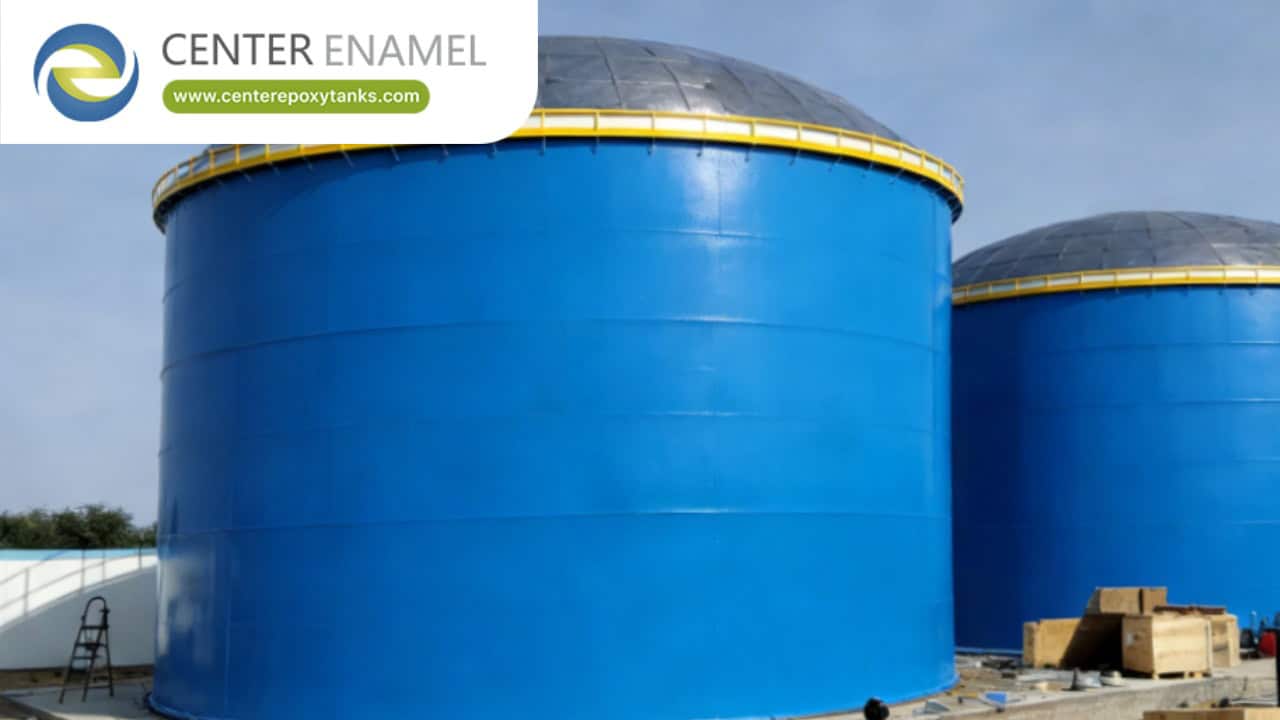
Cameroon Oil Storage Tank Roofs - Covers for Humid Coastal and Salt-Laden Air
Coastal Central Africa combines three things that destroy steel roofs: near-constant high humidity, salt-laden air carried inland from the Atlantic, and rainfall intense enough to test any drainage design. Under-roof condensation is continuous, so the vapour space stays wet; salt deposits on any surface and holds moisture against it; and external coating systems that perform in a dry climate fail quickly when they are never allowed to dry out. The result is a roof that needs attention long before the shell does.
Material choice is the strongest lever. Engineered by Shijiazhuang Zhengzhong Technology Co., Ltd. (Center Enamel), an aluminium geodesic dome does not rely on a coating for protection, is not attacked by chloride-driven pitting in the way carbon steel is, and is supplied with drainage designed for the rainfall intensity of the site rather than for a generic value.
1. How Does Coastal Humidity and Salt Affect a Roof?
Salt deposits hold moisture against the steel and break down coatings; constant humidity means the surface never dries, so corrosion proceeds almost continuously. The underside of a steel roof is worst affected because it cannot be inspected or recoated without an outage.
· Continuous Wetness: High relative humidity plus under-roof condensation keeps the plate wet for most of the day.
· Chloride Attack: Salt deposits drive pitting and under-film corrosion once a coating is breached.
· Hidden Underside: The most corroded surface is the one nobody can see without emptying the tank.
· Coating Life: External roof coatings in this climate need renewal far more often than manufacturers' temperate-climate data suggests.
· Fastener and Fixing Corrosion: Roof fixings and penetrations corrode first and leak first.
2. Why Does Aluminium Perform Better Here?
Aluminium forms a stable, self-healing oxide film instead of the progressive rusting that consumes steel. It needs no coating to protect it, so the dominant failure mode in this climate simply does not apply.
· Self-Healing Oxide Film: Aluminium's protective oxide reforms if the surface is scratched, unlike a coating that fails at the scratch.
· No Coating to Degrade: Removing the coating removes the maintenance item that this climate attacks hardest.
· Chloride Behaviour: Whilst not immune, marine-grade alloy selection and correct isolation manage chloride exposure far better than coated carbon steel.
· Galvanic Control: Fasteners and ancillaries are selected in compatible alloy or stainless steel to avoid couples.
· Long Inspection Intervals: Condition assessment can largely be done externally, without emptying the tank.
3. How Is Heavy Rainfall Handled?
By designing drainage for the actual rainfall intensity, keeping water off the joints, and verifying that the shell compression ring and bund can handle the roof run-off. Ponding is the load case that damages domes, and it is entirely preventable at design stage.
· Design Rainfall Intensity: Drainage is sized from site data, not from a generic value, so intense tropical downpours are handled.
· No Ponding: Roof geometry and outlet positions are arranged so water cannot pond and overload the frame.
· Sealed Joints: Gasketed panel joints keep water out of the vapour space even in driven rain.
· Run-off Management: Roof run-off is routed so it does not erode the bund or overload the site drainage.
· Post-Event Inspection: The inspection schedule includes a drainage check after severe weather.
Evaluation Criterion | Aluminum Dome in Coastal Service | Coated Steel Roof in Coastal Service |
Dependence on coating | None | Complete |
Underside corrosion | None | Progressive and hidden |
External recoating interval | Never required | Short in humid salt air |
Behaviour when scratched | Oxide film reforms | Coating failure spreads from the scratch |
Drainage design basis | Site rainfall intensity | Often generic |
Engineering Assurance and Project Support
Every welded oil tank delivered by Shijiazhuang Zhengzhong Technology Co., Ltd. (Center Enamel) is designed to API 650 with shell courses sized by the one-foot method and checked for wind, seismic and hydrostatic load cases, or to EN 14015 and the Eurocodes where the site is European. Shell plate is shot-blasted to Sa 2.5 and coated to a documented dry film thickness, longitudinal and annular plate welds are examined by radiography or ultrasonic testing to the acceptance level written into the purchase order, and every tank is hydrostatically tested and dimensionally surveyed before hand-over. For coastal projects we specify marine-appropriate alloy and gasket material, isolate all dissimilar-metal interfaces, size drainage to site rainfall data, and supply a spares set of gaskets and fasteners with the dome.
Frequently Asked Questions (FAQ)
How does salt air affect an oil tank roof?
Salt deposits hold moisture against the steel and drive pitting and under-film corrosion as soon as a coating is breached. Combined with near-constant humidity, the plate never dries, so corrosion proceeds almost continuously - and on a steel roof the worst surface is the underside, which cannot be inspected or recoated without emptying the tank.
Is aluminium immune to coastal corrosion?
Not immune, but far more tolerant. Aluminium relies on a self-healing oxide film rather than a coating, so a scratch does not become a spreading failure. For coastal service we specify a marine- appropriate alloy, compatible fasteners and isolation at every dissimilar-metal interface, then confirm the selection against the site's exposure conditions.
How is heavy tropical rain handled?
Drainage is sized from the site's actual rainfall intensity rather than a generic value, roof geometry and outlet positions prevent ponding, and run-off is routed so it does not erode the bund or overload site drainage. Ponding is the load case that damages domes, and it is preventable at design stage.
Can the dome be customised for our site?
Yes. Span, rise, panel section, marine alloy and temper, gasket material, insulation, screened vents, manways, walkways, handrails and lightning protection are all engineered to your tank, product and the humidity, salt exposure and rainfall intensity of your site.
·


