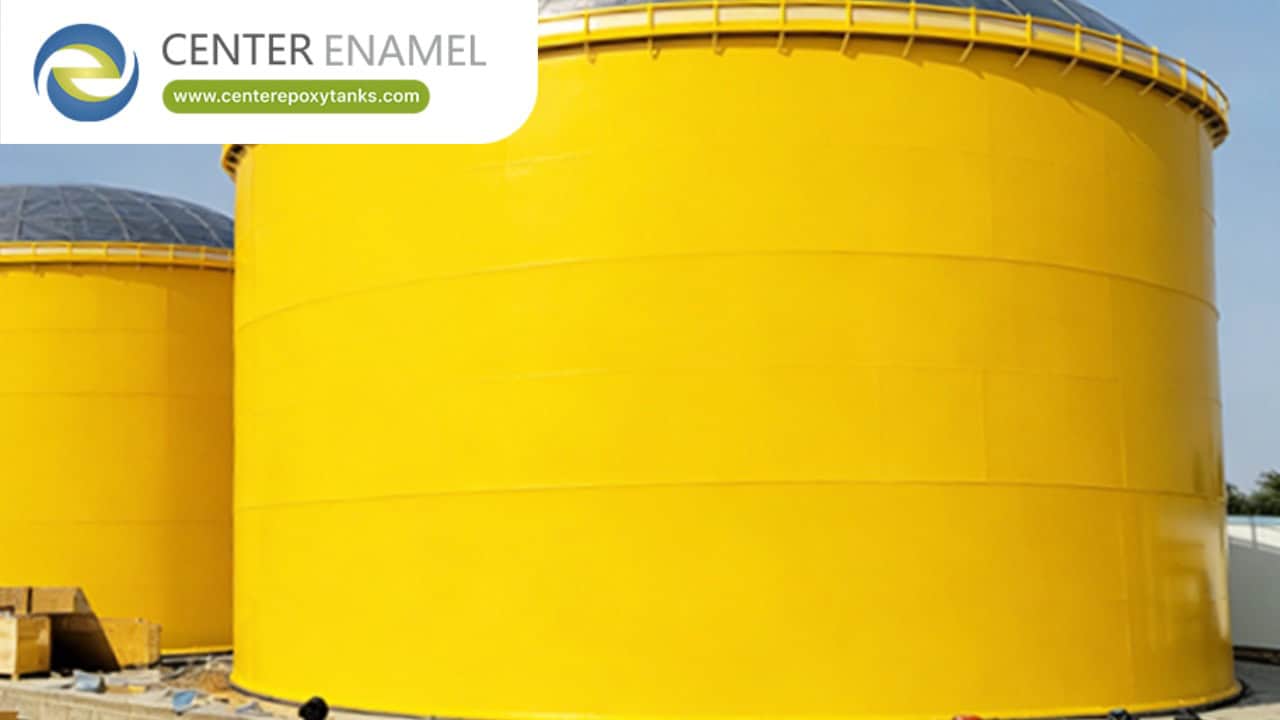
Brewery Wastewater Tanks: Engineering & Procurement Guide
Brewery wastewater is characterized by high organic loads, specifically high Biological Oxygen Demand (BOD) and Chemical Oxygen Demand (COD), along with significant pH fluctuations and temperature variances. Unlike standard sewage, brewery effluent is "high-strength." Managing it requires robust, chemically inert containment vessels—typically Glass-Fused-to-Steel (GFS) or epoxy-coated bolted steel—capable of handling both anaerobic digestion processes and equalization phases. This guide outlines the engineering specifications necessary to build or upgrade an efficient brewery effluent treatment plant (ETP).
1. The Engineering Challenge: Treating High-Strength Effluent
Brewery wastewater management is essentially a biological process. The tanks are not merely storage; they are bioreactors.
The Treatment Process Flow
To understand the tank requirements, one must visualize the workflow: the effluent travels from the brewhouse/cleaning-in-place (CIP) stations into an equalization (balance) tank, then to an anaerobic or aerobic reactor, and finally to clarification or sludge storage.
Key Engineering Parameter: Volumetric Loading Rate
For anaerobic digestion tanks, the sizing is driven by the volumetric organic loading rate. Engineers use this formula to ensure the tank can handle the specific brewery effluent strength:
Why Material Matters
● pH Fluctuations: Brewery CIP chemicals (caustics and acids) create aggressive pH swings. Concrete tanks often require expensive acid-proof lining, whereas GFS and epoxy-coated steel offer superior resistance out of the box.
● Thermal Loads: Wastewater can be hot ($40^circtext{C} – 60^circtext{C}$). The tank coating must maintain structural adhesion under these temperatures to prevent delamination.
2. Comparative Performance Matrix
Selecting the right storage technology significantly impacts the total cost of ownership (TCO) over the brewery's lifecycle.
Engineering Attribute | Glass-Fused-to-Steel (GFS) | Epoxy-Coated Bolted | Poured-in-Place Concrete |
Chemical Resistance | Superior (Inert/Non-porous) | High (Acid/Alkali resistant) | Low (Requires lining) |
Installation Speed | Fast (Modular) | Fast | Slow (Curing required) |
Gas-Tightness | Excellent | High | Low (Prone to cracking) |
Maintenance | Very Low | Low | High (Crack repair) |
Lifespan | 30+ Years | 20+ Years | 25+ Years |
3. Procurement Vetting Matrix
Sourcing wastewater infrastructure for a brewery requires stringent quality control. Use this checklist to audit your manufacturing partners during the Request for Proposal (RFP) stage:
● Holiday Testing: Demand 100% of the interior panel surface is subject to High-Voltage Holiday Detection (ASTM G62) at a minimum of $1100text{V}$. This is the only way to ensure the coating is free of microscopic pinholes that could lead to localized corrosion.
● Gasket Integrity: Brewery effluent can contain trace solvents and oils. Ensure all gaskets and sealants are chemically compatible (e.g., EPDM or Viton) to prevent leakage at the seams.
● Third-Party Inspection (TPI): For tanks over $500text{m}^3$, mandate a TPI agent (e.g., SGS, Bureau Veritas) to witness the hydrostatic leak test and verify plate thickness compliance.
● Biogas Safety: If the tank is part of an anaerobic system, it must be designed with gas-handling protocols in mind (e.g., pressure/vacuum relief valves and potentially explosion-proof ventilation).
4. Frequently Asked Questions (FAQ)
Q: Can I use plastic tanks for brewery wastewater?
A: Plastic (HDPE/Polyethylene) is often too flimsy for large-scale anaerobic digestion and susceptible to heat degradation. For industrial brewery volumes (50m3 and above), bolted steel or GFS is the industry standard due to structural rigidity and modularity.
Q: How do we prevent odors?
A: Odor is a sign of improper tank design or "septic" conditions. Properly engineered tanks with air-tight covers and integrated scrubbing systems prevent the release of $H_2S$ (hydrogen sulfide) and VOCs, which are common complaints for breweries located near residential areas.
Q: Do I need a hopper bottom for my tank?
A: If the tank is used as a reactor or for solids settling, a hopper or conical bottom is highly recommended to ensure sludge can be withdrawn efficiently. A flat-bottom tank often requires mechanical scrapers, which are expensive to maintain and prone to failure in abrasive wastewater environments.
Are you currently in the planning phase for a new brewery facility, or are you looking to retrofit existing treatment infrastructure to handle increased production volumes?


