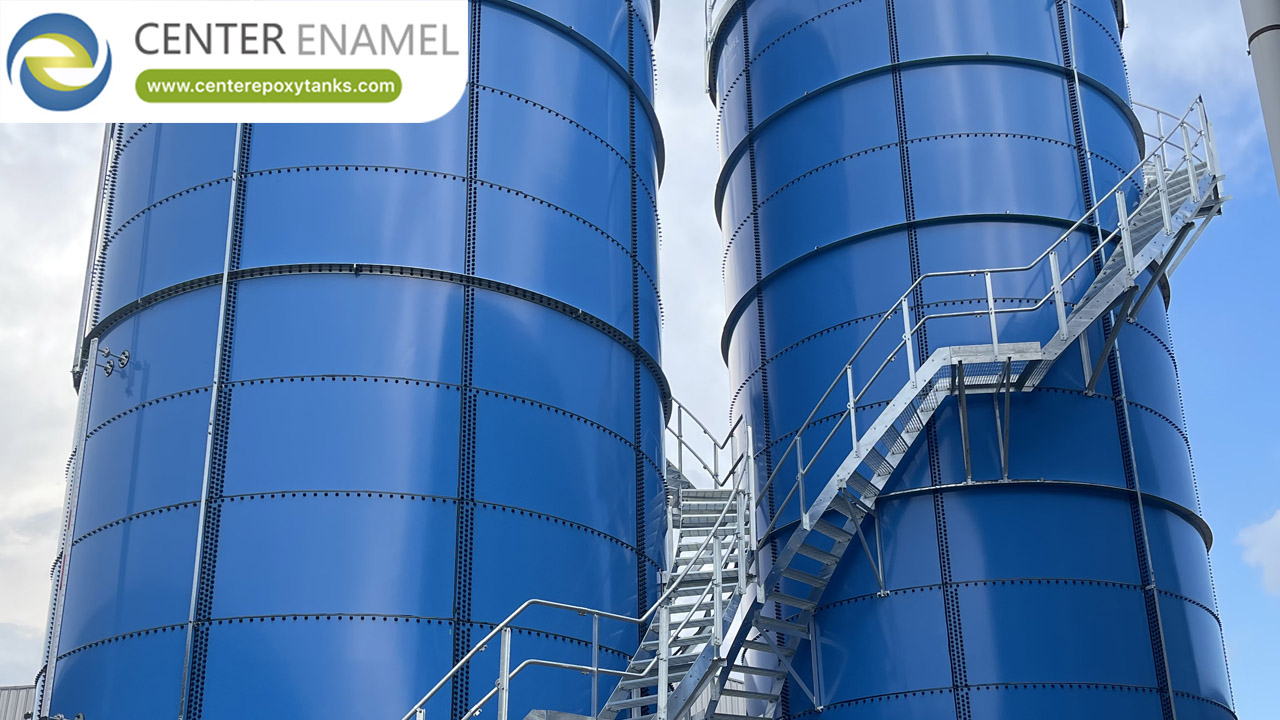
Bolted Steel Tanks with Epoxy Coating: A Reliable Storage Solution
In modern municipal water management, industrial wastewater treatment, and bulk fluid processing, selecting the right containment infrastructure is vital for long-term operational success. Among various containment designs, bolted steel tanks with epoxy coating have emerged as a premier, highly reliable storage solution.
Combining the structural strength of heavy-duty carbon steel with advanced factory-applied Fusion Bonded Epoxy (FBE) technology, these modular tanks provide exceptional resistance to corrosion, chemical attack, and environmental weathering. Built in strict accordance with international standards like AWWA D103, epoxy-coated bolted tanks offer a cost-effective, rapidly deployable alternative to traditional field-welded steel or cast-in-concrete structures.
How Epoxy-Coated Bolted Tanks Are Engineered
The reliability of an epoxy-coated bolted tank lies in its controlled manufacturing process, which separates factory-finished panels from traditional field-painted alternatives:
Precision Panel Fabrication: High-grade structural steel plates are sheared, punched, and rolled to exact engineering radii in a controlled factory environment.
Surface Pretreatment: Steel plates undergo rigorous shot-blasting to eliminate mill scale, rust, and surface impurities, creating an optimal anchor profile for maximum coating adhesion.
Electrostatic Spraying and Thermal Curing: Thermosetting epoxy powders are applied electrostatically to ensure uniform thickness across flat surfaces, panel edges, and bolt holes. The panels are then thermally cured in a factory oven, fusing the epoxy permanently to the steel substrate at a molecular level.
Rigorous Quality Control: Every finished panel undergoes stringent testing, including 100% high-voltage holiday testing (dielectric spark tests) to guarantee a completely pinhole-free, zero-leakage surface barrier.
Technical Specifications & Performance Data
To evaluate structural integrity and chemical resilience, epoxy-coated bolted tanks adhere to rigorous benchmark testing parameters. The data table below highlights standard engineering metrics for premium Fusion Bonded Epoxy (FBE) tank systems:
Technical Parameter | Test Standard | Specification / Result |
Design Compliance | ANSI / AWWA D103 | Factory-coated bolted steel tanks for water storage |
Dry Film Thickness (DFT) | Elcometer / Micrometer | 150 µm – 280 µm (6 to 11 mils) |
Corrosion Resistance | ISO 9227 (Salt Spray) | $ge$ 4,000 hours with no creep or blistering |
Chemical Immersion Range | EN 598 / Laboratory Immersion | Stable across pH 3 to 13 (handles mild acids, alkalis, and wastewater) |
Impact Resistance | ASTM G14 / ISO 6272-2 | Pass (>18J energy absorption without flaking) |
Dielectric Holiday Test | High-Voltage Spark Test | 100% defect-free at 1,100V – 1,500V across every panel |
Key Advantages of Epoxy-Coated Bolted Steel Tanks
Facilities choose modular epoxy-coated tanks over conventional storage options for several distinct engineering and economic reasons:
Superior Corrosion Resistance: The smooth, cross-linked epoxy barrier protects the carbon steel substrate from corrosive liquids, high-humidity environments, and aggressive wastewater effluents.
Elimination of Cathodic Protection: Advanced factory edge-coating techniques provide flawless coverage along panel perimeters and bolt holes, often eliminating the need for costly secondary cathodic protection systems.
Rapid On-Site Installation: Because the steel panels are prefabricated and coated off-site, installation crews simply bolt the structure together on a prepared concrete ringwall or slab. This reduces on-site construction time to a fraction of that required for welded or concrete tanks.
Field Repairability: Unlike glass-enameled surfaces, minor mechanical blemishes or installation scratches on FBE panels can be quickly and easily repaired directly in the job-site environment.
Modular Scalability & Relocation: The bolted architecture allows tanks to be easily expanded with additional panel rings as storage demands grow, or completely unbolted, dismantled, and relocated if site requirements change.
Frequently Asked Questions (FAQ)
Q: What standards govern the design of bolted steel tanks with epoxy coating?
A: High-quality epoxy-coated bolted tanks are designed and manufactured in strict compliance with AWWA D103 (American Water Works Association standard for factory-coated bolted steel tanks) and utilize interior coatings compliant with potable water safety standards.
Q: How do epoxy-coated bolted tanks compare to Glass-Fused-to-Steel (GFS) tanks?
A: While both are top-tier modular bolted systems, GFS tanks fuse a glass-enamel layer to steel at extremely high temperatures (over 800°C), offering exceptional longevity. Epoxy-coated tanks utilize a thermosetting powder coating that provides excellent chemical resistance and a key practical advantage: they are much easier to patch-repair directly in the field if minor scratches occur during transit or installation.
Q: Do epoxy-coated tanks require regular repainting?
A: Factory-applied Fusion Bonded Epoxy (FBE) coatings are engineered for long-term durability and require minimal maintenance compared to field-painted carbon steel tanks. Under normal operating conditions, they deliver decades of reliable service without needing full recoating.
Q: Can epoxy bolted tanks be expanded if our storage volume needs increase?
A: Yes. Because they feature a modular bolted design, facility operators can easily dismantle the roof structure, add additional rings of steel panels, and re-install the roof to increase the tank's total capacity.


