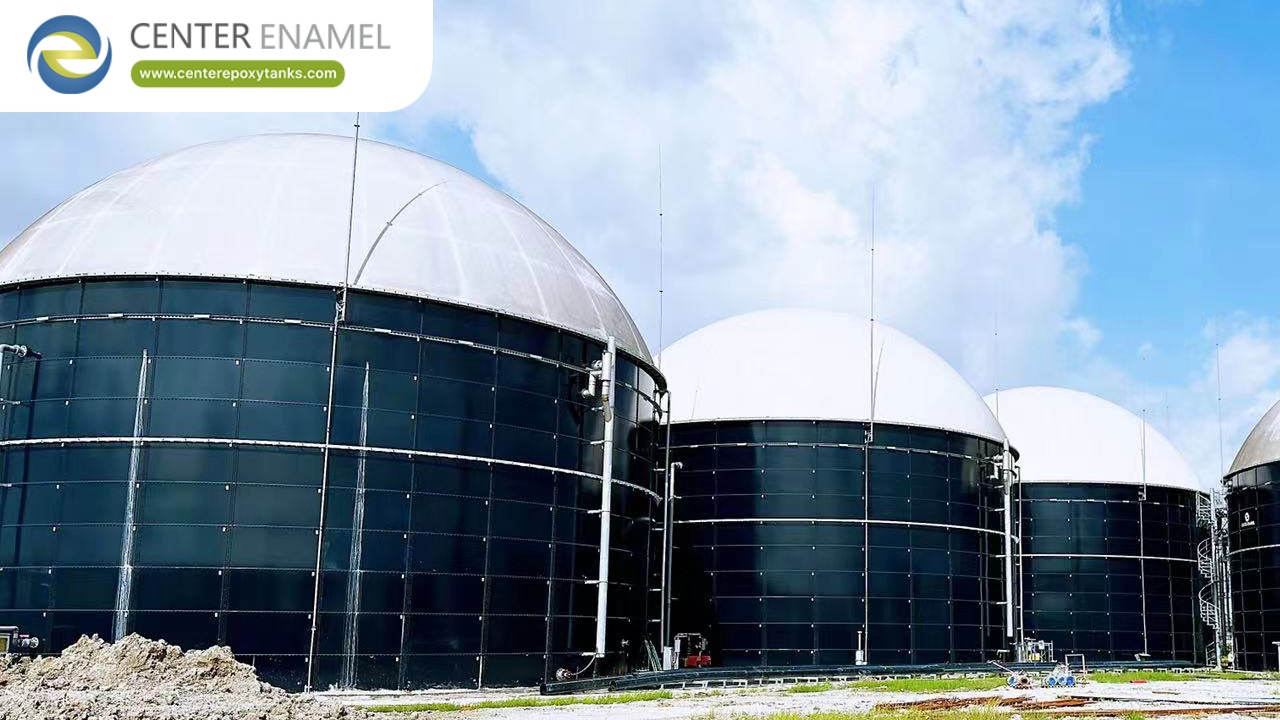
Bolted Steel Tanks As Biogas Preliminary Tanks: Pre-Treatment And Equalization
The front of an anaerobic digestion plant is the hardest working part of it. The feedstock arrives variable, abrasive and unpredictable; it has to be received, equalized, blended and conditioned before it ever reaches the digester; and the equipment that does it works in the harshest environment in the plant. Bolted steel preliminary tanks answer that duty with coated panels and fast erection.
This article covers bolted steel tanks as biogas preliminary tanks: the equalization and mixing duty, the coating for abrasive feedstock, the sizing logic and the integration with the digester train.
The Pre-Treatment Duty
Pre-treatment is everything that happens to the feedstock before digestion: reception, storage, equalization, blending, screening and the conditioning that brings the feedstock to the digester’s design condition. Each step has a tank, and each tank has a duty.
The duty profile is demanding: the feedstock is variable in composition and rate, it carries the abrasive fraction that wears surfaces, and it produces the odours that the front of the plant has to manage.
Equalization Function
Equalization is the buffer that turns a variable delivery into a steady feed. The reception tank holds the delivered feedstock, and the digester feed draws from it at the rate the digestion process wants — decoupling the delivery schedule from the biological process.
The equalization volume is sized from the delivery pattern against the feed rate, carrying the peak delivery day and the delivery gap. The buffer is what keeps the digester loaded steadily, which is what keeps the gas production steady.
Mixing And Blending
Blending turns a mixed feedstock stream into a consistent digester diet. The reception tank mixes the deliveries so the composition the digester sees is the average of the blend rather than the extremes of each delivery.
The mixing duty is abrasive: the agitator works in the feedstock, the wear parts are consumables, and the tank provides the mixing access and the geometry the agitator needs. The design integrates the mixer mounting, the baffles and the draw-off point.
Why Bolted Construction
Bolted construction suits the pre-treatment duty for three reasons: the erection speed lets the train commission ahead of the digesters, the coated panels handle the abrasive feedstock, and the modular format expands as the plant’s feedstock base grows.
The comparison with site-cast alternatives is the schedule: a bolted tank erects in weeks from factory-coated panels, while the cast alternative ties the pre-treatment train to the civil programme.
Factor | Bolted Steel | Site-Cast Alternative |
Erection period | Weeks from factory-coated panels | Months tied to the civil programme |
Surface finish | Factory-applied coating, verified per panel | Site-applied coating or rendering |
Abrasive feedstock tolerance | Coated panels renewed as modules | Repair of the cast surface |
Expansion | Add panel rings or tanks | New civil structure |
Coating For Abrasive Feedstock
The coating selection follows the feedstock’s abrasiveness and chemistry. The vitreous enamel surface of GFS panels and the epoxy systems both serve, and the specification states the surface the feedstock sees and the inspection regime that confirms it.
The wear management is part of the design: the surfaces that see the abrasive flow are identified, the inspection points are placed, and the panel renewal path is planned — because the pre-treatment tank is a wear component, not a permanent fixture.
Sizing The Equalization Volume
The equalization volume is sized from the delivery pattern against the digester feed rate. The calculation carries the peak delivery day, the delivery gap and the blending requirement — the volume that lets the tank deliver a consistent composition as well as a consistent rate.
The sizing also carries the reception function: the volume that lets a delivery be received without stopping the feed, which is the practical constraint most delivery schedules impose.
Feedstock Reception And Handling
The reception arrangement covers the delivery vehicle, the discharge point and the screening that removes the contraries before they reach the tank. The screening protects the pumps and the agitators downstream, and its location is part of the tank design.
The handling covers the pumps, the macerators and the pipework that move the feedstock — each sized for the solids content and the viscosity the feedstock presents, not for clean water.
Odor And Emission Control
The front of the plant is the odour source, and the tank design manages it. The covered tank contains the headspace, the vent routes to the odour treatment rather than the atmosphere, and the reception arrangement contains the discharge point.
The odour management is a specification item, not an accessory: the cover, the vent routing and the reception containment are all part of the tank scope, because retrofitting them onto an open tank is expensive.
Integration With The Digester Train
The integration is the feed interface: the preliminary tank delivers the conditioned feedstock to the digester at the rate and composition the process wants, and the control coordinates the reception, the equalization and the feed.
The integration also covers the failure handling: when the digester cannot take the feed, the equalization volume absorbs the production, and the alarm sequence tells the operator before the tank overflows.
Integration Point | Function | Control |
Feed draw to digester | Conditioned feedstock at design rate | Feed pump control against digester demand |
Equalization level | Buffer state across delivery pattern | Level control with high and low alarms |
Blending composition | Consistent digester diet | Composition sampling on the feed schedule |
Overflow and alarm | Protection when the feed cannot be taken | Alarm sequence before the tank overflows |
Operation And Maintenance
The operation monitors the levels, the mixing state and the feed rate, with the trends showing the delivery pattern and the digester loading. The blending performance is verified by the composition sampling the feed schedule defines.
The maintenance follows the wear: the agitator wear parts, the screening, the pumps and the tank surface inspection are all scheduled from the operating record, and the panel renewal path is planned from the inspection findings.
Center Enamel Preliminary Tank Supply
Center Enamel supplies bolted steel preliminary tanks for AD plant pre-treatment duty, with the coated panels, mixing integration and modular erection that front-of-plant service demands. The supply covers the tank, the fittings and the coating specification for the feedstock.
Our engineering team supports equalization sizing, coating selection and mixer integration against the feedstock profile. Contact our engineering team for pre-treatment tank procurement guidance on your next AD plant project.
Project Case Study
A food waste project in Guizhou, China required digestion-train capacity in a two-tank configuration matched to the plant’s processing sequence. Center Enamel supplied two glass-fused-to-steel bolted tanks — one at 4.59 m diameter by 5.4 m height and one at 5.53 m diameter by 5.4 m height — totaling 219 m3, configured for the food waste duty.
The two-tank configuration let the plant run the units in parallel or in series against its processing schedule rather than committing to a single fixed volume, with the vitreous enamel interior carrying the feedstock chemistry. The project was delivered and completed in June 2023.
Project Reference | 01 China Guizhou Food Waste 202306 |
Location | China |
Application | Food Waste |
Product / Technology | Glass-Fused-to-Steel (GFS) Bolted Tank |
Tank Count | 2 |
Tank Dimensions | φ4.59*5.4m(H)
φ5.53*5.4m(H) |
Total Volume | 219 m3 |
Completion | Delivered and completed 2023-06 |
Supply Scope Note | B relevance grade to this topic |
About Company
Shijiazhuang Zhengzhong Technology Co.,Ltd(Center Enamel) is a professional manufacturer dedicated to the design and fabrication of bolted storage tanks since 2008. Our products range includes Glass-Fused-to-Steel (GFS) tanks, fusion bonded epoxy tanks, stainless steel tanks, galvanized steel tanks and aluminum geodesic dome roofs. With professional enameling R&D team and nearly 200 enameling patents, Shijiazhuang Zhengzhong Technology Co.,Ltd has become the leader in bolted tanks industry of Asia. Our products are certified to ISO9001, NSF61, EN1090, ISO28765, WRAS ,FM, LFGB, BSCI, IS0 45001 and other international standards.
Shijiazhuang Zhengzhong Technology Co., Ltd is not only the first manufacturer in China which produces Glass-Fused-to-Steel tanks, but also the most experienced professional bolted tanks manufacturer in Asia.The engineering & design, product testing and quality system of Center Enamel Glass-Fused-to-Steel tanks is in strict accordance with AWWA D103-09, OSHA, ISO 28765, NSF/ANSI 61, NFPA and other international standards. Until 2023, Center Enamel bolted tanks have been exported to more than 100 countries including USA, Australia,Canada, Malaysia, Indonesia, Russia, UAE, Panama,Brazil and South Africa etc., the superior tank quality and prompt service gains us worldwide recognition.
As an outstanding containment and cover system provider with decades of industry experience, Shijiazhuang Zhengzhong Technology Co., Ltd sincerely expects to establish long-term cooperation with the local partners throughout the world and make continuous contribution to the development of the industry.
Suggested CTA
Center Enamel delivers bolted steel (gfs) engineered for biogas pre-treatment duty, with ad plant tank portfolio, bolted erection speed. Contact our engineering team for engineering guidance on your next bolted steel biogas preliminary tank project — including sizing, standards compliance and delivery scheduling.
Frequently Asked Questions
Q: What is a preliminary tank in an AD plant?
A: A tank at the front of the plant that receives, stores, equalizes and blends the feedstock before digestion. It decouples the variable delivery schedule from the steady feed rate the digester process wants.
Q: Why is bolted construction suited to pre-treatment?
A: Erection speed lets the train commission ahead of the digesters, the coated panels tolerate the abrasive feedstock, and the modular format expands as the feedstock base grows. The comparison with site-cast is weeks against months.
Q: How is the equalization volume sized?
A: From the delivery pattern against the digester feed rate, carrying the peak delivery day, the delivery gap and the blending requirement — the volume that delivers a consistent composition as well as a consistent rate.
Q: What coating handles abrasive feedstock?
A: Vitreous enamel GFS surfaces and epoxy systems both serve, with the specification stating the surface the feedstock sees. The wear management identifies the surfaces in the abrasive flow and plans the panel renewal path.
Q: How is odour controlled at the front of the plant?
A: The tank is covered, the vent routes to odour treatment rather than the atmosphere, and the reception arrangement contains the discharge point. Retrofitting these onto an open tank is expensive, so they are in the tank scope.
Q: Why choose Center Enamel for preliminary tanks?
A: Center Enamel supplies bolted steel preliminary tanks with coated panels, mixing integration and modular erection for front-of-plant duty. Contact our engineering team for procurement guidance.


