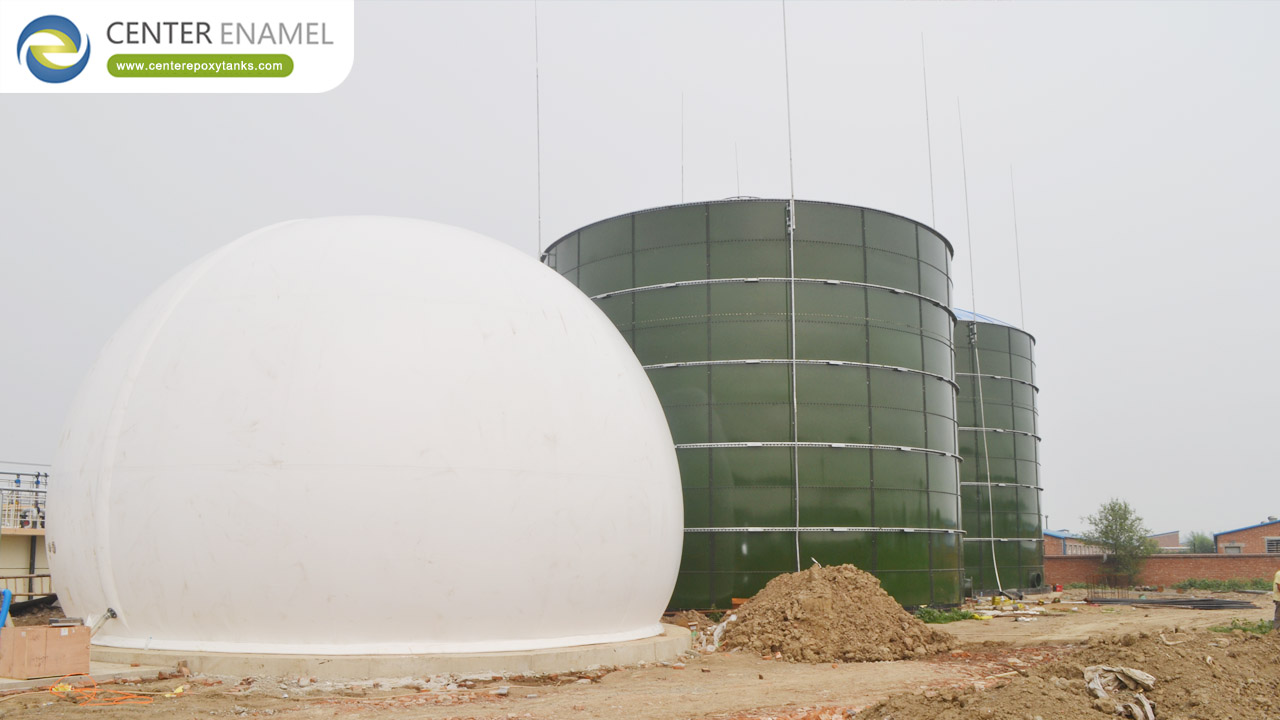
Biogas Storage Tanks With Gasholders: A Renewable Energy Solution
A digester produces liquid and gas, and the conventional project separates them: a tank for the liquid, a separate holder for the gas, and an interface between them that has to be engineered, built and maintained. The integrated tank-and-gasholder system puts both functions in one structure — and removes the interface.
This article covers biogas storage tanks with gasholders: the integrated concept, the system configurations, the structural and safety integration, and the installation advantages the format delivers.
The Integrated Concept
The integrated concept is simple: the digester tank carries the liquid volume, and a gas holder mounted on the same structure stores the gas the digestion produces. One foundation, one access route, one set of connections — the liquid and gas functions share the structure that contains them.
The concept suits the digester directly: the gas separates from the liquid inside the tank, rises into the holder volume, and is drawn from the holder to the utilization equipment. There is no intermediate gas piping to engineer between two separate structures.
What A Gasholder Adds To A Tank
The gasholder adds variable-volume gas storage at low pressure. The holder membrane or water seal rises as gas accumulates and settles as it is drawn, so the storage follows the production without mechanical regulation of the gas space.
The addition also changes the tank specification: the structure carries the holder loads, the roof becomes the holder base, and the pressure management of the gas space becomes part of the tank’s operating envelope.
System Configurations
The configurations run from the double-membrane cover on a bolted or welded digester to the water-seal gasholder on a rigid tank. Each has a capacity range, a pressure band and an integration profile that suits different plant scales and duties.
The selection follows the plant: the digester volume, the gas production rate, the pressure the utilization equipment requires and the site’s structural and access constraints.
Configuration | Description | Best Fit |
Double-membrane digester cover | Inner and outer membrane with air pressurization between | Digesters where storage integrates with the tank |
Single membrane on tank | Membrane holder mounted on the tank shell | Retrofit gas storage on an existing tank |
Water-seal gasholder | Rigid tank with water-sealed gas holder | Steady duty with simple mechanical control |
Membrane bag on tank | Low-pressure bag on the tank vent | Small plants and simple flare or boiler duty |
Structural Integration
The structural integration is where the engineering lives. The tank shell and roof carry the holder loads — the membrane tension, the gas pressure, the wind and snow on the holder geometry — and the anchorage system transfers them to the foundation.
The structural design follows the site: the wind and snow data, the seismic zone and the soil conditions all feed the tank and holder structure as one system rather than two separate designs.
Safety Systems Across The Interface
The safety systems cover the liquid volume and the gas volume together. The gas space has its overpressure and underpressure protection; the liquid volume has its vent and overflow; and the two share the detection and the emergency procedures.
The integrated safety philosophy removes a class of interface failures: with the gas and liquid in one structure, there is no intermediate gas line whose failure dumps gas into an occupied space between two structures.
Corrosion And Gas Compatibility
The gas space sees the digester gas — wet, sulphurous and warm — and the material selection follows it. The membrane material is checked against the H2S, moisture and temperature; the metal components in the gas path are selected or protected for the same envelope.
The liquid side keeps its own compatibility requirement, and the shared structure is detailed so neither side compromises the other: the seal at the liquid line, the condensate drainage and the gas-space ventilation all serve both functions.
Sizing The Integrated System
The sizing sets two volumes together: the liquid volume from the feedstock retention and loading, and the gas volume from the production profile against the utilization. The two are coupled — the gas volume follows the liquid loading — so the sizing is done as one calculation.
The coupling also sets the expansion logic: adding liquid volume adds gas volume in proportion, so the modular expansion of the digestion capacity follows automatically in the gas storage.
Installation Advantages
The integrated system installs as one structure. There is no separate holder foundation, no separate gas line route and no separate access provision — the installation scope is the tank scope plus the holder assembly, which is the format’s principal schedule advantage.
The bolted tank formats extend the advantage: factory-coated panels erect quickly, the holder mounts on the completed shell, and the commissioning sequence is compressed because the interfaces are internal to the structure.
Aspect | Separate Tank And Holder | Integrated System |
Foundations | Two structures, two foundations | One structure, one foundation |
Gas piping between | Engineered and maintained line | Internal to the structure |
Safety envelope | Two zones plus the line | One combined zone |
Installation scope | Tank plus holder plus interface | Tank scope plus holder assembly |
Operation And Monitoring
Operation monitors both volumes: the liquid level, the gas pressure and volume, and the gas quality readings that show the digestion state. The trends tell the operator whether the process is steady and whether the storage is turning over as designed.
The monitoring also covers the shared systems: the condensate drains, the relief devices and the membrane condition, all scheduled from the operating record.
Maintenance Planning
The maintenance plan covers the tank, the holder and the shared systems. The tank follows the coating inspection regime; the holder follows the membrane inspection and replacement cycle; the shared systems follow the relief testing and drain service intervals.
The integrated structure supports the plan: the access to the holder membrane, the isolation of the gas space and the entry provisions for the liquid volume are all designed in from the start.
Center Enamel Integrated System Supply
Center Enamel supplies integrated biogas storage tanks with gasholders, with the structural, safety and control scope engineered as one system. The supply covers the tank, the holder, the interface detailing and the commissioning support.
Our engineering team supports system sizing and configuration selection against the digestion duty and the utilization equipment. Contact our engineering team for integrated tank and gasholder procurement guidance on your next project.
About Company
Shijiazhuang Zhengzhong Technology Co.,Ltd(Center Enamel) is a professional manufacturer dedicated to the design and fabrication of bolted storage tanks since 2008. Our products range includes Glass-Fused-to-Steel (GFS) tanks, fusion bonded epoxy tanks, stainless steel tanks, galvanized steel tanks and aluminum geodesic dome roofs. With professional enameling R&D team and nearly 200 enameling patents, Shijiazhuang Zhengzhong Technology Co.,Ltd has become the leader in bolted tanks industry of Asia. Our products are certified to ISO9001, NSF61, EN1090, ISO28765, WRAS ,FM, LFGB, BSCI, IS0 45001 and other international standards.
Shijiazhuang Zhengzhong Technology Co., Ltd is not only the first manufacturer in China which produces Glass-Fused-to-Steel tanks, but also the most experienced professional bolted tanks manufacturer in Asia.The engineering & design, product testing and quality system of Center Enamel Glass-Fused-to-Steel tanks is in strict accordance with AWWA D103-09, OSHA, ISO 28765, NSF/ANSI 61, NFPA and other international standards. Until 2023, Center Enamel bolted tanks have been exported to more than 100 countries including USA, Australia,Canada, Malaysia, Indonesia, Russia, UAE, Panama,Brazil and South Africa etc., the superior tank quality and prompt service gains us worldwide recognition.
As an outstanding containment and cover system provider with decades of industry experience, Shijiazhuang Zhengzhong Technology Co., Ltd sincerely expects to establish long-term cooperation with the local partners throughout the world and make continuous contribution to the development of the industry.
Suggested CTA
Center Enamel delivers gasholder system engineered for biogas storage duty, with integrated tank and gasholder supply. Contact our engineering team for engineering guidance on your next biogas storage tank gasholder project — including sizing, standards compliance and delivery scheduling.
Frequently Asked Questions
Q: What is an integrated tank and gasholder system?
A: A digester tank that carries the liquid volume with a gas holder mounted on the same structure to store the produced gas. One foundation, one access route and one set of connections remove the interface between two separate structures.
Q: What configurations are available?
A: Double-membrane digester covers, single membrane holders mounted on the tank shell, water-seal gasholders on rigid tanks and membrane bags for small plants. The selection follows the digester volume, production rate and pressure requirement.
Q: How are the structural loads handled?
A: The tank shell and roof carry the membrane tension, gas pressure, wind and snow on the holder geometry, with the anchorage transferring to the foundation. The design uses the site wind, snow, seismic and soil data as one system.
Q: What safety scope does the integrated system need?
A: Overpressure and underpressure protection on the gas space, vent and overflow on the liquid volume, and detection covering both. The integration removes the intermediate gas line failure mode between two structures.
Q: What are the installation advantages?
A: One structure means one foundation, no separate gas line route and a compressed commissioning sequence because the interfaces are internal. Bolted tank formats extend the advantage with fast panel erection.
Q: Why choose Center Enamel for integrated systems?
A: Center Enamel supplies integrated tank and gasholder systems with structural, safety and control engineering as one system. Contact our engineering team for procurement guidance on your next project.


