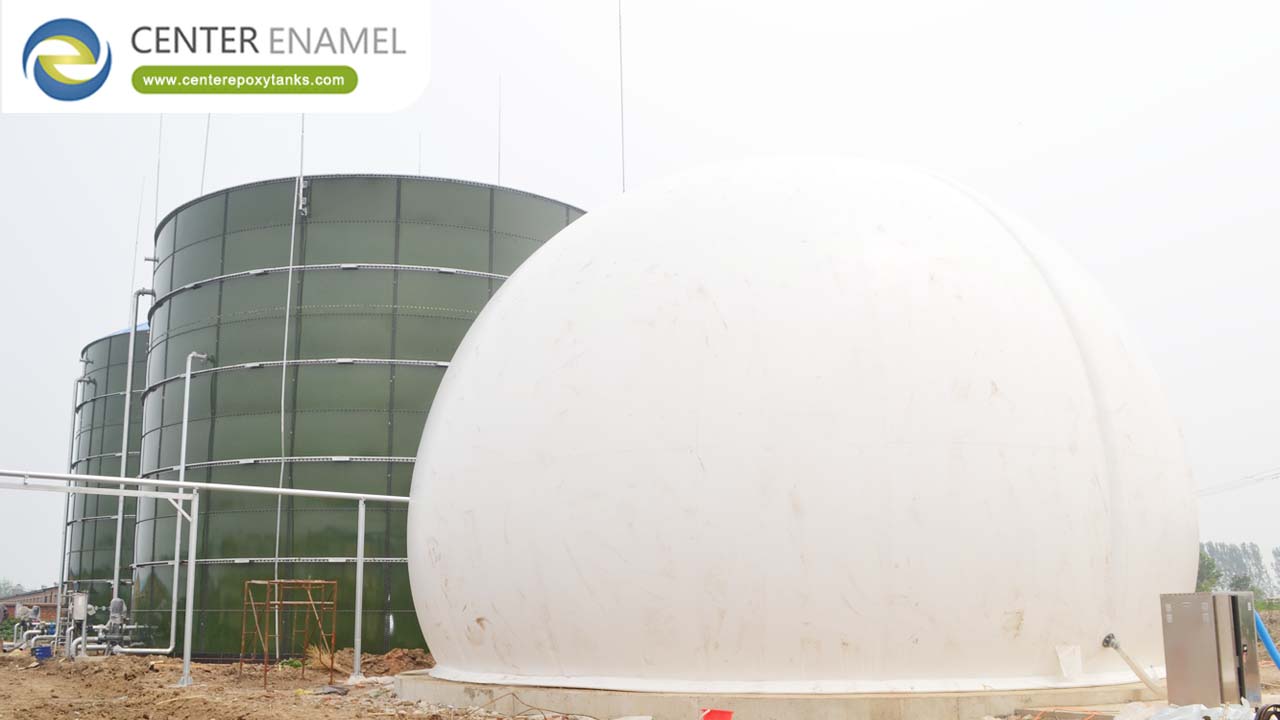
Biogas Storage Solutions: Engineering Efficiency with Double Membrane Gas Holders
How do integrated double membrane gas holders optimize methane recovery while ensuring zero-leakage safety in anaerobic digestion plants? As the global transition toward decentralized renewable energy accelerates, the ability to store and regulate biogas—composed primarily of CH₄ (50–75%) and CO₂—is critical for grid stability and waste-to-energy efficiency.
Center Enamel, a global leader in environmental infrastructure, provides advanced Double Membrane Gas Holders. These systems are engineered to provide a flexible, durable, and highly secure containment environment, protecting renewable energy assets from the volatility of production and environmental degradation.
1. The Engineering Logic: The Dual-Layer Architecture
The double membrane gas holder is a pressure-stabilized system designed to decouple biogas production from consumption. Its performance is rooted in a specialized two-layer design:
● Internal Membrane (Gas Containment): Fabricated from high-tenacity, chemically resistant polyester fabrics with a specialized PVC/PVDF coating, this layer directly houses the biogas. It is engineered for maximum gas-tightness and flexibility to accommodate rapid volume fluctuations.
● External Membrane (Structural Protection): This layer remains constantly pressurized by a dedicated air blower, creating a rigid dome shape. It acts as a shield against UV radiation, heavy snow loads, and wind, while maintaining a constant pressure on the inner membrane to facilitate consistent gas delivery.
2. Technical Advantages for Modern Biogas Plants
For 2026 energy producers, Center Enamel focuses on technical benchmarks that ensure long-term ROI:
● H₂S and Chemical Resistance: Biogas contains trace amounts of hydrogen sulfide (H_2S), which can be corrosive. Our membranes are treated with specialized anti-corrosive coatings to prevent material degradation and embrittlement.
● Dynamic Volume Adaptability: The inner membrane adjusts its shape based on real-time gas volume without increasing internal stress, a critical feature for CSTR (Continuous Stirred-Tank Reactor) and USR (Upflow Solids Reactor) systems.
● Operational Safety: Integrated with ultra-sonic level sensors and hydraulic pressure relief valves, our systems provide continuous monitoring to prevent over-pressurization or vacuum collapse.
3. Comparison: Double Membrane vs. Traditional Storage
For utility-scale biogas projects, the Total Cost of Ownership (TCO) favors the double membrane system:
Feature | Low-Pressure Water Seal | High-Pressure Steel Tanks | Center Enamel Double Membrane |
Corrosion Defense | Low (Water-induced rust) | Moderate (Requires lining) | Absolute (Chemical-Resistant Fabric) |
Installation Speed | Slow | Slow (Heavy logistics) | Rapid (Modular/Lightweight) |
Operational Flexibility | Limited | Fixed Volume | High (Dynamic Volume) |
Foundation Requirement | Heavy/Expensive | Heavy/Expensive | Minimal (Integrates with Tank) |
Initial Investment | Moderate | High | Optimized (Cost-Effective) |
4. Integration with Anaerobic Digestion Ecosystems
Center Enamel’s gas holders are designed for seamless integration with our Glass-Fused-to-Steel (GFS) and Epoxy Coated Bolted Tanks.
● Tank-Mounted Solutions: These gas holders can be mounted directly onto the top of digester tanks, reducing the overall plant footprint and eliminating the need for separate gas storage foundations.
● Independent (Ground-Mounted) Solutions: Ideal for centralized gas hubs where biogas from multiple reactors is collected and stored before being upgraded to biomethane or fed into a CHP (Combined Heat and Power) unit.
5. Why Partner with Center Enamel?
With decades of experience and projects in 100+ countries, Center Enamel is the global standard for biogas containment.
● Precision Manufacturing: Our membranes are produced using high-frequency welding technology to ensure seam strength that exceeds the base material’s tensile strength.
● Global Compliance: Systems are engineered to meet international safety and quality standards, including ISO 9001 and industry-specific fire safety protocols.
● Turnkey Expertise: From custom CAD drafting and FEA (Finite Element Analysis) to international logistics and on-site assembly supervision, we provide a single-source solution.


