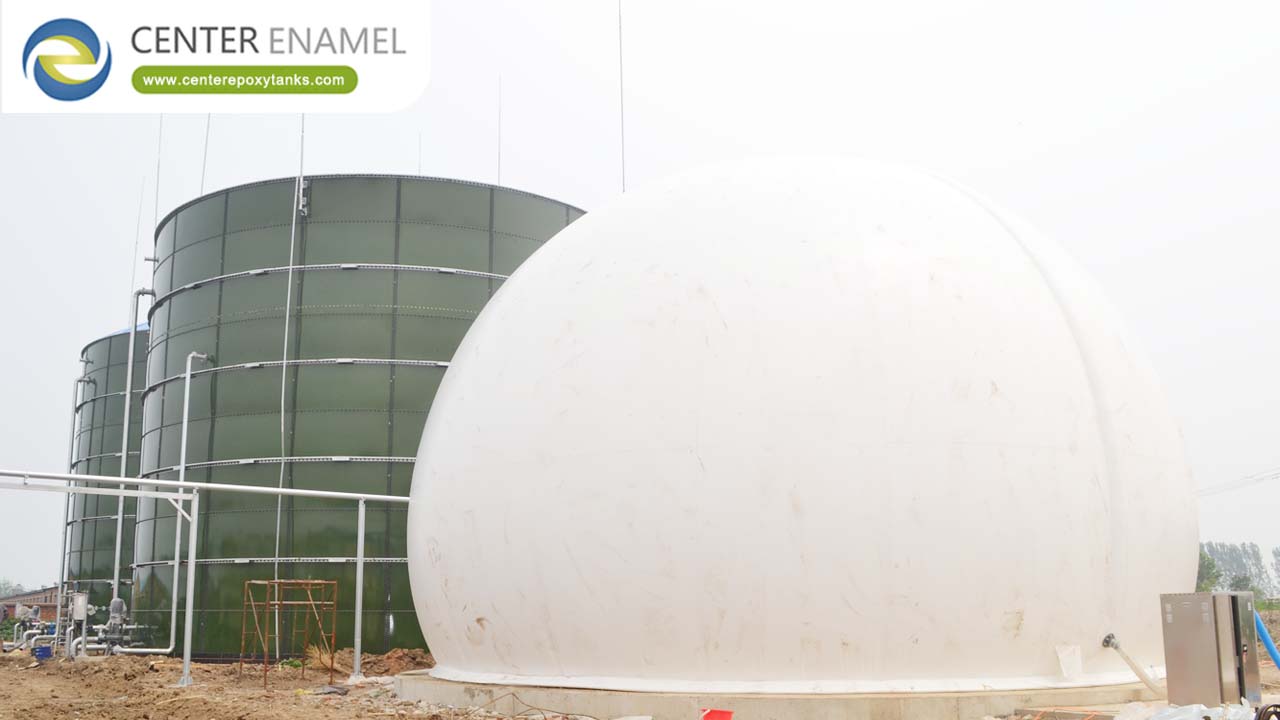
Biogas Storage Solutions: Integrating Advanced Bolted Steel Tanks as Anaerobic Digesters
The transition from traditional, site-poured concrete to advanced, modular bolted steel technology marks a significant evolution in biogas infrastructure. Modern anaerobic digesters require more than just containment; they demand hermetic sealing, chemical resistance to corrosive biogas (H2S), and rapid scalability. By integrating Glass-Fused-to-Steel (GFS) bolted tanks as the primary reactor vessel, project managers can drastically reduce construction timelines, lower maintenance costs (OPEX), and guarantee structural integrity for 30+ years of biogas production.
1. The Paradigm Shift: Why Bolted Steel?
In the early days of biogas, poured-in-place concrete was the standard. However, concrete is porous, prone to cracking, and susceptible to microbial-induced corrosion (MIC) when exposed to sulfuric acid. Advanced bolted steel tanks, specifically GFS, have become the preferred choice for industrial and municipal biogas facilities for three primary reasons:
● Modular Speed: Panels are prefabricated in a controlled factory setting and shipped to the site. Erection happens in a fraction of the time required for concrete curing, allowing for faster time-to-market.
● Predictable Quality: Factory-applied coatings are subjected to rigorous thickness and holiday (spark) testing, eliminating the variability found in field-applied linings.
● Lifecycle Cost Efficiency: Bolted steel tanks are designed for easy maintenance. If a section of the tank requires inspection or repair, individual panels can be accessed without compromising the integrity of the entire structure.
2. Material Science: The GFS Advantage
The "engine" of an anaerobic digester is its ability to maintain a strictly controlled environment. The headspace of a digester is highly corrosive due to the presence of hydrogen sulfide (H2S), which converts to sulfuric acid when it meets moisture.
The Chemical Resistance Benchmark
GFS technology fuses glass to steel at 850C, creating an inert barrier that covers the entire pH spectrum (1–14).
Feature | Concrete Digesters | Welded Steel Tanks | GFS Bolted Tanks |
H2S Resistance | Low (Needs liner) | Moderate (Needs recoating) | Superior (Inert) |
Construction Time | 3–6 Months | 2–4 Months | 3–6 Weeks |
Maintenance | High (Crack repair) | High (Abrasive blasting) | Low (Zero recoating) |
Seal Integrity | Variable (Expansion joints) | High (Weld quality dependent) | High (Factory-tested) |
3. Engineering & Design Standards
When specifying bolted steel digesters, adherence to global engineering standards is the only way to ensure safety and performance. Advanced systems must be designed to:
● AWWA D103-09: The benchmark for factory-coated bolted steel tanks, governing the structural design, foundation requirements, and seismic load capacity.
● ISO 28765: Specifies the requirements for the design and qualification of vitreous enamel (GFS) coatings. This ensures the tank can handle the thermal expansion and contraction cycles typical of heated digesters (35C to 55C).
● Gas Tightness: The design must integrate a specialized double-membrane gas roof that operates under positive pressure to capture methane (CH4) without leakage.
4. System Integration: Digester + Storage
A truly efficient biogas facility does not view the digester and the gas storage as separate entities. The most advanced systems integrate these technologies:
1. The Primary Reactor (GFS Tank): High-strength steel panels provide the structural support and corrosive-resistant interior necessary for the biological digestion process.
2. The Heating System: External or internal heat exchangers maintain the strict mesophilic or thermophilic temperatures required for methanogenesis.
3. The Integrated Gas Holder: A flexible, durable membrane dome is mounted directly onto the GFS tank. This creates a compact, space-saving unit that captures gas directly as it is produced, eliminating the need for external, high-footprint storage tanks.
5. Frequently Asked Questions (FAQ)
Can bolted steel tanks handle the weight of heavy slurry?
Yes. Bolted steel tanks are engineered to handle the hydrostatic loads of high-density agricultural slurry or municipal sludge. The thickness of the steel panels is calculated based on the specific gravity of the feedstock to ensure structural safety.
Do these tanks leak at the seams?
No. Advanced bolted systems utilize high-performance, NSF/ANSI 61 certified sealants between panels. These sealants are specifically formulated to remain flexible under pressure and to resist chemical degradation over decades of service.
How do I maintain a GFS digester?
The primary maintenance requirement is periodic inspection of the sealant and mechanical components (mixers, pumps). Because the glass surface is inert, there is no need for internal sandblasting, recoating, or painting, which are the primary cost drivers in traditional tank maintenance.
Engineering Consultation & Design Support
Selecting the correct tank technology for your biogas plant is a decision that impacts your facility's ROI for the next three decades. Whether you are scaling a food waste processing facility or a large-scale agricultural biogas project, we provide the engineering expertise to ensure your tank design meets international performance standards.
[Request a Biogas Tank Feasibility Study]
Our team offers full design reviews, chemical compatibility reports, and structural calculations to verify your project’s compliance with AWWA/ISO standards.
For more information on integrating GFS technology into your next renewable energy project, consult our technical resource library for detailed material submittals and CAD/BIM assets.


