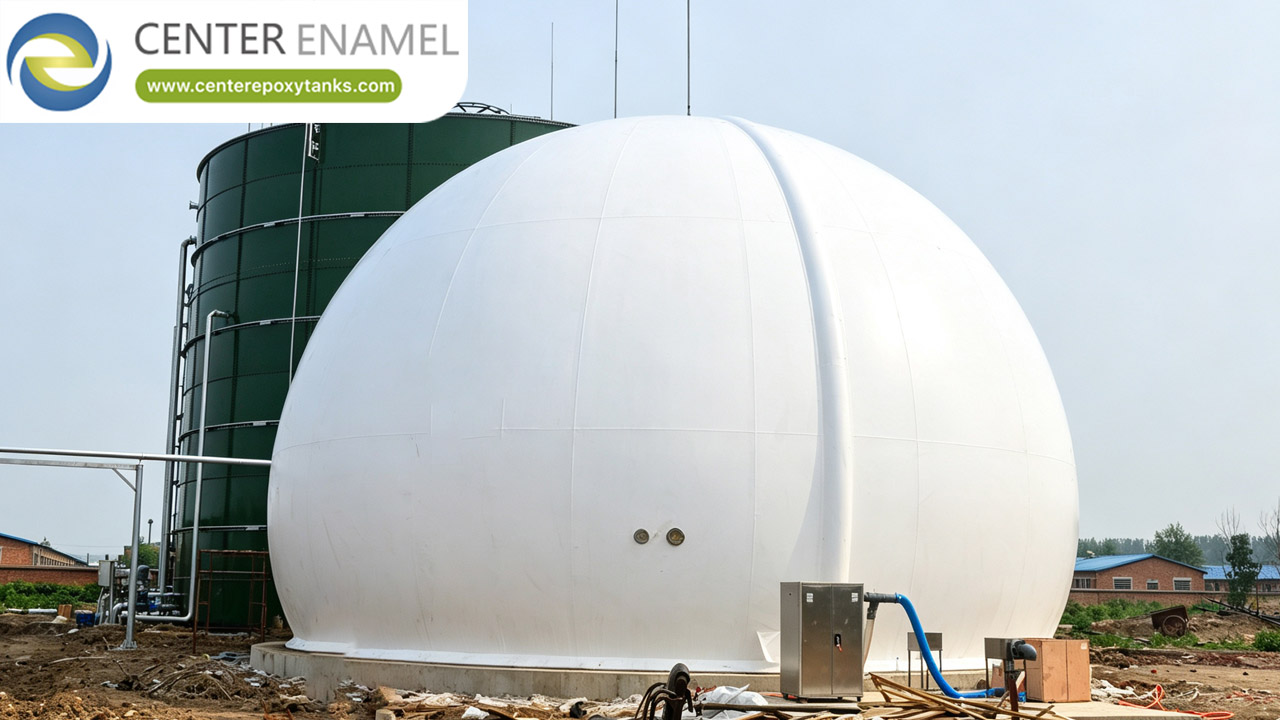
Biogas Holders For Organic Waste Management: Advanced Energy Recovery
Organic waste management turns food waste, agricultural residues and green waste into energy, and the digestion that does it produces a gas stream that follows the feedstock. The holder that stores the gas is what turns a variable production into a usable supply — and the sizing against that variability is the whole design.
This article covers biogas holders for organic waste management: the feedstock variability, the sizing logic, the pressure management for recovery equipment and the safety provisions.
Organic Waste Feedstock Variability
Organic waste feedstock is mixed by nature. Food waste arrives with its moisture and its salt, green waste with its fibre and its seasonal peak, agricultural residues with their storage cycles — and each stream yields gas at a different rate and quality.
The variability is both daily and seasonal: the daily loading follows the collection and delivery pattern, and the seasonal swing follows the agricultural and green waste cycles. The holder design covers both bands.
Gas Quality Considerations
The gas quality follows the feedstock. Food-waste-heavy feedstocks yield gas with higher H2S; fibre-rich feedstocks yield steadier methane; and the moisture content moves with the feedstock moisture. The holder design tolerates the envelope.
The quality question also covers the downstream: the recovery equipment sets the cleanliness requirement, and the cleanup train between digester and holder is sized to deliver it across the feedstock variability.
Sizing For Variable Production
The sizing logic sizes against the variability bands, not the average. The daily band sets the buffer that absorbs the loading swings; the seasonal band sets the storage strategy for the periods when production structurally exceeds or falls short of utilization.
The sizing carries the utilization strategy too: continuous base-load recovery with peak flaring needs a smaller buffer than recovery matched to production, and the strategy decision is made before the volume is calculated.
Variability Source | Holder Response | Sizing Effect |
Daily loading swings | Buffer absorption of the daily band | Sets the working storage volume |
Seasonal feedstock cycles | Strategic storage or seasonal strategy | Sets the peak inventory requirement |
Digester upsets | Absorption during production drop | Sets the drawdown protection volume |
Feedstock composition change | Yield change with same loading | Sets the sizing envelope margin |
Pressure Management For Recovery Equipment
The recovery equipment — CHP engine, boiler or upgrading unit — consumes at its design condition, and the holder pressure management delivers that condition across the production variability. The control coordinates the storage inventory with the blower duty.
The pressure band is set by the equipment: engines and boilers tolerate a band; upgrading membranes need a tighter one. The holder control is designed to the tightest consumer in the train.
Energy Recovery Pathways
The recovery pathways run from simple heat and power to biomethane upgrading. Combined heat and power suits the site with a heat demand; upgrading suits the site with a grid connection or a vehicle fuel offtake; boiler heat suits the site with a process heat demand.
The pathway choice sets the holder duty: CHP and boiler duty need low-pressure buffering, while upgrading adds the pressure stability requirement and the treated-gas assumption the holder design follows.
Pathway | Site Condition | Holder Duty |
Combined heat and power | Site with a heat demand | Low-pressure buffering with blower support |
Biomethane upgrading | Grid connection or vehicle fuel offtake | Tighter pressure band and treated gas |
Boiler heat | Site with a process heat demand | Low-pressure buffering for steady draw |
Flare with heat recovery | No local utilization demand | Peak absorption with controlled discharge |
Safety And Containment
The safety set covers overpressure, underpressure and flame propagation, sized by calculation for the credible failure cases. The containment question covers the holder itself and the gas path — leak-tight connections, isolation points and the relief discharge routing.
The safety scope also covers the site: the exclusion zones around the holder and the relief discharge, the detection network and the emergency procedures written against the failure modes.
Material And Corrosion Resistance
The material selection follows the gas quality envelope. Food-waste-heavy gas carries H2S that attacks the metal components in the wet phase, and the design answers with material selection, condensate drainage and the upstream cleanup.
The membrane material follows the same envelope: the specification checks the membrane against the H2S, the moisture and the temperature, with the service life and inspection regime stated against the actual gas analysis.
Monitoring And Control
The monitoring set covers pressure, volume, temperature and gas quality, with the alarms at the band edges and the detection thresholds. The control coordinates the storage with the recovery equipment and the digester backpressure.
The operating record drives the maintenance: the membrane inspection, the relief testing and the drain service are scheduled from the recorded duty rather than a fixed calendar.
Retrofit And Expansion
Most organic waste projects expand: the feedstock streams grow, the digestion capacity grows and the storage has to follow. The holder design plans the expansion — the connection provisions, the space reservation and the control capacity.
The retrofit case covers the existing digester and gas train: the holder has to fit the existing pressure limits and piping, and the tie-in sequence is planned around the operating plant.
Commissioning And Verification
Commissioning proves the sizing assumption against reality. The pressure band is verified under real production, the control transitions are exercised and the storage turnover is measured across the first operating weeks.
The verification data becomes the baseline: the efficiency and turnover metrics recorded at handover are what the operations team compares against, so the design intent is visible as a trend.
Center Enamel Organic Waste Holder Engineering
Center Enamel supplies biogas holders for organic waste management projects with the sizing, pressure control and safety engineering that variable feedstock operation demands. The supply covers the holder, the control and safety scope and the commissioning support.
Our engineering team supports holder sizing and expansion planning against the feedstock profile and the recovery pathway. Contact our engineering team for organic waste holder procurement guidance on your next project.
Project Case Study
A food waste project in Anhui, China required digestion capacity in a modular multi-tank configuration matched to the plant’s treatment sequence. Center Enamel supplied six glass-fused-to-steel bolted tanks in three specifications — two at 5.35 m diameter by 6 m height, one at 3.82 m diameter by 6 m height and three at 3.06 m diameter by 3.6 m height — totaling 418 m3, configured for the digestion duty.
The mixed specification matched each tank size to its position in the treatment sequence rather than forcing a single standard size across the site, with the vitreous enamel interior carrying the digester chemistry across every unit. The project was delivered and completed in August 2024.
Project Reference | 01 China Anhui Food Waste 202408 |
Location | China |
Application | Food Waste |
Product / Technology | Glass-Fused-to-Steel (GFS) Bolted Tank |
Tank Count | 6 |
Tank Dimensions | φ5.35*6m(H), 2 units; φ3.82*6m(H), 1 unit; φ3.06*3.6m(H), 3 units |
Total Volume | 418 m3 |
Completion | Delivered and completed 2024-08 |
Supply Scope Note | B relevance grade to this topic |
About Company
Shijiazhuang Zhengzhong Technology Co.,Ltd(Center Enamel) is a professional manufacturer dedicated to the design and fabrication of bolted storage tanks since 2008. Our products range includes Glass-Fused-to-Steel (GFS) tanks, fusion bonded epoxy tanks, stainless steel tanks, galvanized steel tanks and aluminum geodesic dome roofs. With professional enameling R&D team and nearly 200 enameling patents, Shijiazhuang Zhengzhong Technology Co.,Ltd has become the leader in bolted tanks industry of Asia. Our products are certified to ISO9001, NSF61, EN1090, ISO28765, WRAS ,FM, LFGB, BSCI, IS0 45001 and other international standards.
Shijiazhuang Zhengzhong Technology Co., Ltd is not only the first manufacturer in China which produces Glass-Fused-to-Steel tanks, but also the most experienced professional bolted tanks manufacturer in Asia.The engineering & design, product testing and quality system of Center Enamel Glass-Fused-to-Steel tanks is in strict accordance with AWWA D103-09, OSHA, ISO 28765, NSF/ANSI 61, NFPA and other international standards. Until 2023, Center Enamel bolted tanks have been exported to more than 100 countries including USA, Australia,Canada, Malaysia, Indonesia, Russia, UAE, Panama,Brazil and South Africa etc., the superior tank quality and prompt service gains us worldwide recognition.
As an outstanding containment and cover system provider with decades of industry experience, Shijiazhuang Zhengzhong Technology Co., Ltd sincerely expects to establish long-term cooperation with the local partners throughout the world and make continuous contribution to the development of the industry.
Suggested CTA
Center Enamel delivers biogas holder engineered for organic waste ad duty, with organic waste ad delivery record. Contact our engineering team for engineering guidance on your next biogas holder organic waste project — including sizing, standards compliance and delivery scheduling.
Frequently Asked Questions
Q: How does feedstock variability affect biogas holder sizing?
A: The holder is sized against the variability bands rather than the average: the daily loading swing sets the working volume, the seasonal feedstock cycle sets the peak inventory, and the digester upset case sets the drawdown protection.
Q: What pressure management does energy recovery equipment need?
A: The holder and its blower set deliver gas at the equipment’s design condition across the production variability. Engines and boilers tolerate a band; upgrading membranes need a tighter one, and the control is designed to the tightest consumer.
Q: What energy recovery pathways suit organic waste projects?
A: Combined heat and power where there is a heat demand, biomethane upgrading where there is a grid connection or vehicle fuel offtake, and boiler heat where there is a process heat demand. The pathway sets the holder duty.
Q: How is corrosion controlled in organic waste gas holders?
A: Through material selection in the wet gas path, condensate drainage that keeps surfaces dry, and upstream cleanup that removes H2S before the gas reaches the storage. The membrane material is checked against the actual gas analysis.
Q: Can a biogas holder be expanded later?
A: Yes. The design plans the expansion with connection provisions, space reservation and control capacity, and the retrofit case fits the existing digester pressure limits and piping with the tie-in planned around the operating plant.
Q: Why choose Center Enamel for organic waste holders?
A: Center Enamel supplies biogas holders with sizing, pressure control and safety engineering for variable feedstock operation. Contact our engineering team for procurement guidance on your next organic waste project.