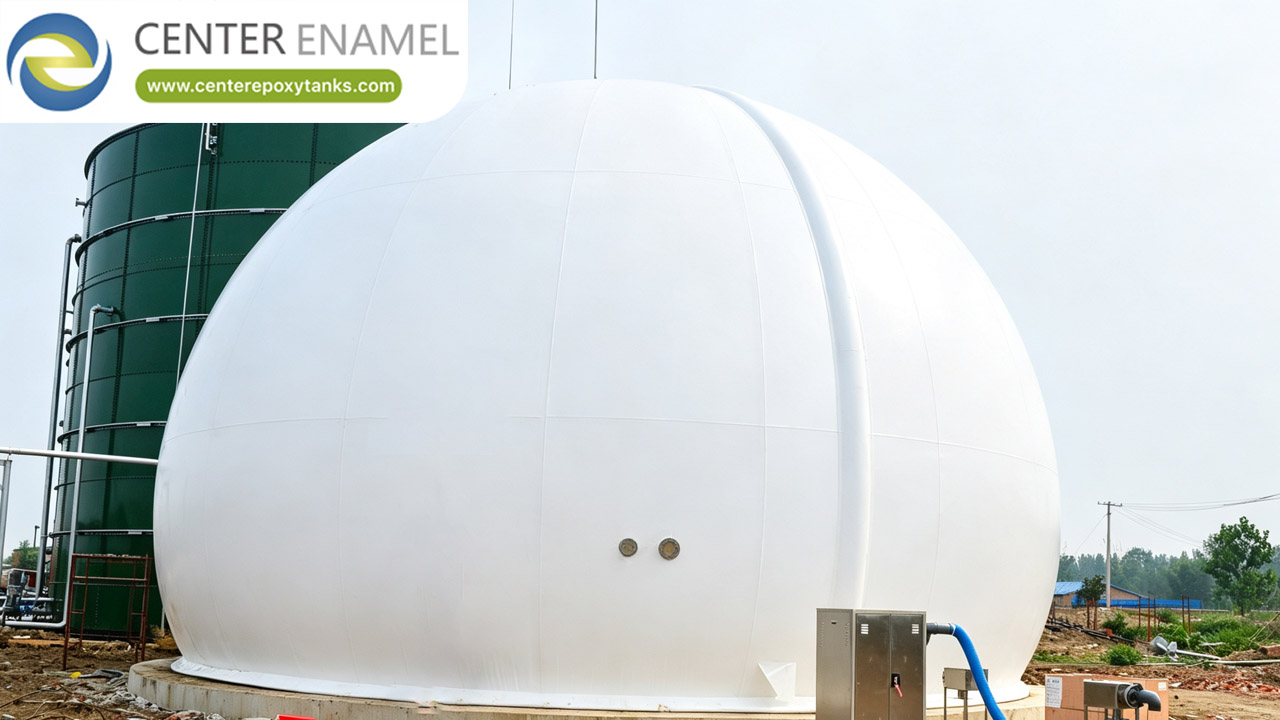
Biogas Holder Balloons: Advanced Flexible Solutions for Efficient Renewable Energy Storage
As global investments in green energy and waste-to-energy conversion accelerate, anaerobic digestion (AD) facilities require reliable, cost-effective infrastructure to store and regulate generated gases. Raw biogas—a mixture primarily composed of methane (CH4) and carbon dioxide (CO2), along with corrosive trace elements like hydrogen sulfide (H2S)—demands specialized containment that prevents atmospheric leakage while accommodating fluctuating daily production cycles.
While traditional steel gasholders require extensive civil foundations and intensive corrosion maintenance, biogas holder balloons and flexible membrane systems have emerged as the modern industry standard. Offering rapid deployment, exceptional chemical resistance, and dynamic volumetric adaptation, these inflatable storage structures optimize the entire bio-energy supply chain.
Engineering Mechanics and Architecture of Biogas Balloons
Modern industrial biogas holder balloons—particularly double-membrane configurations—rely on advanced pneumatic engineering to maintain operational stability:
Inner Gas-Tight Membrane: The expandable inner chamber directly contains the raw biogas. It inflates and deflates dynamically depending on the balance between continuous anaerobic digestion production and downstream compressor consumption.
Outer Weather-Resistant Shell: A heavily tensioned, spherical outer membrane shields the inner storage volume from wind loads, heavy snow, and ultraviolet (UV) degradation.
Air-Support Interstitial Blower: An explosion-proof centrifugal fan continuously maintains positive air pressure in the space between the inner and outer membranes. This air buffer provides structural rigidity to the outer dome while exerting uniform downward pressure on the inner membrane, ensuring a stable, constant gas output pressure to downstream equipment.
Material Science: High-Performance Polymer Composites
The longevity and safety of a biogas holder balloon depend heavily on its specialized fabric matrix:
High-Tenacity Polyester (PES) Substrate: Provides exceptional tensile strength and tear resistance, preventing structural deformation under continuous pneumatic loads.
Specialized PVC or PVDF Coatings: Thick, chemically inert polymer layers protect the base fabric from aggressive organic acids and moisture-laden hydrogen sulfide (H2S), while virtually eliminating methane permeability.
High-Frequency (HF) Welding: Panel joints are fused using advanced high-frequency welding technology, creating molecular bonds that are stronger than the base fabric and guarantee 100% gas-tight seam integrity.
Technical Performance Matrix: Biogas Storage Technologies
Technical Parameter | Double-Membrane Biogas Balloons | Traditional Rigid Steel Gas Holders | Single-Layer Ground Balloons |
Capital Expenditure & Footprint | Economical; lightweight design requires minimal civil foundation work | High cost; heavy steel plate construction demands massive concrete foundations | Highly cost-effective; ideal for small-scale rural or agricultural setups |
Operating Pressure Profile | Constant operating pressure maintained dynamically by the air-support blower | Variable pressure; internal gas pressure drops significantly as the storage volume depletes | Low, variable pressure reliant on natural balloon expansion |
Corrosion Resistance | Zero structural corrosion risk due to chemically inert polymer membranes | High susceptibility to internal oxidation from H2S and moisture without constant recoating | Excellent chemical inertness, though vulnerable to sharp external punctures |
Installation Velocity | Rapid modular setup completed in a matter of days | Extended construction timeline requiring weeks of field welding and crane work | Fast, plug-and-play deployment for packaged digester skids |
Frequently Asked Questions (FAQ)
Q: What is a biogas holder balloon and how does it function in a plant?
A: A biogas holder balloon is a flexible, fabric-engineered containment vessel designed to store and regulate biogas produced during anaerobic digestion. It expands and contracts dynamically based on gas generation rates, balancing system pressure and ensuring a steady feed to downstream generators or upgrading units.
Q: How do double-membrane biogas balloons maintain a constant gas pressure?
A: Double-membrane balloons utilize an outer protective shell and an inner gas storage bladder. An integrated air-support blower continuously pumps air into the space between the two membranes, creating downward pressure that forces the inner bladder to push stored biogas out at a stable, consistent operating pressure.
Q: What materials prevent methane leakage and chemical corrosion in biogas balloons?
A: High-quality biogas balloons are fabricated from high-tenacity polyester fabrics coated with specialized, low-permeability PVC or PVDF layers. These materials block methane diffusion and resist aggressive chemical attack from hydrogen sulfide (H2S) and moisture.
Q: What is the typical operational lifespan of an industrial biogas holder balloon?
A: When manufactured with premium UV-stabilized, fire-retardant membranes and operated within recommended pressure and temperature ranges, an industrial double-membrane biogas balloon provides a reliable operational lifespan of 10 to 15 years or more.


