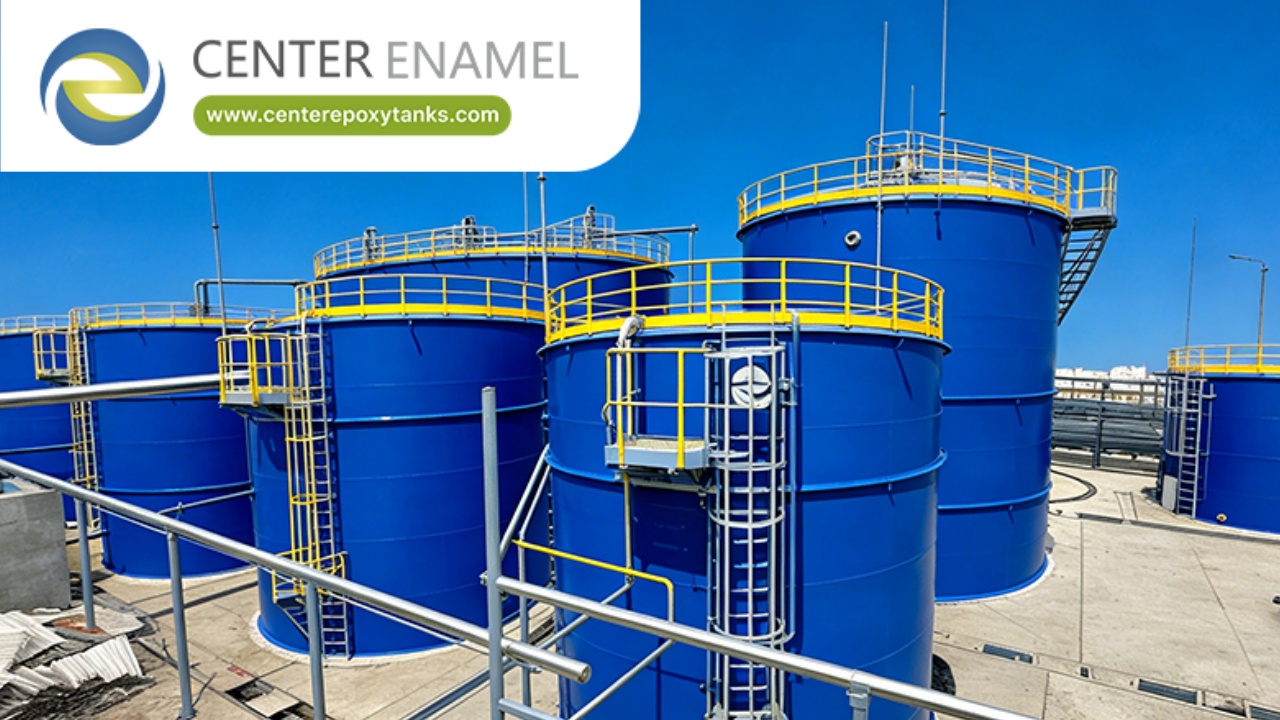
AWWA D103 Standards Epoxy Coated Steel Tanks for Potable Water Storage: Engineering, Compliance, and Longevity
In municipal water supply management, fire suppression reserves, and industrial community infrastructure, maintaining an uninterrupted, hygienic, and structurally secure water supply is paramount. When public utilities and civil engineers specify liquid containment systems, compliance with rigorous engineering standards is non-negotiable. Among all international benchmarks, the American Water Works Association standard governs the gold standard for bolted steel containment: AWWA D103.
When paired with advanced factory-applied Fusion Bonded Epoxy (FBE) coating technology, AWWA D103 compliant bolted steel tanks deliver unmatched structural integrity, superior corrosion resistance, and absolute potable water safety. As a globally trusted leader in advanced liquid storage and containment manufacturing, Shijiazhuang Zhengzhong Technology Co., Ltd. (Center Enamel) delivers precision-engineered epoxy-coated steel tanks designed to secure municipal water resources for decades.
Understanding AWWA D103 Standards for Bolted Steel Reservoirs
The AWWA D103 standard establishes the minimum requirements for the design, fabrication, and erection of factory-coated bolted steel tanks for water storage. Compliance ensures that every structural element—from high-tensile steel plate thickness and bolt torque specifications to shell ring engineering—meets strict safety margins:
Hydrostatic Hoop Stress Calculations: Tank walls are engineered with precise plate tapering to withstand maximum internal liquid pressure loads from base to roof.
Environmental and Seismic Resilience: AWWA D103 mandates rigorous structural calculations to ensure tanks withstand extreme regional wind velocities, seismic ground acceleration, and heavy snow loads without structural failure.
Standardized Quality Control: Governing factory production tolerances, ensuring that every panel and fastener is manufactured under controlled conditions rather than variable field environments.
The Fusion Bonded Epoxy (FBE) Advantage
Traditional field-painted tanks are vulnerable to blistering, peeling, and corrosion due to environmental moisture during application. AWWA D103 epoxy-coated tanks eliminate these risks through advanced factory processing:
Electrostatic Powder Spraying: Thermoset epoxy resin powder is uniformly applied across grit-blasted steel panels, ensuring complete coverage over sharp edges, bolt holes, and corners.
Thermal Curing: Panels are baked in high-temperature industrial ovens, triggering a cross-linking chemical reaction that fuses the epoxy coating into a hard, non-porous, chemically inert barrier.
Potable Water Safety (NSF/ANSI 61): High-grade interior epoxy formulations comply strictly with health standards like NSF/ANSI 61, ensuring that stored drinking water remains completely free of toxic chemical leaching, heavy metals, or unpleasant tastes.
Data Table: Comprehensive Comparison of Potable Water Storage Technologies
Technical Parameter | AWWA D103 Epoxy Bolted Steel Tanks | Field-Welded Carbon Steel Tanks | Cast-in-Place Concrete Reservoirs |
Governing Design Standard | AWWA D103, ISO 28765, NSF/ANSI 61 | AWWA D100, ASME Structural Codes | Regional Civil Masonry Codes |
Coating Application Method | Factory-applied fusion bonded epoxy (FBE); thermally cured | Field-applied liquid coatings subject to weather variations | Minimal interior waterproofing membranes or bare concrete |
Installation Speed & Modularity | Rapid bolted modular assembly; erected in weeks without heavy wet trades | Moderate to slow timeline requiring intensive field welding and testing | Extremely slow construction timeline with multi-week concrete curing |
Maintenance Profile | Low ongoing maintenance; smooth surface resists mineral buildup | High ongoing maintenance overhead for periodic repainting and weld checks | Moderate to high remediation costs if structural micro-cracking occurs |
Expansion Flexibility | Highly modular; easily expanded by adding vertical ring panels | Difficult and labor-intensive to cut and weld in service | Permanent structure; impossible to expand without major demolition |
Frequently Asked Questions (FAQ)
Q: What is the AWWA D103 standard for water storage tanks?
A: AWWA D103 is the recognized American Water Works Association standard that governs the engineering design, factory fabrication, structural calculations, and erection procedures for factory-coated bolted steel storage tanks.
Q: Are epoxy coated tanks compliant with drinking water safety regulations?
A: Yes. High-quality epoxy coated tanks utilized for potable water storage comply with rigorous health standards such as NSF/ANSI 61 and WRAS, ensuring that the interior coating is non-toxic and safe for municipal drinking supplies.
Q: What are the main benefits of bolted steel tanks over traditional concrete reservoirs?
A: Bolted steel tanks offer predictable factory-controlled quality, rapid on-site installation timelines, superior seismic flexibility without catastrophic cracking risks, and lower lifecycle maintenance costs compared to massive concrete structures.
Q: Can AWWA D103 epoxy coated tanks be expanded if municipal water demand increases?
A: Yes. Because Center Enamel's tanks feature a modular bolted design, municipal operators can easily scale up tank height and storage volume by bolting on additional steel panel rings as community needs grow.


