AWWA D103-09 Epoxy Coated Steel Tanks For Textile Effluent Treatment
Textile effluent is one of the more variable streams an industrial storage tank will see: pH swings with the dye cycle, temperature from the dyeing and finishing steps, and a chemistry of dyes, auxiliaries and surfactants that changes with the fabric being processed. The tank specification has to cover that variability rather than a single nominal product.
This article applies AWWA D103-09 to textile effluent storage: the effluent characteristics, the coating and construction requirements the standard sets, and how the tank is specified, tested and maintained for the duty.
Textile Effluent: The Duty Profile
Textile effluent varies with the process: dyeing contributes color, salts and auxiliaries; finishing contributes oils, resins and solvents; bleaching contributes pH extremes. The composite stream a storage tank sees is therefore a moving target, and the specification has to cover the range.
The design consequences are a lining specified for the range rather than a single product, a corrosion allowance that reflects the worst credible exposure, and an inspection regime that catches degradation early.
What AWWA D103-09 Covers
AWWA D103-09 is the standard for bolted steel tanks in water and wastewater service: it covers the panel materials, the coating systems and their application, the bolted construction, the accessories and the testing that verifies all of it. The standard is built around factory-controlled panel fabrication.
The factory-controlled process is the standard’s core advantage for effluent duty: the coating is applied under controlled conditions and documented per panel, which is a quality position a field-applied alternative cannot match.
Coating Requirements For Effluent Duty
The coating system is specified for the service exposure: for the internal splash zone and the liquid line especially, where alternating wet-dry exposure, chemistry and oxygen attack together. The specification covers surface preparation, film build and the inspection method.
The verification is holiday testing before service plus the film thickness record — the two evidences that the lining was built as specified before the effluent went in.
Exposure Zone | Coating Requirement | Verification |
Submerged interior | Full film per specification | Thickness record |
Splash zone | Highest duty specification | Thickness plus holiday test |
Exterior | Atmospheric system | Thickness record |
Bolted joints | Sealed, inspectable detail | Assembly inspection |
Construction Requirements
The construction requirements cover the panel materials, the bolted assembly and the accessories: panel thickness against the design loads, bolt and gasket specification, and the roof and cover configuration. The construction is verified by dimensional check and the erection survey.
The bolted construction also serves the effluent duty practically: panels replace as modules, so a damaged panel is a planned activity rather than a hot-work project.
Textile-Specific Considerations
The textile-specific design questions are pH range, temperature and the chemistry of the dyes and auxiliaries. The lining is selected for the range, the corrosion allowance reflects the worst credible exposure, and the venting and cover design follows the odor and emission objective.
The segregation question follows the plant layout: where different effluent streams are stored separately, the tank farm layout has to keep the streams apart by design rather than by procedure.
Effluent Characteristic | Design Response |
pH range | Lining specified for the range |
Temperature | Material and gasket selection |
Dyes and auxiliaries | Coating compatibility review |
Odor | Cover and venting design |
Bolted Vs Welded For Effluent Storage
The bolted-versus-welded decision on effluent duty follows coating quality and schedule: bolted construction delivers factory-controlled coating with documented records and erection in weeks; welded field erection covers the sizes above the bolted band and the geometries that need it.
For the size band most textile effluent storage occupies, the bolted coated tank’s coating documentation is usually the deciding advantage.
Testing And Inspection
The test regime covers the coating and the structure: holiday testing and film thickness before service, the leak test of the assembled tank, and the dimensional verification of the erected structure. Each has an acceptance criterion and a record.
The inspection regime continues in service: internal inspection at planned shutdowns, with the coating condition assessed against the original records.
Standards And Certification
The certification set covers the construction standard, the coating specification and its records, and the quality management system behind both. For potable-adjacent duties the material selection also aligns with drinking water standards.
The dossier is the evidence: panel coating records, material certificates, the erection survey and the test records, assembled at handover.
Maintenance And Renewal
The maintenance regime follows the coating: inspection at shutdown against the original records, and renewal where the film has degraded. The bolted construction makes renewal a panel-level activity rather than a tank-level one.
The regime also covers the gaskets and fasteners — inspectable from outside in hours, and replaceable as a planned activity.
Case Context: Industrial Effluent Delivery
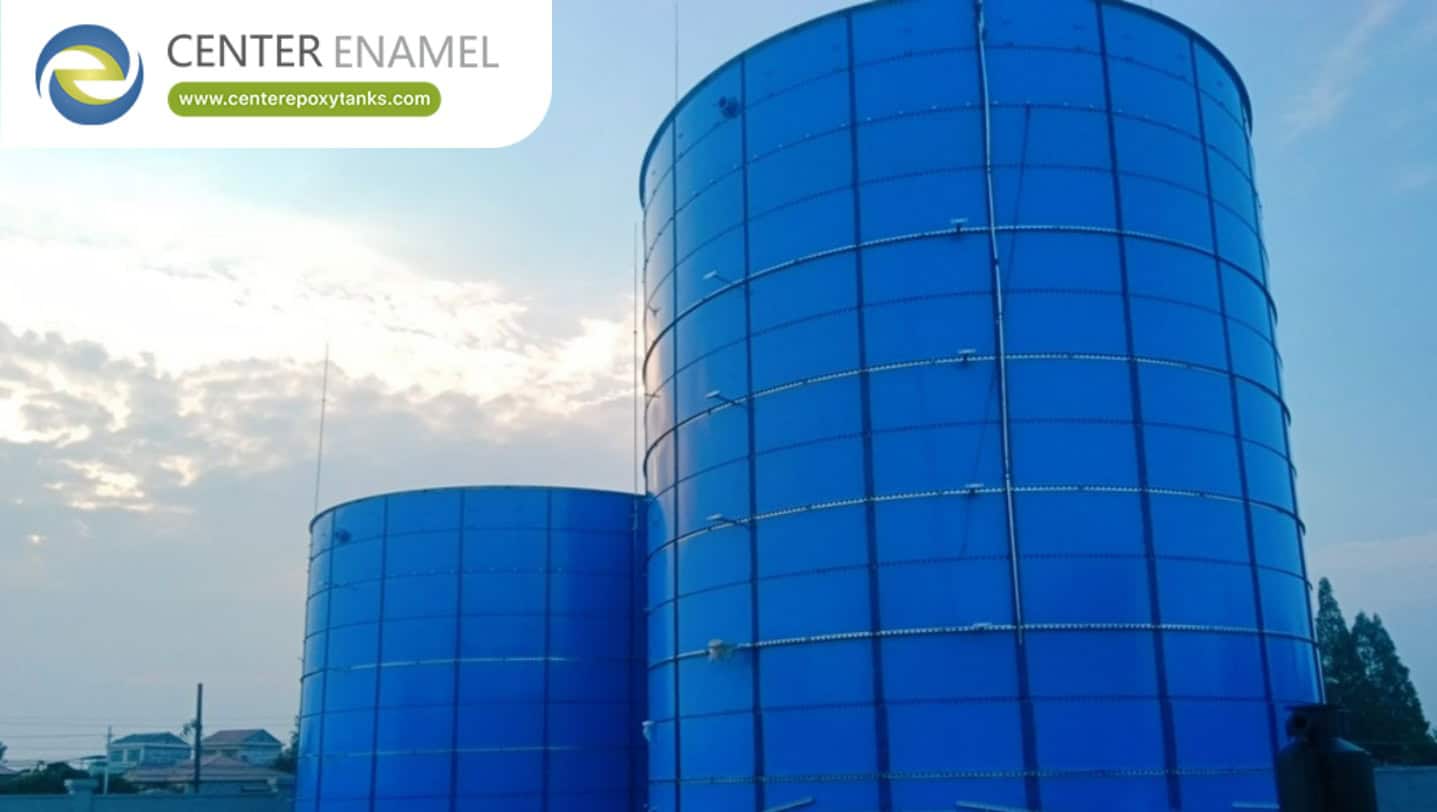
The referenced project shows the duty pattern: an industrial wastewater installation delivered with GFS bolted tanks in a two-specification configuration, sized to the treatment train duties. The coated interior carries the effluent chemistry while the bolted assembly keeps every panel inspectable and replaceable.
The delivery model is the point: one supplier engineering the tank, the coating and the documentation, with the records the duty’s inspection regime runs on.
Center Enamel Effluent Tank Capability
Center Enamel delivers industrial wastewater tanks to AWWA D103-09 with the coating quality system the standard sets: factory-controlled application documented per panel, holiday testing before service, and the full dossier at handover. GFS and epoxy coated systems cover the effluent chemistry range.
For textile effluent duty, the standard we hold is the one the variability demands — a lining specified for the range, verified before service, and inspectable for the life of the tank.
Project Case Study
An industrial wastewater project on Cyprus required covered storage capacity engineered for aggressive effluent duty. Center Enamel supplied two glass-fused-to-steel bolted tanks totaling 5,557 m3: one unit at 16.81 m diameter by 6.0 m height and one at 23.68 m diameter by 9.6 m height, matched to the treatment train duties.
The two-specification configuration matched the plant’s process layout, with the large-volume tank serving the core treatment duty and the smaller unit handling equalization and transfer. The vitreous enamel interior carries the effluent chemistry while the bolted assembly keeps every panel inspectable and replaceable. The project was delivered and completed in November 2025.
Project Reference | 01 Cyprus Industrial Wastewater 202511 |
Location | Cyprus |
Application | Industrial Wastewater |
Product / Technology | Glass-Fused-to-Steel (GFS) Bolted Tank |
Tank Count | 2 |
Tank Dimensions | φ16.81*6.0m(H), 1 unit; φ23.68*9.6m(H), 1 unit |
Total Volume | 5557 m3 |
Completion | Delivered and completed 2025-11 |
Supply Scope Note | A relevance grade to this topic |
About Company
Shijiazhuang Zhengzhong Technology Co.,Ltd(Center Enamel) is a professional manufacturer dedicated to the design and fabrication of bolted storage tanks since 2008. Our products range includes Glass-Fused-to-Steel (GFS) tanks, fusion bonded epoxy tanks, stainless steel tanks, galvanized steel tanks and aluminum geodesic dome roofs. With professional enameling R&D team and nearly 200 enameling patents, Shijiazhuang Zhengzhong Technology Co.,Ltd has become the leader in bolted tanks industry of Asia. Our products are certified to ISO9001, NSF61, EN1090, ISO28765, WRAS ,FM, LFGB, BSCI, IS0 45001 and other international standards.
Shijiazhuang Zhengzhong Technology Co., Ltd is not only the first manufacturer in China which produces Glass-Fused-to-Steel tanks, but also the most experienced professional bolted tanks manufacturer in Asia.The engineering & design, product testing and quality system of Center Enamel Glass-Fused-to-Steel tanks is in strict accordance with AWWA D103-09, OSHA, ISO 28765, NSF/ANSI 61, NFPA and other international standards. Until 2023, Center Enamel bolted tanks have been exported to more than 100 countries including USA, Australia,Canada, Malaysia, Indonesia, Russia, UAE, Panama,Brazil and South Africa etc., the superior tank quality and prompt service gains us worldwide recognition.
As an outstanding containment and cover system provider with decades of industry experience, Shijiazhuang Zhengzhong Technology Co., Ltd sincerely expects to establish long-term cooperation with the local partners throughout the world and make continuous contribution to the development of the industry.
Suggested CTA
Center Enamel delivers epoxy coated bolted engineered for textile effluent storage duty, with industrial wastewater tank delivery, coating quality systems. Contact our engineering team for engineering guidance on your next AWWA D103-09 epoxy coated steel tanks project — including sizing, standards compliance and delivery scheduling.
Frequently Asked Questions
Q: What makes textile effluent a demanding storage duty?
A: Its variability: pH swings with the dye cycle, temperature from dyeing and finishing, and a chemistry of dyes, auxiliaries and surfactants that changes with the fabric being processed. The specification has to cover the range.
Q: What does AWWA D103-09 cover?
A: Bolted steel tanks for water and wastewater service: panel materials, coating systems and their application, bolted construction, accessories and the testing that verifies them — built around factory-controlled panel fabrication.
Q: Which coating zone sees the most duty?
A: The splash zone and the liquid line, where alternating wet-dry exposure, chemistry and oxygen attack together. That zone carries the highest coating specification and the most rigorous verification.
Q: How is coating quality verified?
A: Holiday testing before service plus the film thickness record — the two evidences that the lining was built as specified before the effluent went in. Factory-controlled application is documented per panel.
Q: Why choose bolted construction for effluent storage?
A: Factory-controlled coating with documented records, erection in weeks, and panel-level replacement — a damaged panel is a planned activity rather than a hot-work project.
Q: How does the referenced Cyprus project show the duty pattern?
A: Two GFS bolted tanks in a two-specification configuration matched to the treatment train: 16.81 m by 6.0 m and 23.68 m by 9.6 m, totaling 5,557 m3, with the enamel interior carrying the effluent chemistry and every panel inspectable.


