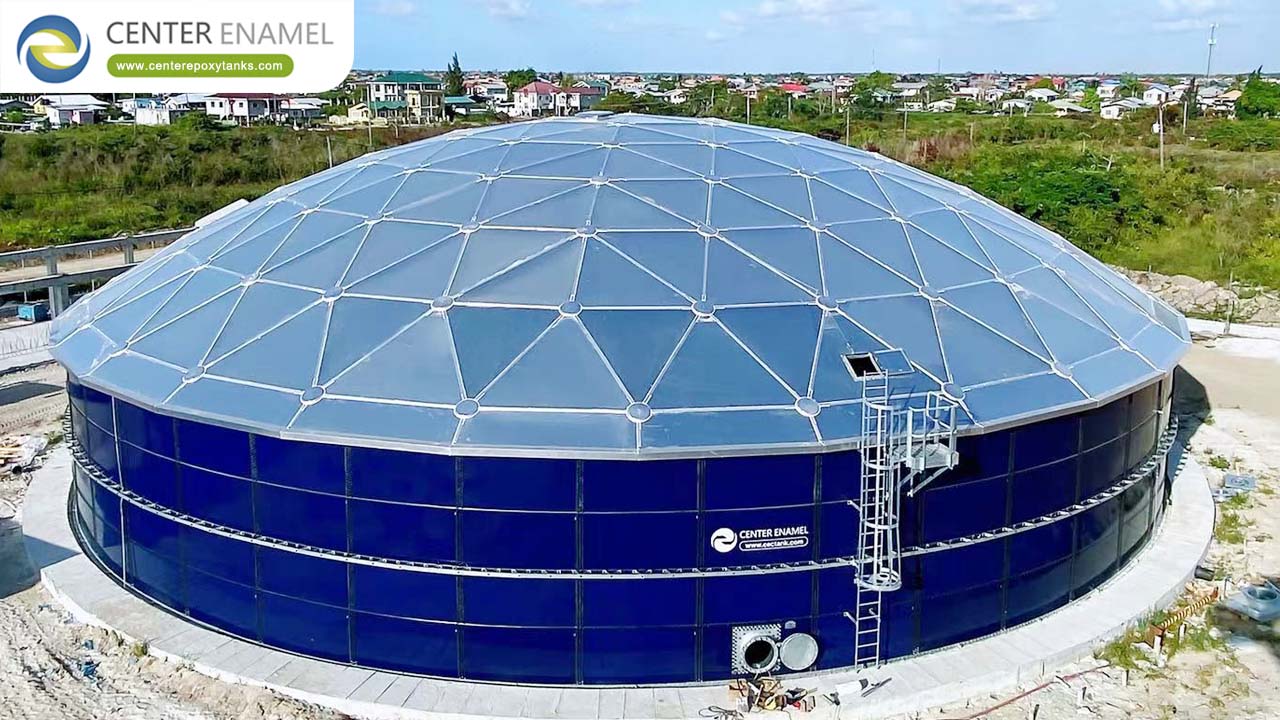
AWWA D103-09 Epoxy Coated Steel Tanks for Potable Water Storage: Engineering & Compliance Guide
The AWWA D103-09 standard, established by the American Water Works Association, governs the design, manufacture, and erection of Factory-Coated Bolted Carbon Steel Tanks for Water Storage. For municipal engineering and public utilities, specifying an AWWA D103-09 compliant tank paired with high-durability epoxy coatings guarantees a certified, leak-free asset for potable water storage. By moving the coating and fabrication processes entirely into a controlled factory setting—often leveraging massive, specialized manufacturing bases spanning over 150,000 square meters—this standard eliminates the environmental and quality variables inherent to field-welded and field-painted alternative vessels.
1. Structural Design Principles under AWWA D103-09
AWWA D103-09 enforces rigid structural calculations to ensure safety under maximum hydrostatic and environmental loads. Unlike welded tank standards, D103-09 specifically accounts for the mechanical boundaries of bolted lap joints, gasket compression, and pre-punched shell plates.
Shell Thickness Formulation
The minimum allowable thickness ($t$) of cylindrical shell plates in any given ring is determined using highly specific stress-loading mechanics. To satisfy high-intent engineering lookups, the core calculation dictates:
$$t = frac{2.6 cdot H cdot D cdot G}{S cdot E} + CA$$
Where:
● $t$ = Minimum shell plate thickness (inches)
● $H$ = Height of liquid from the bottom of the ring to the overflow level (feet)
● $D$ = Nominal diameter of the tank (feet)
● $G$ = Specific gravity of the stored liquid (1.0 for potable water)
● $S$ = Allowable design stress of the specific steel grade used (psi)
● $E$ = Joint efficiency factor of the bolted connection array
● $CA$ = Corrosion allowance, if specified by the project engineer (inches)
Load Combinations Explained
A fully compliant design must simultaneously withstand a combination of environmental forces:
● Hydrostatic Load: The weight of the liquid filled to the absolute overflow level.
● Wind Load: Engineered to resist localized wind pressures based on international velocity maps without buckling.
● Seismic Loads: Calculations factoring in both impulsive and convective (sloshing) wave dynamics according to the local Seismic Design Category.
2. Factory-Applied Epoxy Coating & Potable Water Safety
When a bolted steel tank is destined for potable (drinking) water service, the internal lining faces extreme scrutiny. AWWA D103-09 mandates strict protocol options for factory-applied coatings, with thermosetting fusion bonded or high-solids liquid epoxies leading the industry.
The NSF/ANSI/CAN 61 Mandate
Any epoxy formulation utilized on the internal surfaces of an AWWA D103-09 tank must carry official NSF/ANSI/CAN 61 certification. This certification validates that the cured epoxy matrix will not leach contaminants, microplastics, volatile organic compounds (VOCs), or heavy metals into the municipal drinking water supply, maintaining absolute water purity.
Factory Quality Control vs. Field Painting
Top-tier manufacturers with decades of operational history utilize rigorous quality testing at their facilities prior to shipment:
1. Surface Profile: Steel sheets are shot-blasted to a near-white finish (SSPC-SP10 / NACE No. 2) to establish an optimal anchor profile.
2. Thermal Curing: The epoxy is applied and thermally cross-linked under controlled temperatures, achieving uniform Dry Film Thickness (DFT).
3. Holiday Testing: 100% of the panel surfaces undergo high-voltage discontinuity testing to ensure zero micro-pinholes exist in the barrier.
3. Technical Compliance Matrix: AWWA D103-09 Requirements
Structural Component | Engineering Standard / Parameter | Municipal Asset Benefit |
Shell Joint Design | High-tensile bolts with EPDM washers | Prevents localized joint weeping |
Internal Lining | NSF/ANSI 61 Certified Epoxy | Guarantees public health compliance |
Manufacturing Gate | 100% Factory NDT Holiday Test | Eliminates field coating failures |
Foundation Boundary | Concrete ring wall with anchor arrays | Resists severe wind & seismic overturning |
4. Key Advantages over Field-Welded Infrastructure
For public works directors and civil engineering firms, specifying a factory-coated bolted tank over a field-welded alternative offers massive lifecycle advantages:
● Drastically Reduced Erection Timelines: Because the panels are pre-fabricated and coated at the factory, site assembly is executed using mechanical jacks and synchronous torque tools. This bypasses the weeks of field-welding, radiograph testing, and multi-coat field painting required by welded tanks.
● Weather-Independent Quality: Field-applied paint systems often fail prematurely due to high humidity, shifting wind speeds, or unexpected temperature drops during site application. Factory-cured epoxy avoids these risks entirely.
● Modular Scalability & Repair: If a municipal tank requires inspection or suffers localized mechanical damage, individual bolted panels can be unbolted and replaced without taking the entire facility offline for prolonged periods or performing high-risk hot work.
5. Frequently Asked Questions (FAQ)
Q: Does AWWA D103-09 cover the design of the concrete foundation?
A: AWWA D103-09 outlines the loading criteria and forces that the tank will exert on the foundation (such as anchor bolt loads and base shear pressures). However, the detailed structural design of the reinforced concrete foundation ring wall or slab remains the responsibility of a licensed civil engineer utilizing local geotechnical data.
Q: What is the typical lifespan of an AWWA D103-09 epoxy-coated tank?
A: With standard routine inspections and proper operational water levels, a factory-coated bolted epoxy tank possesses a structural service life exceeding 30 to 40 years. The factory-controlled application ensures the steel substrate remains completely isolated from oxygen and moisture.
Q: Can these tanks be used to store chlorinated water directly?
A: Yes. High-quality factory-applied epoxies are highly resistant to standard chemical disinfection agents used in municipal networks, including chlorine and chloramines, provided concentrations remain within standard potable water parameters.


