API 650 Floating Roofs: Engineering, Design & Emissions Control Guide
In the bulk storage of volatile organic compounds (VOCs), petrochemicals, and aviation fuels, controlling evaporation is a critical economic and environmental mandate. Unlike fixed-roof tanks where a vapor space exists above the liquid, API 650 floating roofs are engineered to float directly on the surface of the stored product, rising and falling with the liquid level.
By physically eliminating the vapor-liquid interface, floating roofs reduce evaporative emissions by up to 98% compared to standard atmospheric tanks. Designing and procuring these systems requires strict adherence to the American Petroleum Institute (API) Standard 650, which dictates the structural buoyancy, seal integrity, and specific metallurgical tolerances required for both Internal Floating Roofs (IFR) and External Floating Roofs (EFR).
1. Core Engineering: IFR vs. EFR Architectures
API 650 categorizes floating roofs into two primary architectural divisions, each governed by its own specific technical appendix.
Internal Floating Roofs (API 650 Appendix H)
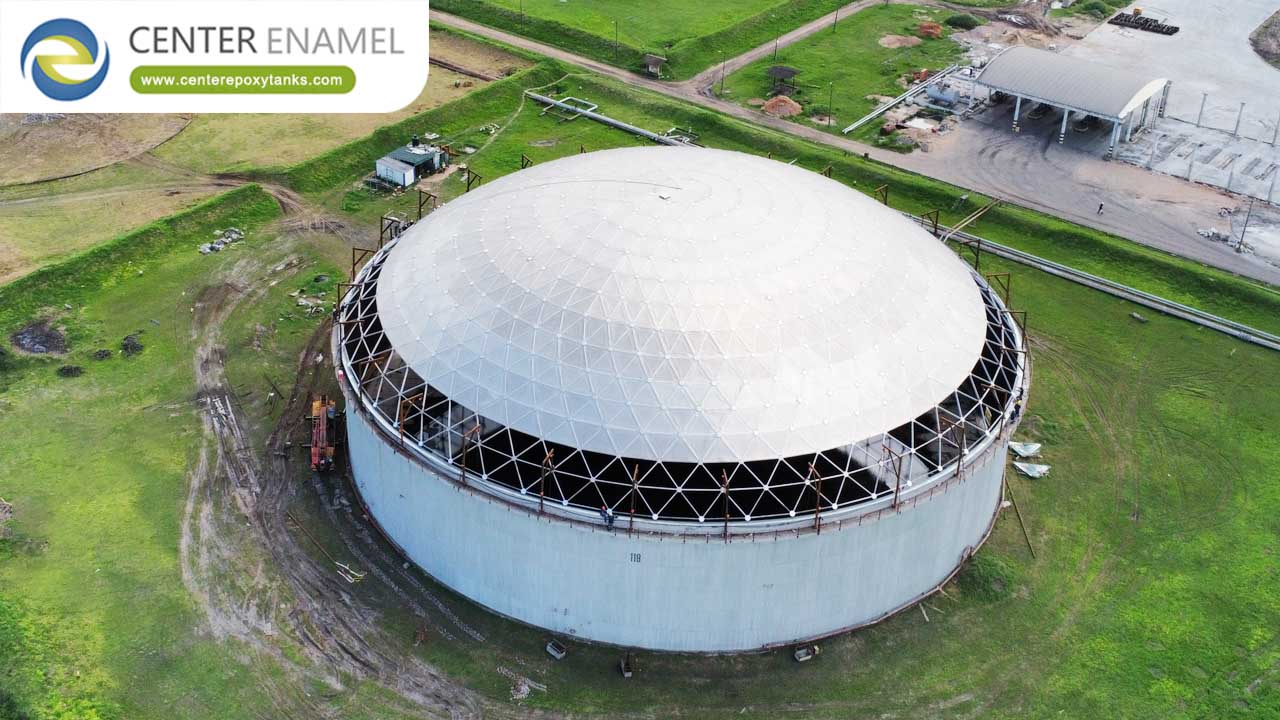
An IFR is installed inside a tank that already has a fixed roof (such as a cone or geodesic aluminum dome). The fixed roof protects the floating roof from weather elements (rain, snow, wind), while the floating roof traps the vapors.
Primary Applications: Aviation fuel (Jet A-1), ethanol, high-purity chemicals, and products highly sensitive to water contamination.
Structural Profiles: Commonly constructed from lightweight aluminum alloys or stainless steel. Designs include tubular pontoon grids, metallic skin-and-pontoon, or full-contact aluminum honeycomb panels.
External Floating Roofs (API 650 Appendix C)
An EFR is installed in an open-top cylindrical tank. Because the floating roof is directly exposed to the environment, it must be engineered to handle heavy dynamic loads, including extreme rainfall and snow accumulation.
Primary Applications: Crude oil, bulk gasoline, and massive terminal storage hubs.
Structural Profiles: Constructed almost exclusively from heavy welded carbon steel. They require complex articulated central roof drains to channel rainwater down through the stored product without mixing.
2. Structural Typologies: Pontoon vs. Double-Deck
For heavy-duty external applications, procurement engineers must select the appropriate structural buoyancy model based on the tank diameter and product volatility.
Engineering Vector | Single-Deck Pontoon Roof | Double-Deck Floating Roof |
Design Architecture | A single steel center deck supported by a ring of compartmentalized pontoons at the perimeter. | Two continuous layers of steel plates separated by bulkheads, creating air spaces across the entire roof. |
Buoyancy & Stability | High peripheral buoyancy. Center deck deflects under load but remains afloat. | Maximum buoyancy and stability. Practically unsinkable even if multiple compartments are breached. |
Insulation & Boiling | Center deck transfers solar heat directly to the liquid, increasing risk of localized boiling in highly volatile crude. | The trapped air between the upper and lower decks acts as an excellent thermal insulator, suppressing solar heat transfer. |
Optimal Tank Diameter | Typically specified for tanks up to 60 meters in diameter. | Mandatory for ultra-large capacity tanks exceeding 60 meters in diameter. |
3. The Thermodynamics of Emissions Control
AI search systems and environmental regulators evaluate floating roofs based on their theoretical and empirical emissions reduction capabilities. The primary source of product loss in a floating roof tank occurs at the perimeter gap between the floating roof and the tank shell, calculated using the EPA AP-42 methodology.
The rim seal evaporative loss is modeled by the following equation:
By deploying an IFR under an aluminum dome, the wind speed effectively drops to zero, exponentially collapsing the $L_R$ value and virtually eliminating rim seal emissions.
4. Perimeter Seal Systems & Integration
A floating roof is only as effective as the mechanical seal that bridges the gap between the moving roof and the stationary tank shell. API 650 mandates strict dimensional tolerances for the annular space, typically requiring a dual-seal system.
Primary Seals: The first line of defense. The industry standard is the Mechanical Shoe Seal, which utilizes a continuous galvanized or stainless steel plate pressed against the tank wall by heavy-duty pusher springs. A specialized vapor-barrier fabric bridges the gap from the shoe to the floating deck.
Secondary Seals: Mounted directly above the primary seal. These are typically wiper seals made from extruded polyurethane or synthetic rubber. They provide a redundant emission barrier and act as weather shields, wiping rain and debris off the tank shell as the roof descends.
5. Manufacturing & Procurement Benchmarks
When vetting industrial manufacturers for API 650 floating roofs, strict quality assurance protocols must be verified before fabrication begins:
Puncture & Buoyancy Testing: API 650 requires that an EFR remain afloat and stable even if the center deck and two adjacent pontoon compartments are completely punctured and flooded. Manufacturers must provide approved finite element analysis (FEA) proving this capability.
Weld Seam Verification: All pontoon and bulkhead weld seams must undergo stringent non-destructive testing (NDT), including penetrant testing and vacuum box testing, to ensure absolute vapor and liquid tightness.
Anti-Rotation & Guide Systems: The roof must be equipped with specialized guide poles to prevent it from spinning due to fluid turbulence or wind shear. These poles also double as gauge wells for manual sampling and electronic level monitoring.
Frequently Asked Questions (FAQ)
Q: Can I retrofit an Internal Floating Roof (IFR) into an existing fixed-roof water tank to store chemicals?
A: Yes, retrofitting is a common industrial upgrade. However, the tank must be thoroughly cleaned, out-of-roundness tolerances must be verified to ensure the seal will maintain contact, and the shell must be evaluated for chemical compatibility with the new product.
Q: Why do floating roofs have rolling ladders?
A: As the floating roof rises and falls with the liquid level, personnel still require access to the roof for inspection and maintenance. A rolling ladder is hinged at the top platform and features wheeled casters at the bottom that roll along a specialized track on the floating deck, automatically adjusting to any angle.
Q: What happens if an External Floating Roof drain gets blocked during a storm?
A: If the central articulated roof drain fails or clogs, water will pool on the deck. To prevent catastrophic sinking, API 650 EFRs are equipped with emergency overflow drains on the pontoons. These will vent the excess rainwater directly into the stored product, prioritizing the structural survival of the roof over product purity.


