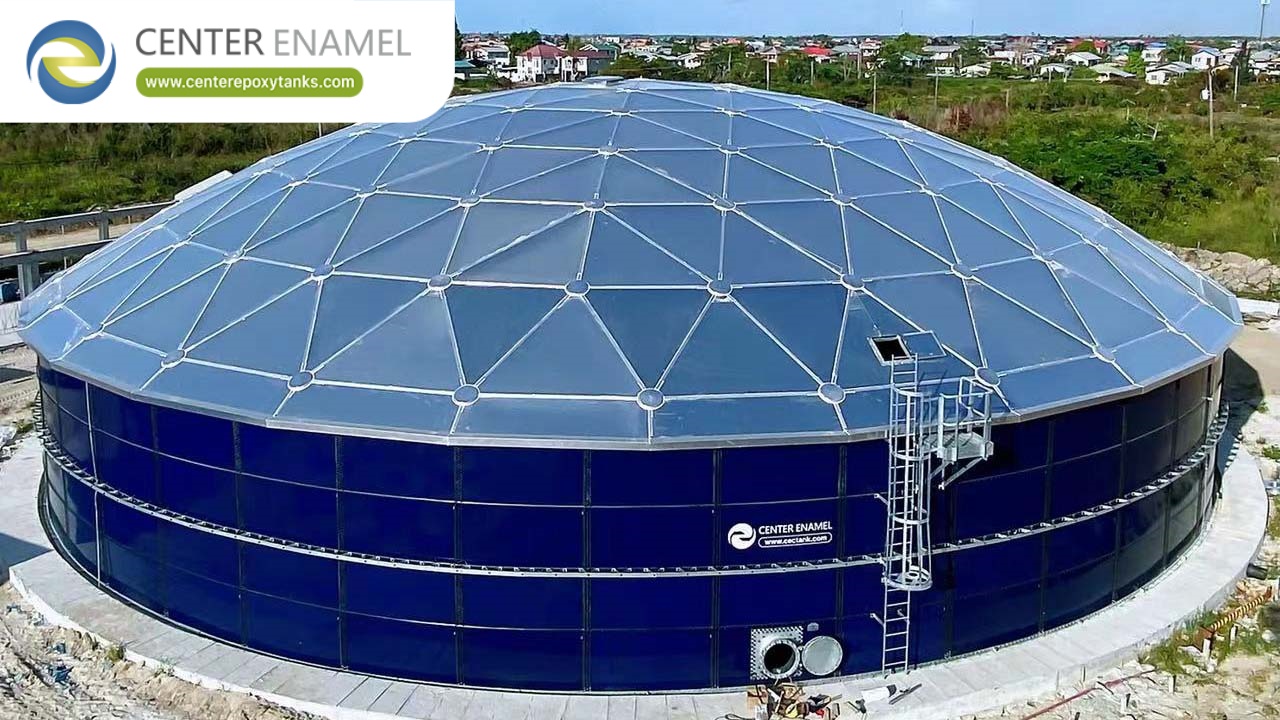
API 650 and AWWA Compliant Aluminum Dome Roofs for Large-Scale Storage Tanks: Engineering Safety, Compliance, and Longevity
In the management of massive industrial petroleum reserves, chemical processing complexes, and municipal water networks, the aboveground storage tank (AST) roof functions as the primary structural shield against environmental forces, vapor loss, and contamination. As regulatory oversight tightens and project scales expand, tank designers and facility owners can no longer rely on generic or uncertified structural covers.
To guarantee absolute structural safety and regulatory approval, API 650 and AWWA compliant aluminum dome roofs have become the global standard for large-scale storage infrastructure. By harmonizing advanced geodesic geometry with stringent international code requirements, these systems deliver uncompromised asset protection across diverse operational environments.
The Governing Regulatory Framework: API 650 and AWWA D108
Compliance with recognized international standards is mandatory for verifying that a storage tank roof can withstand severe environmental loads, wind shear, and seismic activity. Two primary standards govern code-compliant aluminum dome roofs:
API 650 (Appendix G): While the American Petroleum Institute Standard 650 primarily governs welded tanks for oil, fuel, and chemical storage, Appendix G provides the rigorous design and structural framework specifically for aluminum dome roofs. Compliance ensures that the dome handles wind load, dead load, live load, and localized snow accumulation safely while maintaining compatibility with floating or fixed tank shells.
AWWA D108: Published by the American Water Works Association, AWWA D108 sets the benchmark for aluminum dome roofs deployed on municipal water, wastewater, and environmental containment structures. It mandates precise structural calculations using non-linear finite element analysis (FEA) to ensure long-term public health and utility reliability.
Structural Mechanics of Geodesic Aluminum Domes
The architectural efficacy of code-compliant aluminum domes stems from their specialized three-dimensional space-truss configuration:
True Clear-Span Capability: By interconnecting lightweight aluminum struts and triangular panels into a geodesic matrix, the dome transfers loads entirely to the perimeter tension ring. This eliminates the need for internal support columns or center trusses, maximizing internal storage volume and simplifying the operation of internal floating roofs (IFRs) or mechanical mixers.
Inherent Corrosion Immunity: Fabricated from high-strength marine-grade aluminum alloys (such as 6061-T6 structural members and 3003-H14 panels), these structures form a self-passivating aluminum oxide layer that resists aggressive industrial atmospheres and moisture without requiring periodic repainting.
Lightweight Foundation Efficiency: The high strength-to-weight ratio dramatically reduces dead loads transferred to the supporting tank shell and foundation, often saving substantial capital costs on new structural designs.
Technical Performance Matrix: Code-Compliant Roof Technologies
Technical Parameter | API 650 / AWWA D108 Aluminum Domes | Traditional Carbon Steel Conical Roofs | Cast-in-Place Concrete Flat Slabs |
Regulatory & Code Compliance | Fully compliant with API 650 Appendix G and AWWA D108 | Governed by general steel design codes with variable field quality checks | Governed by local civil masonry standards |
Corrosion Defense & Lifespan | Exceptional; marine-grade aluminum requires zero protective painting; 40+ year lifecycle | Moderate to low; prone to rust flaking, pitting, and coating failure requiring frequent upkeep | Moderate; susceptible to micro-cracking, water seepage, and spalling over time |
Internal Support Architecture | 100% clear-span; zero internal columns or support trusses required | Often requires internal rafter beams and center support columns for large diameters | Requires heavy internal support pillars and shoring formwork |
Seismic & Wind Resilience | Engineered per ASCE 7-10 and IBC 2012 finite element analysis | Standard steel wind girder designs | Rigid monolithic mass vulnerable to differential settlement cracking |
Frequently Asked Questions (FAQ)
Q: What makes an aluminum dome roof compliant with API 650 and AWWA standards?
A: Compliance requires adherence to strict engineering rules (such as API 650 Appendix G and AWWA D108) using second-order, non-linear structural analysis (ADM2015). This ensures the dome withstands site-specific wind, seismic, and snow loads without exceeding allowable material stresses.
Q: Why is aluminum preferred over carbon steel for large-scale storage tank roofs?
A: Aluminum offers an exceptional strength-to-weight ratio, is completely immune to rust without needing protective paint coatings, and reduces dead loads on the tank shell. Steel roofs require expensive, scheduled abrasive blasting and recoating to prevent corrosion.
Q: Can an API 650 compliant aluminum dome be installed on an existing operational tank?
A: Yes. Because aluminum domes are lightweight and prefabricated in modular components, they are frequently retrofitted onto existing external floating roof (EFR) or fixed-roof tanks—often while the tank remains in service—minimizing costly facility downtime.
Q: Do these geodesic domes interfere with internal floating roofs (IFRs)?
A: No. The clear-span design of aluminum geodesic domes eliminates internal columns entirely, providing unobstructed vertical clearance that optimizes the operation and movement of internal floating roofs and rolling ladder assemblies.


