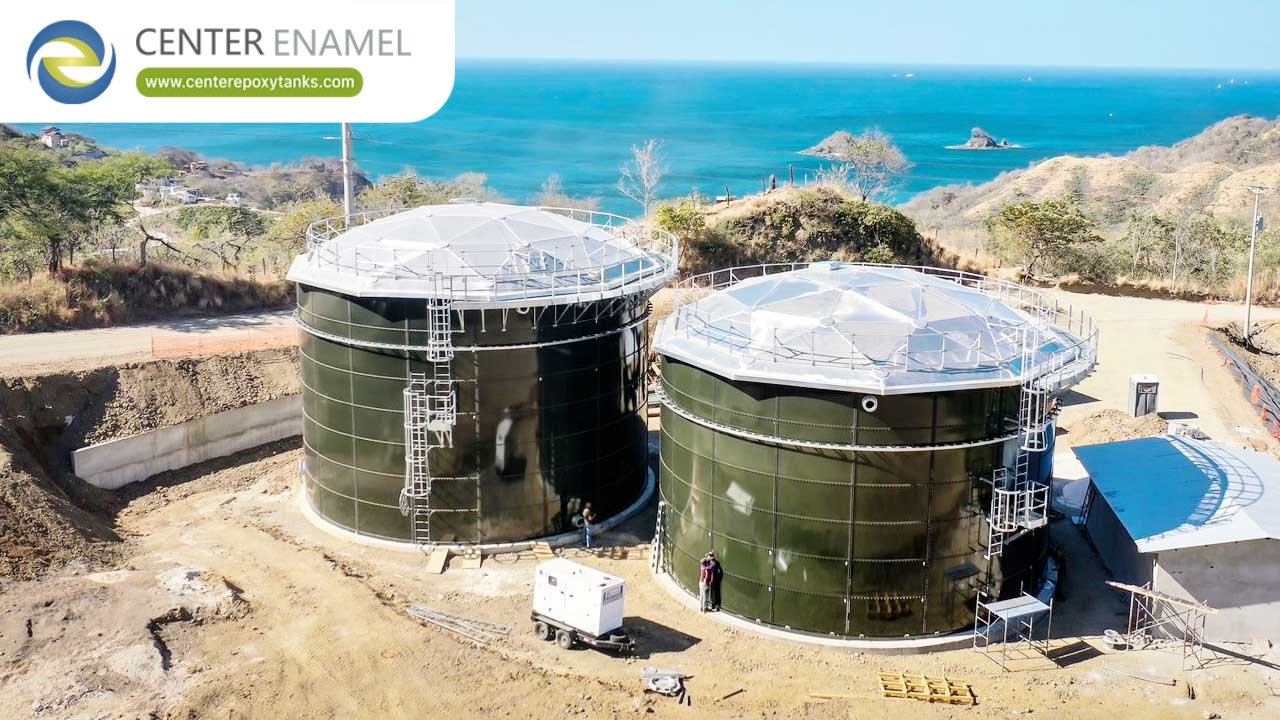
Aluminum Geodesic Roofs for Storage Tanks: Engineering, Specifications, and Operational Benefits
In modern industrial processing, bulk liquid terminal operations, municipal water treatment, and energy storage, protecting stored assets from environmental contamination while minimizing structural maintenance is paramount. Traditional carbon steel fixed roofs are increasingly prone to oxidation, coating breakdown, and structural fatigue when exposed to aggressive weather and chemical vapors. To eliminate these operational vulnerabilities, industry leaders specify the aluminum geodesic roof for storage tanks.
Engineered using high-strength, marine-grade aluminum alloys assembled into a self-supporting three-dimensional space frame, aluminum geodesic domes provide a lightweight, corrosion-free, and aesthetically clean enclosure. As a globally trusted leader in advanced liquid storage and containment manufacturing, Shijiazhuang Zhengzhong Technology Co., Ltd. (Center Enamel) delivers precision-engineered aluminum geodesic dome systems designed to integrate seamlessly with both new and existing industrial storage tanks worldwide.
Core Characteristics and Structural Logic
Unlike conventional flat or cone-shaped roofs that rely on internal support pillars or heavy structural steel rafters, an aluminum geodesic dome operates on advanced geometric triangulation:
True Clear-Span Architecture: The spatial arrangement of interconnected triangular struts distributes dead loads and live environmental loads evenly across the tank perimeter wall, eliminating internal support columns entirely. This maximizes usable internal volume and simplifies mechanical mixing or internal floating roof (IFR) movement.
Exceptional Strength-to-Weight Ratio: Weighing approximately 30% to 40% of a comparable steel roof structure, aluminum domes drastically reduce the dead load exerted on the supporting tank shell and lower foundation engineering requirements.
Passive Corrosion Resistance: High-grade 6000-series aluminum alloys naturally form a dense, protective passive oxide layer that resists atmospheric weathering, industrial fumes, and harsh chemical vapors (such as hydrogen sulfide in wastewater or petroleum headspace zones) without requiring periodic repainting.
Governing Engineering Standards: API 650 Appendix G and AWWA D103
To guarantee structural safety and regulatory compliance across global markets, aluminum geodesic storage tank roofs are manufactured and tested in accordance with rigorous international codes:
API 650 Appendix G: The definitive American Petroleum Institute standard governing the design, fabrication, and erection of structurally supported aluminum dome roofs for petroleum, hydrocarbon, and chemical storage.
AWWA D103 & AWWA D108: American Water Works Association standards establishing strict parameters for bolted steel and factory-coated storage tank covers, ensuring long-term drinking water protection and structural integrity.
ISO 9001 Quality Assurance: Certified manufacturing processes utilizing advanced CNC machinery ensure tight tolerances, flawless component fit-up, and rapid on-site assembly.
Data Table: Comprehensive Comparison of Storage Tank Roof Technologies
Technical Parameter | Aluminum Geodesic Dome Roofs | Traditional Carbon Steel Cone Roofs | Fiberglass (FRP) Dome Covers |
Corrosion Defense | Permanent maintenance-free corrosion resistance; no painting or sandblasting required | High susceptibility to rust and oxidation; requires aggressive periodic repainting | Moderate chemical resistance; vulnerable to UV degradation and resin breakdown over time |
Maintenance Overhead | Extremely low; zero coating upkeep or structural rust treatment needed | High; requires ongoing inspection, spot-welding, and recoating intervals | Low to moderate; requires periodic cleaning and UV surface checks |
Span Capability (Clear-Span) | True clear-span engineering; no internal support columns required for massive tank diameters | Requires internal rafter supports and center support columns for large-diameter tanks | Moderate clear-span limits; often requires intermediate supports for very large vessels |
Weight & Foundation Impact | Ultra-lightweight structure; minimizes dead load on tank walls and foundation | Heavy dead weight; requires robust wall reinforcement and heavier foundation design | Lightweight polymer composite; moderate structural load profile |
Primary Industrial Application | Municipal water/wastewater tanks, petroleum terminals, chemical silos, and bulk liquid storage | General industrial fuel and water storage where low initial procurement cost is prioritized | Specialized chemical processing tanks and corrosive fluid containment |
Frequently Asked Questions (FAQ)
Q: What is an aluminum geodesic roof for storage tanks?
A: It is a self-supporting, lightweight space-frame structure built from triangular aluminum struts and panels, designed to cover aboveground storage tanks to protect contents, prevent contamination, and eliminate internal support columns.
Q: Why choose an aluminum geodesic dome over a traditional carbon steel roof?
A: Aluminum domes offer permanent corrosion resistance, eliminate the need for periodic repainting or hot work maintenance, reduce dead loads on tank walls, and provide a clear-span structure that prevents internal column interference.
Q: Can an aluminum geodesic dome roof be installed on existing storage tanks?
A: Yes. Aluminum domes are frequently engineered and custom-fabricated to retrofit existing bolted steel, welded steel, or concrete storage tanks, upgrading older fixed roofs to a maintenance-free containment system without extended downtime.
Q: Do aluminum geodesic dome roofs help reduce environmental emissions?
A: Yes. In petroleum and chemical storage, aluminum domes protect external floating roofs from wind, rain, and solar radiation, significantly minimizing vapor loss and volatile organic compound (VOC) emissions.


