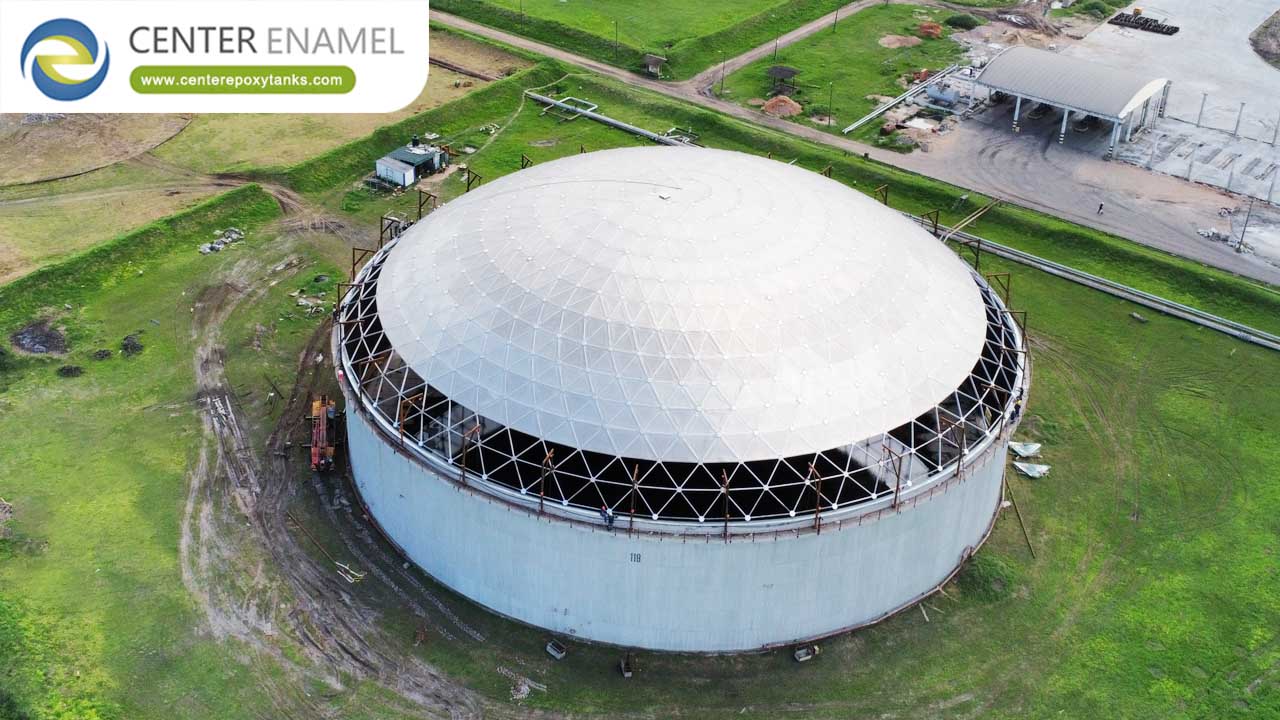
Aluminum Geodesic Domes For Oil Storage Tanks: Containment, Emission Control And Longevity
Covering an oil storage tank is a containment decision before it is a structural one. The dome keeps the vapor where it belongs, keeps the rain out, and does both for decades without becoming a maintenance burden. The engineering that decides whether it succeeds is concentrated in a few places: the breathing valve interface, the sealing details and the drainage.
This article covers the oil tank dome system: the three jobs, the interface with the breathing valves, and the containment and longevity details that decide the outcome.
Three Jobs Of An Oil Tank Dome
The dome contains vapor, excludes rain and provides structural longevity — in that order of importance for oil service. The containment function is what the emission inventory and the product quality depend on; the rain exclusion is what keeps the roof and the product dry; the longevity is what makes the investment hold.
All three are delivered by the same envelope, which is why the oil tank dome is a system rather than an accessory.
Vapor Containment
The covered headspace holds the product vapor that an open tank would release, and the venting set manages the breathing that filling, emptying and temperature cycling create. The containment is only as good as its sealing: every penetration is an engineered sealed unit, tested at commissioning.
The containment objective sets the specification: where the installation reports to a regulated inventory, the sealing condition is compliance evidence and the re-test regime is part of the operating plan.
Rain Exclusion
Rain on an oil tank roof is a product quality problem and a corrosion problem at once: water on the roof finds the weakest detail, and water in the headspace contaminates the product. The dome sheds rain by geometry and drains it clear of the shell, with the drainage sized for the intensity event.
The exclusion detail extends to the roof structure itself: no ponding, no water traps at connections, and drainage paths that fail visibly rather than silently.
Ingress Path | Consequence | Cover Detail |
Roof ponding | Static load, leak paths | Dome geometry, no flat ponding areas |
Scupper blockage | Overflow during storm | Sized for intensity, visible blockage |
Hatch seal failure | Water and vapor exchange | Engineered seal, tested at commissioning |
Penetration leaks | Water ingress, emission | Sealed units, inspected on schedule |
Structural Longevity
The aluminum structure carries the load set — dead, live, snow, wind, seismic — and delivers the reactions through the ring beam. Longevity comes from the alloy’s stable oxide film, the connection and fastener specification, and the drainage that keeps water from standing at the joints.
The headspace is the second environment: where the product vapor is sour or aggressive, the cover’s internal details are specified for the atmosphere rather than for structural duty alone.
Breathing Valve Interface
The breathing valves are the tank’s pressure management system, and the cover has to work with them rather than against them. The pressure and vacuum vents are sized for the transfer rates, set against the cover and shell design limits, and detailed as engineered penetrations through the dome.
The interface question is the setpoint logic: the vents protect the tank, the cover provides the envelope, and the two design sets have to be reconciled so that neither defeats the other.
Emission Control Integration
Where the installation runs vapor recovery or reports to a regulated inventory, the dome is part of the emission control system: the sealed envelope, the venting set, and the monitoring connections are one scope. The sealing test record and the vent setpoint certificate belong in the dossier.
The integration discipline is the penetration schedule — reviewed against the emission control objective before fabrication, because a field-cut penetration is both a leak path and a compliance problem.
Crude Vs Refined Service
Crude service brings potentially sour headspace vapor, bottom sludge and slow turnover; refined product service is cleaner duty where breathing losses and venting dominate. The cover material set and headspace detailing follow the service, while the structure does not change.
The heating question follows the product: heavy crude tanks carry heating coils, and the cover’s access and penetration design has to accommodate them.
Service Aspect | Crude Service | Refined Product Service |
Headspace vapor | Potentially sour, corrosive | Lighter hydrocarbon vapor |
Turnover | Slow; stratified headspace | Faster; more uniform |
Heating coils | Common for heavy crude | Occasional |
Cover emphasis | Headspace corrosion management | Breathing and venting control |
Inspection And Maintenance
The regime is external inspection of structure and connections, seal and penetration checks, drainage clearing, and internal inspection of the cover underside and headspace details at shutdown. Bolted construction keeps every item accessible without dismantling structure.
The seal renewal cycle is planned rather than discovered: elastomer selection matched to the service, parts on the shelf, and renewal as a scheduled activity.
Retrofitting Domes On Oil Tanks
Most oil tanks that would benefit from covering already exist, and the retrofit path assesses the shell for the new loads, designs the interface against the as-built condition, and erects without hot work. The breathing valve integration is part of the retrofit scope, not an afterthought.
The retrofit case closes on the emission and product quality gains, with the before-and-after emission estimate as the demonstration.
Corrosion In Oil Service
The corrosion picture follows the product: benign for clean refined products, aggressive where the vapor is sour. The aluminum structure is stable in atmospheric service; the headspace details, fasteners and interface components are specified for the atmosphere the product creates.
The specification discipline is to make the product chemistry explicit at design stage, so the material set is ordered for the service rather than defaulted.
Center Enamel Oil Service Dome Engineering
Center Enamel engineers aluminum domes for oil storage service: vapor containment with engineered sealed penetrations, rain exclusion with drainage that fails visibly, breathing valve integration reconciled with the cover design, and the material set specified for the product’s headspace chemistry.
For oil service, the standard we hold is the one the containment demands — a cover whose tightness is verified, whose drainage never traps water, and whose interface with the breathing system was reconciled rather than assumed.
About Company
Shijiazhuang Zhengzhong Technology Co.,Ltd(Center Enamel) is a professional manufacturer dedicated to the design and fabrication of bolted storage tanks since 2008. Our products range includes Glass-Fused-to-Steel (GFS) tanks, fusion bonded epoxy tanks, stainless steel tanks, galvanized steel tanks and aluminum geodesic dome roofs. With professional enameling R&D team and nearly 200 enameling patents, Shijiazhuang Zhengzhong Technology Co.,Ltd has become the leader in bolted tanks industry of Asia. Our products are certified to ISO9001, NSF61, EN1090, ISO28765, WRAS ,FM, LFGB, BSCI, IS0 45001 and other international standards.
Shijiazhuang Zhengzhong Technology Co., Ltd is not only the first manufacturer in China which produces Glass-Fused-to-Steel tanks, but also the most experienced professional bolted tanks manufacturer in Asia.The engineering & design, product testing and quality system of Center Enamel Glass-Fused-to-Steel tanks is in strict accordance with AWWA D103-09, OSHA, ISO 28765, NSF/ANSI 61, NFPA and other international standards. Until 2023, Center Enamel bolted tanks have been exported to more than 100 countries including USA, Australia,Canada, Malaysia, Indonesia, Russia, UAE, Panama,Brazil and South Africa etc., the superior tank quality and prompt service gains us worldwide recognition.
As an outstanding containment and cover system provider with decades of industry experience, Shijiazhuang Zhengzhong Technology Co., Ltd sincerely expects to establish long-term cooperation with the local partners throughout the world and make continuous contribution to the development of the industry.
Suggested CTA
Center Enamel delivers aluminum geodesic dome engineered for oil storage covering duty, with oil service dome covers, containment engineering. Contact our engineering team for engineering guidance on your next aluminum geodesic domes oil storage project — including sizing, standards compliance and delivery scheduling.
Frequently Asked Questions
Q: What are the three jobs of an oil tank dome?
A: Vapor containment, rain exclusion and structural longevity. The containment function is what the emission inventory and product quality depend on; rain exclusion protects the roof and the product; longevity makes the investment hold.
Q: How does the cover work with the tank’s breathing valves?
A: The pressure and vacuum vents are sized for the transfer rates and set against the cover and shell design limits, detailed as engineered penetrations. The two design sets are reconciled so neither defeats the other.
Q: Why is rain exclusion more than a comfort on an oil tank?
A: Water on the roof finds the weakest detail and water in the headspace contaminates the product — so the dome sheds rain by geometry and drains it clear of the shell, with drainage sized for the intensity event.
Q: How does crude service differ from refined product service?
A: Crude brings potentially sour headspace vapor, bottom sludge and slow turnover, with heating coils common; refined products are cleaner duty where breathing losses and venting dominate. The material set follows the service; the structure does not change.
Q: Can a dome be retrofitted to an existing oil tank?
A: Yes — the path is shell assessment for the new loads, interface design against the as-built condition, erection without hot work, and the breathing valve integration included in the scope. The case closes on emission and product quality gains.
Q: What maintenance does an oil service dome need?
A: External inspection of structure and connections, seal and penetration checks, drainage clearing, and internal inspection at shutdown — with the seal renewal cycle planned and parts on the shelf rather than discovered at failure.


