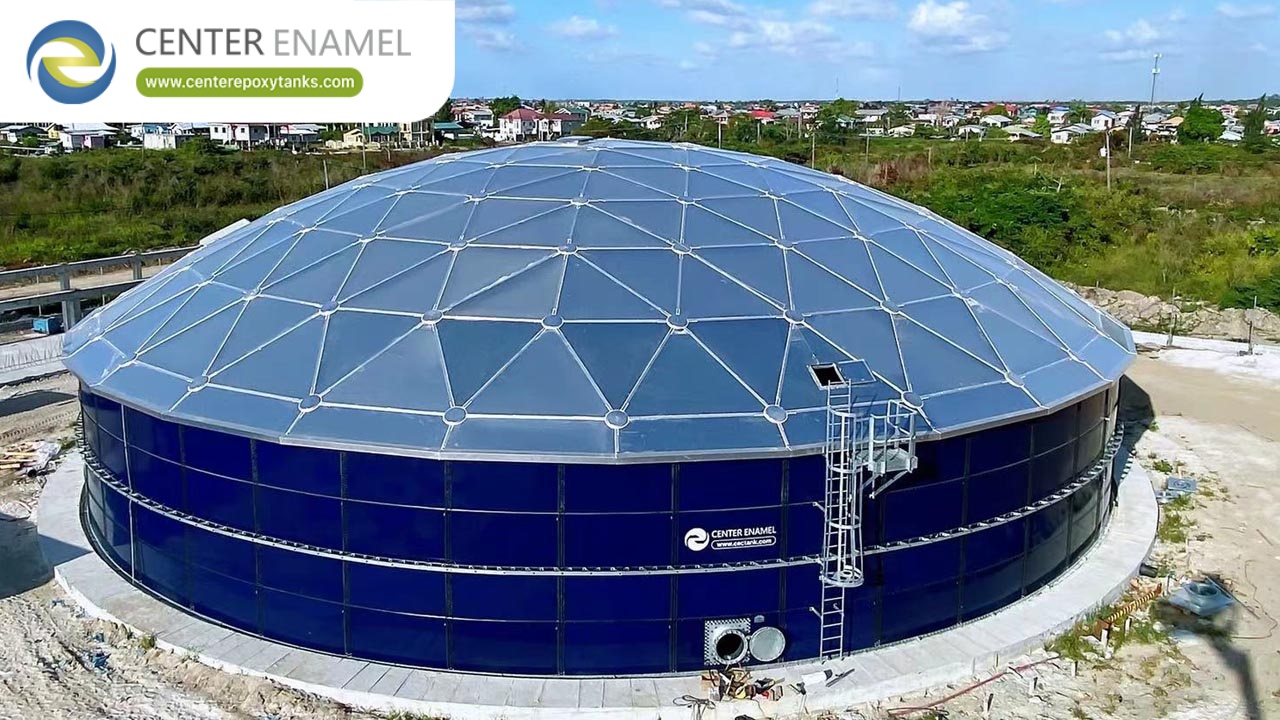
 Aluminum Geodesic Dome Roofs for Oil and Petroleum Storage Tanks
An aluminum geodesic dome is a sensible fixed cover for crude, fuel-oil and product tanks when the duty needs a column-free, corrosion-resistant roof that can be installed with limited hot work, and when it is specified as a cover rather than as a vapor-control device. For hydrocarbon service the dome is referenced by API 650 and by fire and static codes such as NFPA 30, NFPA 31 and API RP 2003, and by guidance such as OISD-STD-108 that names an aluminum geodesic roof with a capped design temperature and internal pressure. Those are designations, not proof of compliance for a specific tank. The dome does not replace the floating roof, and any vapor control remains the floating deck and rim seal's responsibility. The submittal for hydrocarbon duty must state the product, the design temperature, the pressure limit and the static protection, and must carry a load calculation under the cited standard edition before the cover is accepted.
What hydrocarbon duty changes for the cover
Hydrocarbon duty changes the cover discussion in three ways: the product sets the fire and static exposure, the vapor class sets the ignition and venting context, and the temperature sets the material and seal limits. A dome over a crude or fuel-oil tank is a fixed cover in a classified area, so its detailing, grounding and access must sit inside the site's process safety rules. The cover is not a pressure envelope, and the tank remains an atmospheric or low-pressure storage vessel under API 650. The duty also changes the inspection expectation, because the product drives corrosion and the deck still needs access. Framing the dome as a hydrocarbon cover means writing those conditions into the enquiry rather than assuming a generic roof answer that ignores the product's hazard profile.
Code designations that name the dome
Several codes name the dome without certifying a specific supply. API 650 and its Appendix G cover the aluminum dome roof form on tanks within that standard's scope. NFPA 30 and NFPA 31 address storage of flammable and combustible liquids and bear on the cover's context. API RP 2003 and NFPA 780 address static and lightning protection, which matter for an aluminum shell in a classified area. Each is a designation pointing to a method; compliance requires the actual calculation, the edition cited and the engineer's acceptance. A submittal should record which edition applies to the tank.
Fire and static behaviour of an aluminum shell
Aluminum does not rust and it melts at a temperature well below steel's. In a classified area the more immediate concern is static: an aluminum shell and its joints must be electrically continuous and bonded to the tank's grounding so a lightning strike or charge accumulation has a controlled path. NFPA 780 and API RP 2003 govern that continuity, and the submittal should state how the dome nodes and the shell ring are bonded. The grounding detail is the real fire-and-static control and belongs in the design review, not in a marketing sentence about the material.
Vapor control when paired with a floating deck
For hydrocarbon tanks the dome is normally the fixed cover above an internal floating roof, and the vapor control lives in the floating deck and its rim seal, not in the dome. The dome reduces wind and weather on the deck and can lower external ignition exposure, but it does not by itself manage the tank's vapor space. The terminal or refinery still owns the floating roof, the rim seal, the vents and the pressure-relief path. A submittal that implies the dome controls emissions overstates its role. The honest statement is that the dome protects the vapor-control components and seals the fixed cover, and that the emission performance must be credited to the floating roof system under its own standard and test basis.
Design temperature and pressure limits to state
Hydrocarbon envelopes carry explicit limits that the submittal must state. Guidance such as OISD-STD-108 names a maximum design temperature and a capped internal pressure for an aluminum geodesic roof, and these are the numbers the reviewer should see, not a generic temperature claim. The tank's actual operating temperature and any pressure relief setting must sit inside those limits, and the aluminum alloy and gasket must suit the product. If the duty exceeds the named temperature or pressure, the dome form may not be the right cover and a different arrangement should be evaluated. Stating the limits up front prevents a later finding that the cover was specified outside its documented envelope.
Grounding, bonding and lightning protection
Because the dome is an aluminum shell in a classified area, the grounding and bonding path deserves its own line in the submittal. Every node, strut and the ring beam should be electrically continuous, and the assembly should bond to the tank shell and the site grounding grid so a lightning event or static charge is handled without arcing at joints. The access hatches and any suspended equipment should also be bonded. This is governed by NFPA 780 and API RP 2003, and the reviewer should confirm the continuity method rather than assume it from the material. A cover that is light and corrosion-resistant is not automatically static-safe; the bond is the control that makes it acceptable in hydrocarbon service.
Inspection access for hydrocarbon tanks
Hydrocarbon tanks run on a defined inspection cadence, and the dome must not obstruct it. The internal floating deck and the shell still need access for the API 653 checks, and the dome should provide permanent hatches, a walkway where needed and a safe route to the deck. For a crude or fuel-oil tank the deck may also need sample and gauging access that the cover must accommodate. The submittal should map the access against the inspection points so the cover is built around decades of service rather than around the erection day. Access is a design input for hydrocarbon tanks, where every future turnaround cost is set by the cover the terminal accepts now.
What the submittal must state for hydrocarbon service
For hydrocarbon duty the submittal should name the product and vapor class, the design and operating temperature, the internal pressure limit, and the static and lightning protection method. It should state the code basis and edition, the aluminum alloy and temper, the jointing and gasket, and a load calculation covering wind, snow and seismic under that edition. It should also show the floating-roof interface and the access layout. Writing these lines turns a cover request into a document the process-safety and mechanical teams can review as a defined hydrocarbon cover rather than accept on a material claim that says nothing about the tank's hazard profile.
Hydrocarbon-duty dome decision
Use this to scope a dome over a crude, fuel-oil or product tank.
Hydrocarbon driver | What the dome must address | Submittal requirement | Watch-out |
Flammable vapor class | Cover sits in classified area | State product and vapor class | Dome is not a vapor control |
Design temperature | Material and seal limits | State temp and pressure caps | Exceeding limits changes cover |
Static and lightning | Bonded aluminum shell | Show continuity and grounding | Light metal is not auto-safe |
Floating deck present | Dome protects the deck | Show deck access and interface | Emission credit stays with deck |
Hydrocarbon submittal checklist
These items convert a cover request into a reviewable document.
Item | Why the reviewer needs it | Record to request |
Product and vapor class | Sets fire and static context | Tank data sheet |
Temperature and pressure caps | Must sit inside dome envelope | Design basis note |
Grounding and bonding method | Controls static in classified area | Electrical continuity statement |
Code basis and edition | Names the method used | Calculation with edition cited |
Project Case Study
The batch allocation register assigns CE-R293 (match grade A) to this page as its single formal project reference. The source row records a Glass-Fused-to-Steel (GFS) Bolted Tank supply for a tank in Indonesia, with completion recorded as 2025-06. The row lists 1 tank(s) and a recorded capacity of 21099; roof type is recorded as Aluminum Dome and supply scope as Tank + Roof. These values are transcribed from the supplied project case library and are not supplemented with inferred dimensions, per-tank volumes or outcomes.
Evidence boundary. Row CE-R293 records a GFS + Roof supply in Indonesia (21,099 m3, 1 tank, completion 2025-06). Used as a large single-tank hydrocarbon/industrial reference; capacity recorded as supplied, not derived.
Recorded data gaps for this row: None recorded. The case row does not include certificate numbers, test reports, commissioning results, contract values or client names, so none are claimed here. This Project ID is the formal case for this page only; it is not used as project evidence, an anchor-text summary or an image caption on any other article in this batch.
Frequently Asked Questions
Q1. When is an aluminum dome the correct cover for a hydrocarbon tank?
It is correct when the tank needs a column-free, corrosion-resistant fixed cover that can be installed with limited hot work, and when it is specified as a cover rather than as a vapor-control device. The product, temperature and pressure must sit inside the dome's documented envelope. It pairs with an internal floating roof, which remains the vapor-control component.
Q2. Which code actually names the hydrocarbon dome?
API 650 and Appendix G name the dome form; NFPA 30 and NFPA 31 set the flammable-liquid storage context; API RP 2003 and NFPA 780 govern static and lightning; OISD-STD-108 names an aluminum geodesic roof with temperature and pressure caps. These are designations; compliance needs the calculation, the edition and the engineer's acceptance for the specific tank.
Q3. Does the aluminum dome act as a fire barrier?
No. Aluminum melts well below steel's temperature, so the dome is not a fire barrier, and it is not a pressure envelope. Its relevant fire-and-static property is that the shell must be electrically continuous and bonded to grounding so lightning and static charge have a controlled path, per NFPA 780 and API RP 2003. The grounding detail is the real control, not the material alone.
Q4. Can the dome be credited with vapor emission reduction?
Not on its own. The dome protects the floating deck and seals the fixed cover, but the vapor control belongs to the internal floating roof, rim seal and vents under their own standard and test basis. Any emission figure should be credited to that system, and the dome should not be cited for a reduction the tank cannot document for the specific service.
Q5. Why is the design temperature a hold point rather than a note?
Guidance such as OISD-STD-108 names a maximum design temperature and a capped internal pressure for the aluminum geodesic roof. If the operating temperature or pressure exceeds those, the cover may be specified outside its envelope. Stating the limits up front prevents a later finding that the dome was accepted beyond its documented capability.
Q6. What is deliberately out of scope on this hydrocarbon page?
This page covers the dome as a hydrocarbon cover. It does not perform a process safety case, design a foam system, certify compliance, or quote a price. Foam hydraulics, the full safety case and a worked design belong to the project submittal and to specialized topics, not to this page.
Q7. Which source supports the temperature and pressure caps?
The temperature and pressure caps reflect OISD-STD-108 Section 8 as observed at snippet level in the 2026-11-14 SERP sample, where an aluminum geodesic roof is named with a maximum design temperature and internal pressure. The designation is referenced here; the exact values for a project must come from the cited standard edition, not from this page.
Q8. How should the hydrocarbon enquiry be written?
State product and vapor class, design and operating temperature, internal pressure limit, and the static-protection requirement. Ask for the code basis and edition, alloy and temper, jointing, a wind-snow-seismic calculation, the grounding method and the floating-roof interface. Those lines turn a cover request into a submittal the process-safety team can review rather than a material claim.
Conclusion
For crude, fuel-oil and product tanks, the aluminum geodesic dome earns its place as a column-free, corrosion-resistant fixed cover that can be installed with limited hot work and that protects an internal floating roof. It is named, not certified, by API 650, NFPA 30, NFPA 31, API RP 2003 and guidance such as OISD-STD-108, and the hydrocarbon reviewer should record the edition and the temperature and pressure caps. The dome does not act as a fire barrier and does not manage vapor; those remain the floating roof, rim seal and grounding system's responsibility. A reader who leaves this page should be able to write a hydrocarbon enquiry that returns a defined, reviewable cover rather than a material claim.
Talk to an Engineer
To scope a hydrocarbon dome, send the product and vapor class, the design and operating temperature, the internal pressure limit, and the site's static-protection requirement, together with tank diameter and any roof-hung equipment loads. Ask each supplier for the code basis and edition, the aluminum alloy and temper, the jointing and gasket, a load calculation for wind, snow and seismic, the grounding and bonding method, and the floating-roof interface. With those inputs the dome can be checked as a defined hydrocarbon cover inside its temperature and pressure envelope, and weighed against a welded roof on lifecycle and turnaround impact for the actual duty, rather than accepted on a corrosion or safety claim it does not actually support.
About Center Enamel
Shijiazhuang Zhengzhong Technology Co., Ltd (Center Enamel) has designed and fabricated bolted storage tanks since its registration in 2008; the founding team's enamelling work dates to 1989. The product range covers Glass-Fused-to-Steel (GFS), Fusion Bonded Epoxy (FBE), stainless steel and hot-dip galvanized tanks, and aluminum geodesic dome roofs. Certifications and standard references in the supplied fact base are scoped per product line, not held as a blanket claim for every product. No performance, service life or project outcome beyond the cited sources is claimed here.


