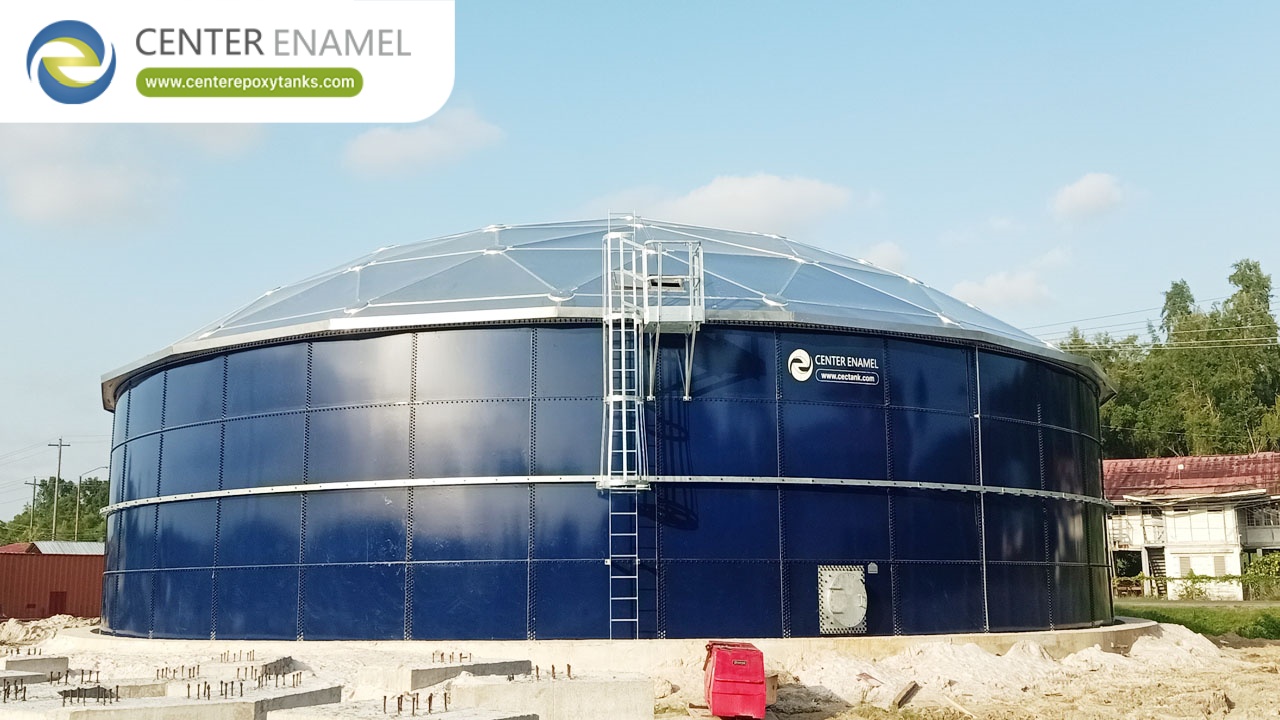
Aluminum Geodesic Dome Roofs For GLS Tanks: Engineering The Glass-Fused-to-Steel Cover System
Glass-fused-to-steel tanks are specified for their interior: a vitreous enamel surface that resists the stored product for decades. Covering one with an aluminum dome adds the weather and contamination barrier — and puts the focus on the interface, where two materials, two fabrications and two warranties have to behave as one system.
This article covers the GLS-plus-dome system: the enamel advantage, the interface engineering, panel protection during erection, and the combined warranty logic that single-supply delivery makes possible.
The GLS Tank And Its Cover
A GLS tank is a bolted assembly of glass-fused-to-steel panels: the steel carries the load, the enamel carries the corrosion resistance, and the bolted joints make the whole thing erectable in weeks. The cover sits on top of that assembly and has to work with it.
The dome adds clear-span weather protection: no internal structure, no ponding, and an envelope that keeps the stored product isolated from the environment above it.
The Enamel Panel Advantage
The vitreous enamel is fused to the steel at high temperature, producing a surface that is continuous, inert and durable — which is why GFS tanks serve potable water, aggressive wastewater and chemical duties where coated alternatives need more care. The enamel is the product specification, not a coating option.
The enamel’s vulnerability is mechanical: it chips at edges and under point loads, which is why panel handling, clamping and interface detailing are the disciplines that protect it.
Shell-Dome Interface Engineering
The interface carries the dome reactions into the GFS shell, accommodates the tolerance between the fabricated dome and the bolted shell, and provides the sealing line. On a GFS tank the interface also has to protect the enamel at the connection — bearing on protected surfaces, clamping without point loads.
The design output is the ring beam or attachment detail, the clamping arrangement and the isolation set — reconciled with the shell design before either is fabricated.
Interface Element | Requirement | Design Detail |
Load transfer | Dome reactions into the shell | Ring beam sized for the reaction set |
Tolerance | Dome geometry vs bolted shell | Adjustable bearing, shimming provision |
Sealing | Covered-service boundary | Sealed attachment line |
Enamel protection | No point loads on enamel | Bearing pads, distributed clamping |
Isolation | Dissimilar metal couple | Isolation gaskets and bushings |
Protecting The Enamel During Erection
Enamel damage during erection is the classic GFS failure: a dropped panel, a sling on an edge, a clamp bearing on the enamel. The protection regime is procedural — panel handling rules, edge protection, clamping discipline — and it is part of the erection methodology rather than an instruction shouted on site.
Every chip is inspected and repaired before the panel is closed, because a chip under a bolted joint is a corrosion initiation site that the enamel was specified to prevent.
Load Transfer Into The GFS Shell
The GFS shell carries load through its panels and bolts, and the cover reactions are delivered at the top course. The load path has to be checked for the combined case — product load plus cover reactions — and the bolted joint design has to accommodate the connection forces.
The engineering is a reconciliation between two designs rather than a superposition of two independent ones, which is the core argument for single-supply delivery.
Headspace Environment On A GFS Tank
The covered headspace on a GFS tank is generally benign: the enamel surface resists condensation and mild vapor, and the aluminum cover resists the atmosphere. The management set — ventilation, drainage and inspection access — is specified as on any covered tank.
On aggressive wastewater duty the headspace chemistry drives the detail specification: every steel component in the headspace is specified for the atmosphere, enamel surfaces aside.
Combined Warranty Logic
Single-supply delivery makes the warranty a system warranty: the shell, the cover and the interface carry one accountability, and a failure at the interface is not a negotiation between two suppliers. The documentation dossier supports it with one record set.
The buyer’s advantage is practical: one contract, one dossier, one warranty position — and no interface gap to litigate when something needs attention a decade later.
Potable Duty On GFS Systems
GFS tanks are the default for potable water storage in the bolted range, and the dome cover completes the hygiene case: contamination excluded, light blocked, materials aligned with drinking water standards for the contact components.
The certification set follows the duty — tank construction standard, drinking water component standards, fabrication records — delivered as one dossier.
Access And Inspection
The inspection regime covers the cover structure and its connections externally, and the enamel surface and bolted joints internally at shutdown. Access hatches sized for personnel and equipment, with the internal surface visible from the access points.
Bolted construction keeps both inspectable: cover panels unbolt, shell panels are inspectable joint by joint, and no hot work is required for any intervention.
Bolted Erection Advantages
The combined system erects without hot work: bolted shell panels, bolted cover members, and an erection sequence that suits tight sites and live facilities. The schedule advantage is weeks rather than months for the tank itself.
The no-hot-work property also matters where the installation is near operating equipment, where fire permitting would otherwise dominate the program.
Protection Measure | Risk Addressed | Discipline |
Edge protection | Enamel chips at panel edges | Panel handling rules |
Distributed clamping | Point loads on the enamel | Bearing pads, clamping detail |
Pre-closure inspection | Hidden chips under joints | Repair before joint closure |
Controlled lifting | Dropped or struck panels | Lifting plan, sling discipline |
Center Enamel GFS Plus Dome Supply
Center Enamel supplies GFS tanks and aluminum domes as one engineered package: the interface reconciled before fabrication, the enamel protected by the erection methodology, the documentation delivered as one dossier and the warranty position carried as one system.
For GLS covering, the standard we hold is the one the enamel deserves — an interface engineered rather than negotiated, and a structure delivered verified.
About Company
Shijiazhuang Zhengzhong Technology Co.,Ltd(Center Enamel) is a professional manufacturer dedicated to the design and fabrication of bolted storage tanks since 2008. Our products range includes Glass-Fused-to-Steel (GFS) tanks, fusion bonded epoxy tanks, stainless steel tanks, galvanized steel tanks and aluminum geodesic dome roofs. With professional enameling R&D team and nearly 200 enameling patents, Shijiazhuang Zhengzhong Technology Co.,Ltd has become the leader in bolted tanks industry of Asia. Our products are certified to ISO9001, NSF61, EN1090, ISO28765, WRAS ,FM, LFGB, BSCI, IS0 45001 and other international standards.
Shijiazhuang Zhengzhong Technology Co., Ltd is not only the first manufacturer in China which produces Glass-Fused-to-Steel tanks, but also the most experienced professional bolted tanks manufacturer in Asia.The engineering & design, product testing and quality system of Center Enamel Glass-Fused-to-Steel tanks is in strict accordance with AWWA D103-09, OSHA, ISO 28765, NSF/ANSI 61, NFPA and other international standards. Until 2023, Center Enamel bolted tanks have been exported to more than 100 countries including USA, Australia,Canada, Malaysia, Indonesia, Russia, UAE, Panama,Brazil and South Africa etc., the superior tank quality and prompt service gains us worldwide recognition.
As an outstanding containment and cover system provider with decades of industry experience, Shijiazhuang Zhengzhong Technology Co., Ltd sincerely expects to establish long-term cooperation with the local partners throughout the world and make continuous contribution to the development of the industry.
Suggested CTA
Center Enamel delivers aluminum dome on gfs tank engineered for gls tank covering duty, with gfs tank and dome integrated supply. Contact our engineering team for engineering guidance on your next aluminum geodesic dome GLS tank project — including sizing, standards compliance and delivery scheduling.
Frequently Asked Questions
Q: Why supply the GFS tank and dome together?
A: Because the interface is a structural junction, not a commodity: loads, tolerances, sealing and enamel protection are reconciled before fabrication. Single supply delivers one contract, one dossier and one warranty position.
Q: What is the main vulnerability of a glass-fused-to-steel tank?
A: Mechanical damage to the enamel — chips at edges and under point loads. Panel handling rules, edge protection and distributed clamping during erection are the disciplines that protect it, with every chip repaired before the joint is closed.
Q: How are the dome loads transferred into a GFS shell?
A: Through the top course into the bolted shell, with the combined case — product load plus cover reactions — checked in the bolted joint design. The two designs are reconciled rather than independently assumed.
Q: What does the combined warranty cover?
A: The shell, the cover and the interface as one system: a failure at the interface is one supplier’s accountability rather than a negotiation between two, supported by one documentation record set.
Q: Is a covered GFS tank suitable for potable water?
A: Yes — GFS tanks are the default for potable storage in the bolted range, and the dome completes the hygiene case: contamination excluded, light blocked and contact materials aligned with drinking water standards.
Q: What erection advantage does the combined bolted system offer?
A: No hot work anywhere in the assembly — bolted shell panels and bolted cover members — which suits tight sites, live facilities and programs measured in weeks rather than months.


