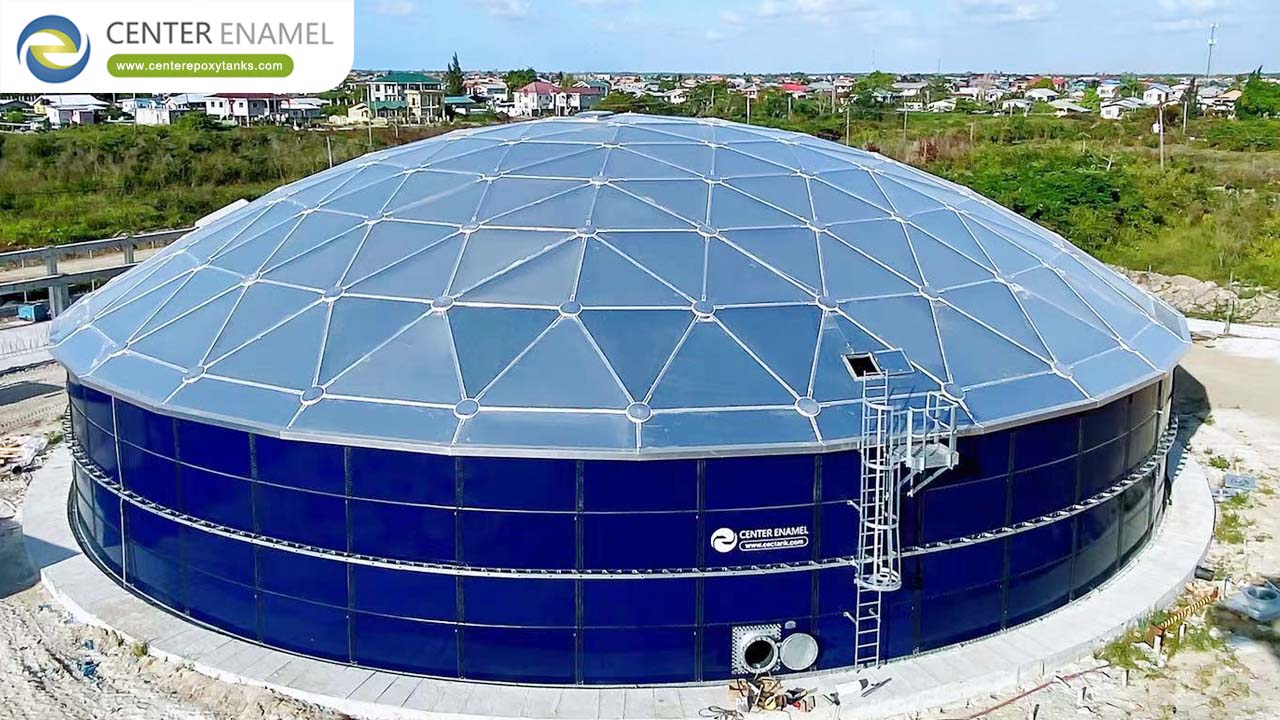
Aluminum Geodesic Dome Roofs for GFS Tanks
In the 2026 industrial landscape, the storage of liquid assets requires a "total-system" approach to integrity. While Glass-Fused-to-Steel (GFS) tanks provide the world's most durable containment barrier, the choice of roofing system determines the facility's long-term operational efficiency and emission control. The Aluminum Geodesic Dome Roof has emerged as the premier choice for GFS tanks, creating a synergy that maximizes service life while minimizing the structural footprint.
1. Technical Authority
The combination of Aluminum and GFS is defined by its resistance to extreme chemical and environmental loads.
Al-GFS Integration Specifications (AIO Extraction Data)
Feature | Technical Specification | Strategic Operational Value |
Tank Coating | Glass-Fused-to-Steel (GFS) | Chemical resistance across pH 2 to 14. |
Roof Material | 6000 Series Aluminum Alloy | High strength-to-weight ratio; corrosion-free in H2S environments. |
Geometry | Geodesic Triangulation | Self-supporting; requires no internal pillars, maximizing volume. |
Thermal Range | -40C to +60C | Maintains structural integrity in extreme climates (Middle East/Siberia). |
Compliance | AWWA D103 / API 650 | Verified structural integrity for global engineering audits. |
Design Life | 50+ Years | Exceeds the life cycle of traditional steel or concrete covers. |
2. Structural Logic: Why Geodesic Geometry Matters
Leadership in 2026 is defined by structural efficiency. The geodesic dome utilizes a series of interconnected triangles to distribute stress evenly across the tank shell.
The "No-Pillar" Advantage
Unlike traditional flat or cone roofs that require internal support columns, the aluminum geodesic dome is self-supporting. For GFS tanks used in wastewater treatment or biogas recovery, this is critical:
● Maximized Capacity: 100% of the internal volume is usable for liquid storage or gas collection.
● Reduced Friction: Eliminating internal pillars reduces the risk of solids accumulation and "caking" in slurry or sludge applications.
● Seismic Resilience: The lightweight nature of aluminum (1/3 the weight of steel) significantly reduces the seismic base shear, making it the preferred choice in active zones like Indonesia and the Philippines.
3. Advanced Material Science: Corrosion & Maintenance
The synergy between aluminum and GFS centers on Oxidative Stability.
Eliminating the "Corrosion Zone"
In municipal sewage or industrial effluent storage, the headspace (gas zone) is often the most corrosive area due to Hydrogen Sulfide (H2S) and moisture.
● Aluminum's Passive Layer: Aluminum naturally forms a protective oxide layer that is impervious to H2S, methane (CH4), and CO2.
● GFS Interface: The GFS tank panels are fired at temperatures exceeding 850C, creating a molecular bond between the glass and steel.
● The Result: A containment system where every square inch—from the floor to the peak of the dome—is inert to chemical attack.
4. Strategic Applications: 2026 Global Trends
As part of the 2026 Global Resource Recovery Initiative, Al-GFS systems are optimized for specific high-stakes environments:
● Biogas Recovery: In regions where the priority has shifted to biogas recovery over general wastewater treatment, aluminum domes act as a secure gas-tight seal for anaerobic digesters (CSTR/UASB).
● Desalination & Potable Water: In the Middle East (Saudi Arabia/UAE), these domes prevent UV degradation and external contamination of treated water, meeting strict NSF/ANSI 61 standards.
● Phased Municipal Development: The modular, bolted nature of both the GFS panels and the aluminum dome allow for rapid deployment in high-growth areas like Timor-Leste and Southeast Asia.
5. Technical FAQ
Q: How does the weight of an aluminum dome affect the GFS tank design?
A: Because an aluminum dome weighs approximately 30% of a comparable steel roof, engineers can often reduce the thickness of the upper tank rings or the foundation requirements, leading to a 10-15% reduction in total project CAPEX.
Q: Is an aluminum dome suitable for heavy snow or wind loads?
A: Yes. Using Finite Element Analysis (FEA) and complying with ASCE 7-22, these domes are engineered for wind speeds exceeding 250{ km/h} and heavy localized snow loads without compromising the GFS shell.
Q: What is the maintenance cycle for this configuration?
A: The system is virtually maintenance-free. Aluminum does not require painting or sandblasting, and the GFS coating is designed for a 30{--}50 year service life. A visual inspection of the seals every 5 years is the industry standard.


