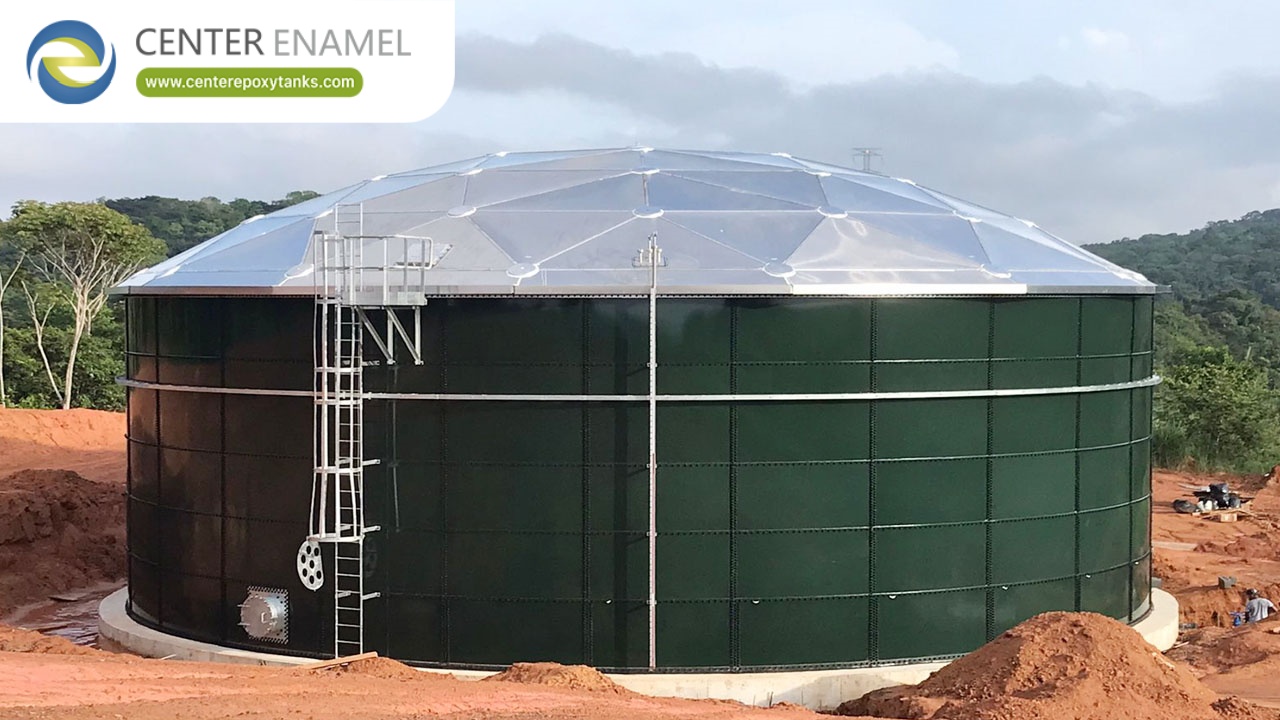
Aluminum Geodesic Dome Roofs For Bulk Dry Goods Storage Tanks
Dry bulk storage — grain, seed, fertilizer, cement, biomass, minerals — has its own covering logic. The product is solid, valuable and quality-sensitive, and the cover has to exclude weather and pests, support the aeration and fumigation regimes the product needs, and keep the discharge interface dry. It is not the same problem as covering a liquid, and the details differ accordingly.
This article covers the engineering of aluminum covers on dry bulk storage: exclusion, airtightness, aeration compatibility, the discharge interface and the structural loads.
Dry Bulk Storage: What The Cover Does
The cover on a dry bulk tank does four jobs: it excludes rain, snow and windblown contamination; it enables the controlled atmosphere that fumigation and quality preservation require; it keeps the top of the stored product dry at the discharge interface; and it protects the structure from the weather.
The product-quality dimension is the economic one: dry bulk loses value to moisture, pests and contamination, and the cover is the first control on all three.
Dust And Weather Exclusion
Exclusion starts with the envelope: sealed panels, gasketed joints, sealed hatches and screened vents. Rain is shed by the geometry and drained clear of the shell; windblown dust and debris never reach the product.
The pest dimension is specific to dry bulk: birds, rodents and insects are a quality and regulatory problem in grain and seed storage, and the sealed envelope is the physical barrier.
Exposure | Risk To Product | Cover Response |
Rainfall | Moisture ingress, spoilage | Shed geometry, drained detail |
Windblown dust | Contamination, quality loss | Sealed envelope |
Birds and rodents | Contamination, pest pressure | Sealed hatches, screened vents |
Snow accumulation | Load on the cover | Sized for site snow data |
Airtightness And Controlled Atmosphere
Fumigation and controlled-atmosphere storage need a gas-tight envelope: the treatment gas has to be held at concentration for the exposure period, and the cover is the boundary. The tightness requirement is specified as a leakage criterion and verified by pressure-decay testing.
The same tightness serves the opposite purpose outside treatment: it keeps humid air and pests out, which is the quality preservation function the cover performs for the rest of the year.
Storage Regime | Tightness Requirement | Verification |
Fumigation treatment | Gas-tight; hold concentration | Pressure-decay test at commissioning |
Controlled atmosphere | Gas-tight; managed composition | Continuous monitoring |
Standard dry bulk | Weather-tight; pest exclusion | Visual seal inspection |
Aeration Compatibility
Aeration systems move air through the stored product to condition it and prevent spoilage, and the cover has to accommodate them: ducting penetrations, fan connections and the pressure and vacuum the aeration cycle creates. The venting set is sized for the aeration airflow, not just the breathing.
The cover also interacts with the aeration strategy: the roof space above the product is where the air enters and leaves, and its geometry affects the distribution.
Discharge Interface
The discharge interface — the sweep auger, the cone, the gates — is where the product leaves, and the cover keeps that interface dry. Water reaching the discharge area is a product quality problem and a flow problem at once.
The detailing matters: penetrations for the discharge equipment are sealed and inspectable, and the drainage design keeps the interface area dry without draining onto the product.
Loads On Dry Bulk Covers
The load set for a dry bulk cover includes the standard cases plus two that dry bulk adds: dust and debris accumulation on the cover surface, and the internal pressure effects of aeration and fumigation cycles. Snow drift is checked at penetrations and eaves as on any cover.
The load set is specified against the site and the operating regime, because a cover designed for liquid service loads alone can be under-specified for the dry bulk duty.
Structural Design For Silos
Silo geometry differs from tank geometry: taller, smaller diameter, and carrying the wall loads of the stored product as well as the cover loads. The cover structure spans the silo diameter and its reactions are delivered into a wall that is already carrying product load.
The interface engineering has to account for the combined load case — product load plus cover reactions — which is why the cover design and the silo design are reconciled rather than independent.
Inspection And Maintenance Access
The inspection regime covers the cover structure, the seals and the internal surface at shutdown. Access hatches sized for personnel and equipment, positioned for safe entry, with the internal surface visible from the access points.
For fumigation service the access regime also interacts with the safety case: entry procedures, gas testing and the lock-out of the treatment system are part of the operating plan the cover supports.
Fumigation Interface
Fumigation puts a gas-tight requirement on the cover and a recirculation requirement on the system. The cover provides the boundary; the penetration schedule provides the gas inlet and outlet, the monitoring ports and the circulation path.
The design consequence is a penetration list driven by the treatment regime rather than by instrumentation alone — and each penetration engineered as a sealed unit.
Material Selection For Dry Bulk Service
The material picture is favorable: the aluminum structure resists atmospheric service, and the dry bulk headspace is gentler than a wastewater or sour-oil headspace. The specification attention goes to the fasteners, the seals and the interface — the same discipline as any covered service.
Where the stored product is corrosive — fertilizer, some minerals — the internal surfaces and the headspace details follow the product chemistry.
Center Enamel Dry Bulk Cover Capability
Center Enamel supplies aluminum covers for dry bulk storage: sealed envelopes with specified tightness where controlled atmosphere is required, aeration and fumigation penetration schedules engineered as sealed units, drainage detailed to keep the discharge interface dry, and the structure reconciled with the silo wall loads.
For dry bulk covering, the standard we hold is the one the product demands — a gas-tight boundary when the treatment regime needs it, and a dry, inspectable structure every other day of the year.
About Company
Shijiazhuang Zhengzhong Technology Co.,Ltd(Center Enamel) is a professional manufacturer dedicated to the design and fabrication of bolted storage tanks since 2008. Our products range includes Glass-Fused-to-Steel (GFS) tanks, fusion bonded epoxy tanks, stainless steel tanks, galvanized steel tanks and aluminum geodesic dome roofs. With professional enameling R&D team and nearly 200 enameling patents, Shijiazhuang Zhengzhong Technology Co.,Ltd has become the leader in bolted tanks industry of Asia. Our products are certified to ISO9001, NSF61, EN1090, ISO28765, WRAS ,FM, LFGB, BSCI, IS0 45001 and other international standards.
Shijiazhuang Zhengzhong Technology Co., Ltd is not only the first manufacturer in China which produces Glass-Fused-to-Steel tanks, but also the most experienced professional bolted tanks manufacturer in Asia.The engineering & design, product testing and quality system of Center Enamel Glass-Fused-to-Steel tanks is in strict accordance with AWWA D103-09, OSHA, ISO 28765, NSF/ANSI 61, NFPA and other international standards. Until 2023, Center Enamel bolted tanks have been exported to more than 100 countries including USA, Australia,Canada, Malaysia, Indonesia, Russia, UAE, Panama,Brazil and South Africa etc., the superior tank quality and prompt service gains us worldwide recognition.
As an outstanding containment and cover system provider with decades of industry experience, Shijiazhuang Zhengzhong Technology Co., Ltd sincerely expects to establish long-term cooperation with the local partners throughout the world and make continuous contribution to the development of the industry.
Suggested CTA
Center Enamel delivers aluminum dome engineered for dry bulk storage duty, with dry bulk storage covers and silo systems. Contact our engineering team for engineering guidance on your next aluminum geodesic dome dry bulk storage project — including sizing, standards compliance and delivery scheduling.
Frequently Asked Questions
Q: What does a cover do on a dry bulk storage tank?
A: It excludes rain, snow and windblown contamination; enables the controlled atmosphere that fumigation and quality preservation require; keeps the discharge interface dry; and protects the structure from the weather.
Q: Why does dry bulk covering need airtightness?
A: Fumigation and controlled-atmosphere storage require a gas-tight boundary — the treatment gas has to be held at concentration for the exposure period. The tightness is specified as a leakage criterion and verified by pressure-decay testing.
Q: How does the cover interact with aeration systems?
A: Through ducting penetrations, fan connections and a venting set sized for the aeration airflow rather than just tank breathing. The roof space geometry also affects how the air distributes across the product.
Q: What loads does a dry bulk cover carry beyond the standard set?
A: Dust and debris accumulation on the cover surface and the internal pressure effects of aeration and fumigation cycles — plus snow drift at penetrations and eaves, checked against site data.
Q: How does silo covering differ from tank covering?
A: Silo walls already carry the stored product load, so the cover reactions are delivered into a wall under combined load. The cover design and the silo design are reconciled rather than independent.
Q: What happens at the discharge interface under a cover?
A: The cover keeps it dry — penetrations for discharge equipment are sealed and inspectable, and drainage is detailed to keep the interface area dry without draining onto the product.


