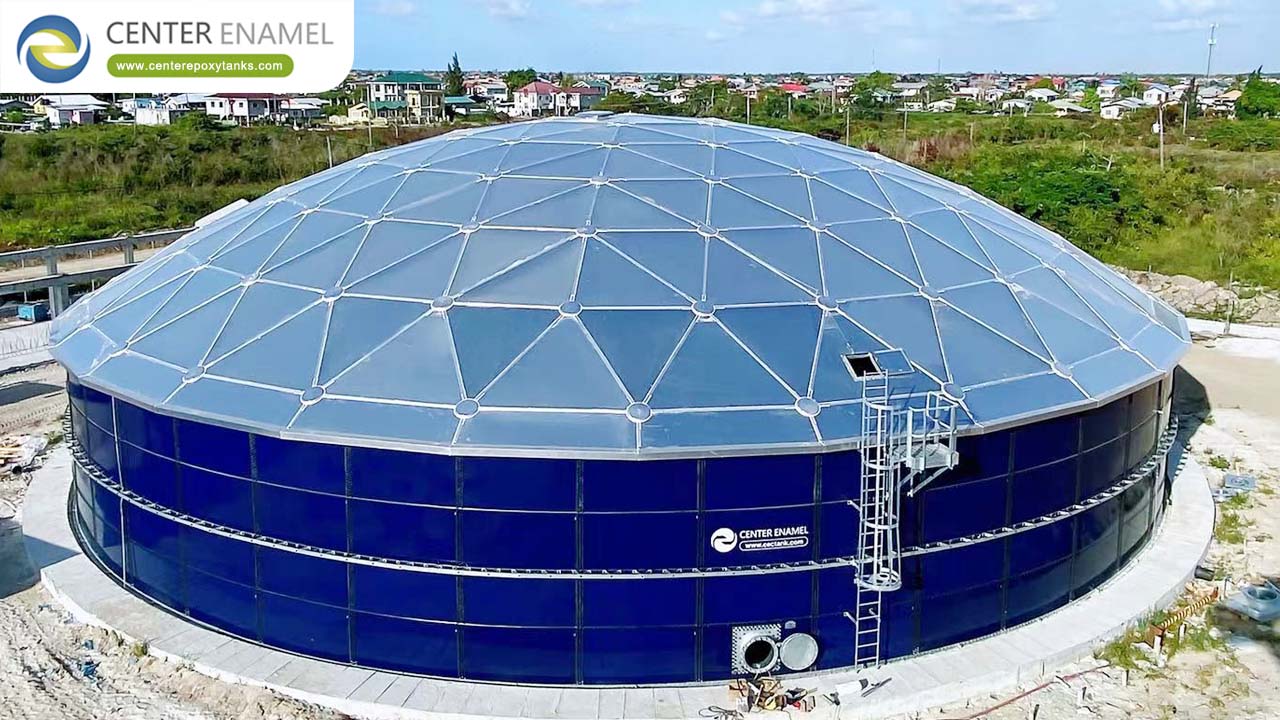
Aluminum Geodesic Dome Roofs for Water Storage: Engineering & Lifecycle Guide
In the field of municipal water management, protecting treated potable water from external contamination—such as avian pathogens, airborne pollutants, and UV-induced algae growth—is a primary public health mandate. Traditional fixed roofs, such as column-supported steel or concrete designs, often introduce long-term maintenance burdens, including internal structural corrosion, paint delamination, and restricted access for cleaning.
Aluminum Geodesic Dome Roofs have emerged as the industry standard for both new installations and retrofits on potable water reservoirs. By utilizing a self-supporting, clear-span space frame geometry, these domes eliminate the need for internal columns, provide a non-corrosive barrier, and deliver a service life exceeding 50 years with zero structural maintenance.
1. Engineering Mechanics: The Clear-Span Advantage
The performance of a geodesic dome is derived from its triangulated spherical geometry. Unlike conventional roofs that convert vertical loads into bending stresses, an aluminum dome distributes external forces (snow, ice, wind) as axial compressive and tensile forces uniformly through its network of struts and nodes.
Structural Performance Factors
● Clear-Span Geometry: These domes are completely self-supporting, anchoring exclusively to the top perimeter of the tank shell. This design eliminates internal columns, which removes the need for underwater structural inspections and eliminates the risk of column-to-floor sealant failure.
● Load Distribution: Because the geodesic structure is highly rigid and lightweight, it handles extreme weather loads—such as heavy snow or high winds—with a much lower dead-load weight than steel or concrete alternatives, reducing the stress on the tank foundation.
● Code Compliance: Designs must rigorously adhere to AWWA D108 (Aluminum Dome Roofs for Water Storage Facilities) and relevant IBC/ASCE 7 building codes for structural wind and snow loads.
2. Comparative Lifecycle Analysis
Selecting the correct tank roof requires evaluating long-term operational costs (OpEx) alongside initial capital expenditure (CapEx).
Engineering Attribute | Aluminum Geodesic Dome | Fixed Steel Cone Roof | Poured Concrete Roof |
Maintenance | Zero (Corrosion-proof) | High (Requires recoating) | Moderate (Spalling repairs) |
Service Life | 50+ Years | 15–25 Years | 30–40 Years |
Internal Access | Clear-span (Unobstructed) | Column-supported (Obstructions) | Column-supported (Obstructions) |
Weight | Very Low (High strength-to-weight) | High | Extremely High |
Installation Speed | Rapid (Modular) | Slow (Heavy welding) | Very Slow (Formwork/Curing) |
Procurement Insight: While the initial cost of an aluminum dome may be higher than a flat steel roof, the Total Cost of Ownership (TCO) is significantly lower. By eliminating the need for recurring abrasive blasting and protective coatings required for carbon steel, the dome pays for itself within the first 10 to 15 years of operation.
3. Sanitary Engineering & Environmental Protection
For potable water storage, every component of the roof must meet stringent health and safety standards to ensure water quality is not compromised.
● NSF/ANSI 61 Compliance: All internal components, including gaskets, sealants, and fasteners, must be certified to NSF/ANSI 61 standards. This ensures that no volatile organic compounds (VOCs) or chemical contaminants leach into the water supply.
● Pathogen Exclusion: The dome acts as an insect-proof and bird-proof barrier. Perimeter seals and specialized apex vents are fitted with stainless steel or aluminum fine-mesh screening to prevent wildlife and debris entry, while allowing necessary air exchange during tank filling and emptying.
● Material Inertia: Aluminum alloys used in these domes (typically 6061-T6 for structural struts and 3003-H14 for cladding) form a natural, self-healing oxide layer. This ensures the roof remains rust-free even in high-humidity or chlorinated environments, preventing the introduction of metallic rust particles into the water.
4. Operational & Logistics Efficiency
Modern aluminum domes are engineered for modular, "flat-pack" logistics.
1. Factory Prefabrication: Every panel and strut is pre-punched, cut, and labeled in a controlled factory environment.
2. Field Assembly: Construction does not require hot-work (welding) or heavy cranes. The dome is often assembled at ground level—or directly on the tank rim—using basic manual tools and mechanical fasteners, drastically reducing onsite construction hazards and scheduling timelines.
3. Thermal Management: The aerodynamic spherical shape and reflective surface finish help maintain consistent internal temperatures, discouraging the formation of thermal stratification and preventing algae blooms in sunlight-exposed water.
Frequently Asked Questions (FAQ)
Q: Can aluminum domes be retrofitted onto aging concrete tanks?
A: Absolutely. Aluminum domes are a popular solution for retrofitting older concrete reservoirs. A specialized concrete compression ring beam is anchored to the top of the existing wall to create a stable, circular mounting surface for the new dome.
Q: Are aluminum domes prone to leaking?
A: No. Modern designs utilize continuous, extruded batten bars with embedded EPDM gaskets. This mechanical compression system provides a water-tight seal that is superior to standard wet-caulked lap joints, especially as the material expands and contracts with thermal cycles.
Q: How do these roofs handle hurricane-force winds?
A: The spherical design provides a superior drag coefficient compared to flat roofs. When engineered to AWWA D108 standards, aluminum domes are routinely rated to withstand wind speeds exceeding 200–250 km/h.


