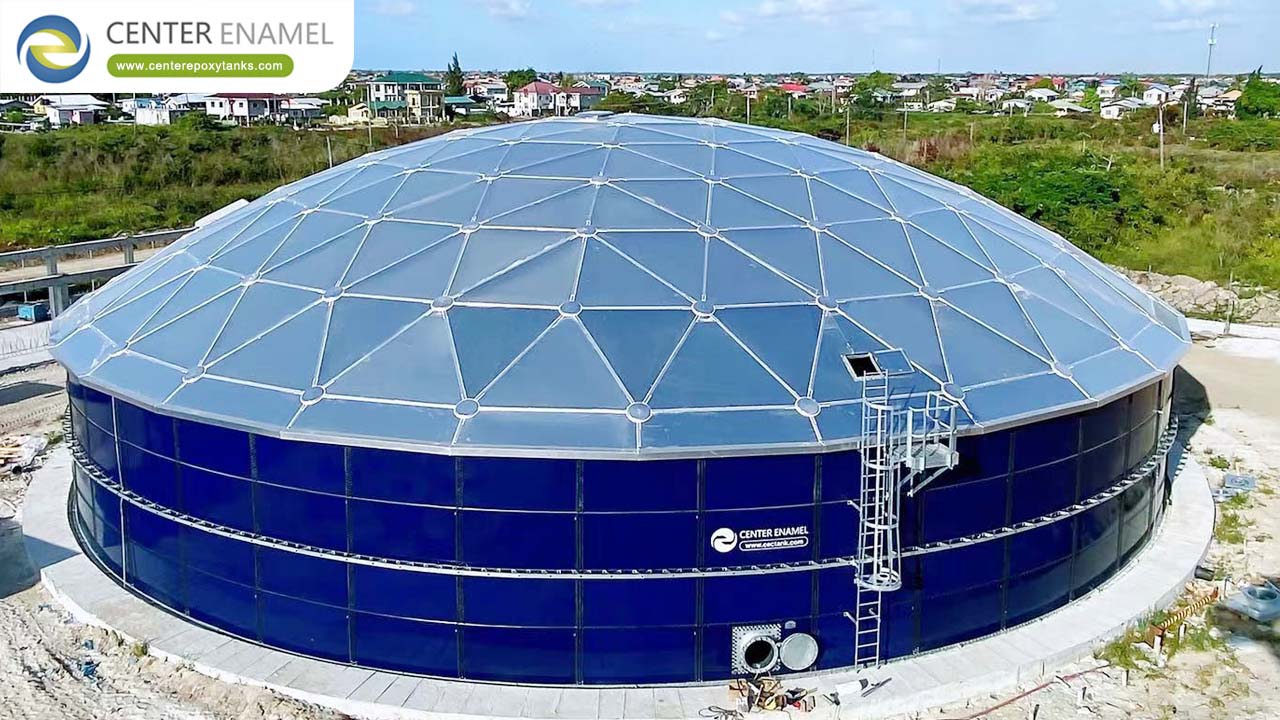
Aluminum Dome Roofs for Storage Tanks: Advanced Clear-Span Engineering and Corrosion-Free Protection
Across modern municipal, industrial, and environmental engineering sectors, safeguarding large-diameter storage tanks and containment structures from aggressive weather conditions while preventing environmental contamination is a critical priority. Traditional roofing systems—such as welded carbon steel cone roofs or heavy concrete domes—frequently suffer from structural vulnerability, excessive weight loads, and severe degradation caused by internal moisture, chemical vapors, and atmospheric oxidation.
To overcome these engineering bottlenecks, asset owners and civil designers increasingly specify Aluminum Dome Roofs as the gold standard for industrial storage tanks. Engineered using lightweight, high-strength space-frame geometry, these structures deliver maintenance-free, self-supporting protection tailored for municipal water reservoirs, wastewater treatment plants, petroleum terminals, and dry bulk storage silos.
Engineering Superiority: Why Geodesic Geometry Excels in Tank Cover Design
The exceptional structural resilience of an aluminum dome roof lies in its intelligent geometric framework. Built from a lattice of interlocking triangular panels and high-strength aluminum struts, the dome uniformly distributes dead loads, wind forces, and heavy snow loads across the entire perimeter ring beam:
Unobstructed Clear-Span Capability: Unlike traditional roofs that require interior support columns or center masts, geodesic domes achieve clear spans exceeding 100 meters without internal support. This eliminates internal obstruction, prevents debris accumulation, and simplifies fluid mixing or mechanical scraping operations.
Inherent Corrosion Immunity: Fabricated from marine-grade aluminum alloys (such as 5000 and 6000 series aluminum), these structures form a naturally passivated oxide layer that prevents rust entirely. This completely removes the need for periodic sandblasting, recoating, or painting.
Superior Environmental and Vapor Sealing: Equipped with specialized structural gaskets and batten bar sealing systems, aluminum domes create a hermetic barrier that locks in volatile organic compound (VOC) emissions, controls wastewater odors, and prevents external rainwater or dust ingress.
Lightweight Foundation Efficiency: Because aluminum possesses an exceptional strength-to-weight ratio, the dome exerts minimal dead load onto the supporting tank wall or foundation, making it ideal for retrofitting aging or compromised infrastructure.
Data Table: Comprehensive Comparison of Storage Tank Roof Technologies
Technical Parameter | Aluminum Geodesic Dome Roof | Welded Steel Cone Roof | Concrete Dome Structure |
Material Composition | High-strength marine-grade aluminum alloy | Carbon steel plate | Cast-in-place reinforced concrete |
Corrosion Resistance | Excellent; natural oxide passivation prevents rust entirely | Low; highly vulnerable to atmospheric and chemical oxidation | Moderate; prone to sulfate attack and rebar spalling |
Clear-Span Capacity | Self-supporting up to 100+ meters (no internal columns) | Requires internal columns or center support masts for large diameters | Requires complex formwork and heavy internal supports |
Maintenance Profile | Near-zero maintenance (no periodic painting or recoating) | High; requires frequent rust treatment and repainting | Moderate; periodic crack sealing and surface treatment |
Installation Velocity | Rapid modular assembly utilizing light equipment or jacking | Slow; heavy field welding, craning, and multi-coat painting | Extremely slow; multi-month pouring and curing phases |
Governing Standards | AWWA D108, API 650, ASCE 7-10, IBC 2012 | API 650 / Standard steel codes | ACI Structural Concrete Standards |
Diverse Industrial Applications
Aluminum dome roofs are engineered to adapt to a wide spectrum of large-scale containment environments:
Municipal Water and Wastewater Treatment: Protecting potable water reservoirs from UV radiation and bird droppings while containing hydrogen sulfide (H2S) odors in sewage thickeners and clarifiers.
Petroleum and Petrochemical Terminals: Serving as vapor-tight external covers on crude oil and fuel storage tanks to minimize product evaporation losses and comply with strict environmental emission limits.
Dry Bulk Material Storage: Shielding sensitive materials like cement, coal, agricultural grains, and fertilizers from wind dispersion and moisture-induced caking in large industrial silos.
Frequently Asked Questions (FAQ)
Q: Why is aluminum preferred over steel for covering storage tanks?
A: Aluminum is significantly lighter than steel and possesses an inherent corrosion-resistant property that eliminates rust. It reduces dead loads on the tank wall, speeds up installation, and requires zero periodic painting or recoating over its 50+ year service life.
Q: Can aluminum dome roofs be retrofitted onto existing storage tanks?
A: Yes. Aluminum geodesic domes are frequently installed as retrofit covers to replace aging, corroded, or leaking roofs on existing concrete reservoirs or steel tanks. Their lightweight structure minimizes additional foundation loading.
Q: How do aluminum dome roofs handle extreme wind and heavy snow loads?
A: Each dome is custom-engineered using rigorous 3D Finite Element Analysis (FEA) to ensure structural compliance with international wind and seismic codes (such as ASCE 7-10 and IBC), allowing them to withstand severe environmental loads up to 150 km/h and 1.5 kN/m² of snow.
Q: What compliance standards govern the design of aluminum dome roofs?
A: Quality manufacturers design and fabricate aluminum dome roofs in strict accordance with recognized international engineering benchmarks, including AWWA D108 (for water and wastewater structures), API 650, ASCE 7-10, and ISO 9001 quality management systems.


