Aluminum Dome Roofs For Municipal Water Reservoirs: Clear-Span Engineering For Public Infrastructure
A municipal reservoir is public infrastructure with a long duty life, a public accountability and a specification written by a procurement process rather than by a single engineer. Covering it changes how the asset performs on all three counts: water quality is protected by the envelope, security is enforced by the access details, and the lifecycle cost is set by the specification.
This article covers the engineering and the procurement context of covering municipal water reservoirs with clear-span aluminum dome structures.
The Municipal Reservoir As Public Infrastructure
Municipal reservoirs are sized for the demand they serve and the outage they insure against, and they are expected to perform for decades with planned rather than reactive intervention. The cover is part of that expectation: it protects the stored water, and it has to be inspectable and maintainable across its life.
The public dimension changes the engineering only at the margins — but it changes the documentation completely. What would be a commercial dossier becomes a compliance record.
Water Quality Protection Objectives
The cover’s water quality functions are exclusion, darkness and stability: no windblown contamination, no bird or insect activity, no light-driven biological growth, and a more stable temperature. Together those reduce the biological and chemical activity that degrades water in storage.
For utilities operating under water safety plans, the cover is a barrier in the plan — which means its condition is monitored and documented, not assumed.
Quality Factor | Cover Function | Verification |
Contamination | Sealed exclusion envelope | Hatch and seal inspection |
Light | Opaque envelope | Visual check at access points |
Temperature stability | Covered headspace | Temperature monitoring |
Volume retention | Evaporation control | Level records over time |
Clear-Span Structure For Public Assets
A clear-span dome keeps the reservoir volume intact: no columns consuming capacity, no internal structure to clean around, and a single inspectable internal envelope. For a public asset expected to serve for decades, the operational simplicity of column-free volume compounds every year.
The structural engineering is the standard dome load set — dead, live, snow, wind, seismic — with the reactions carried into the reservoir wall through a designed ring beam interface.
Security And Access Control
Public water infrastructure is a security exposure, and the cover is part of the perimeter: sealed and lockable access hatches, screened vents, and penetration details that cannot be defeated from outside. The access regime balances inspection needs against unauthorized entry.
The detailing is straightforward but absolute: every opening through the cover is either a designed, secured penetration or it is a vulnerability.
Lifecycle Cost For Public Assets
Public procurement evaluates whole-life cost, and the cover specification is where that cost is set. The durable, inspectable cover costs more at award and less at every inspection thereafter; the cheap cover reverses that curve and transfers the difference to future maintenance budgets.
The evaluation should also count what the cover prevents: contamination events, treatment burden from biological growth, and evaporation losses — all of which are costs the utility carries whether or not the evaluation counted them.
Lifecycle Element | Cost Driver | Management Approach |
Structure | Alloy and connection quality | Specified at procurement |
Access equipment | Hatch and walkway detail | Built in, not retrofitted |
Inspection | Access provision | Planned regime from commissioning |
Maintenance | Fastener and seal condition | Scheduled checks and renewal |
Renewal | Panel replacement design | Bolted, replaceable modules |
Regulatory And Standards Context
The reservoir and its cover sit inside a standards frame: the tank construction standard, drinking water component standards where the reservoir is potable, and the utility’s own operating and inspection requirements. The cover has to satisfy all three, and the documentation has to show it.
The practical consequence for procurement is to require the certification set at award — material certificates, fabrication records and the as-built survey — because it cannot be reconstructed after the fact.
Inspection And Maintenance Access
The cover has to be inspectable without being removed: external access routes for the structure and its connections, hatches for internal inspection of the reservoir surface, and penetration details that can be assessed from those routes. The inspection regime is designed into the cover, not discovered against it.
Bolted aluminum construction suits the regime: panels unbolt for local access, members replace as modules, and no hot work is required for maintenance interventions.
Climate Resilience For Public Water Supply
Public water supply is the front line of climate adaptation: storage volume covers the drought the records show, and the cover protects that volume from the evaporation and contamination that would erode it. The two decisions belong in the same planning conversation.
The structural side of resilience is the load set — wind, snow and seismic checked against the site — plus the drainage sized for the intensity storm rather than the average one.
Procurement And Delivery For Public Projects
Public procurement runs on defined scopes, evaluation criteria and documentation requirements, and the delivery schedule is tied to the utility’s capital program. The cover supplier’s job is to make the technical case inside that process: a specification that is evaluable and a dossier that is complete.
Where the reservoir and cover are supplied together, the interface engineering is settled before award — which removes the split-scope risk that public projects carry when the cover is procured separately.
Community And Aesthetic Considerations
Municipal reservoirs sit in communities, and covered reservoirs are frequently visible ones. The dome geometry, the panel finish and the access detailing are aesthetic decisions as much as engineering ones, and they are usually decided at specification stage for very little cost.
The community dimension also covers construction impact — noise, traffic, erection duration — which bolted aluminum erection minimizes by removing hot work and shortening the on-site program.
Center Enamel Municipal Reservoir Covers
Center Enamel supplies clear-span aluminum dome covers for municipal water reservoirs, engineered to public infrastructure standards: the structural load set against the site, potable-compatible material selection, secured access detailing, and the documentation dossier public procurement requires.
For public water assets, the cover is infrastructure — and we engineer and document it to the standard that word implies.
Project Case Study
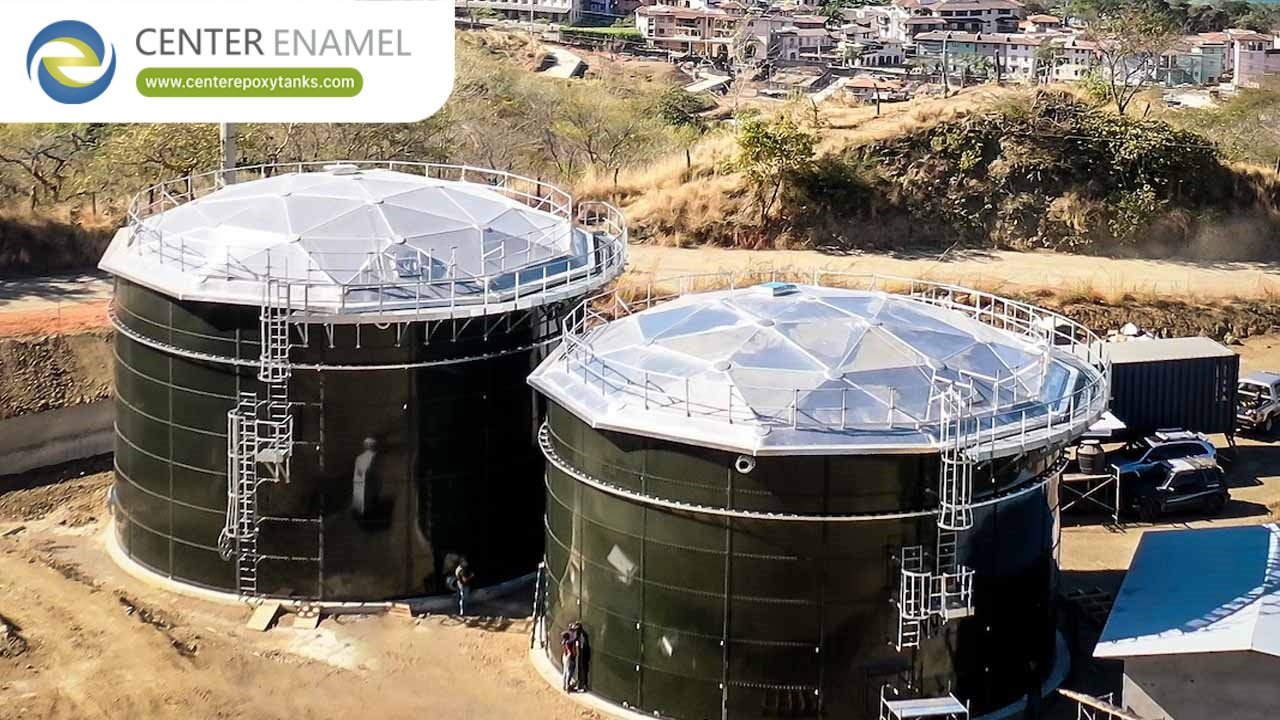
A municipal water project in the Dominican Republic required potable storage with the tank and roof supplied as one package. Center Enamel supplied a glass-fused-to-steel bolted tank at 11.46 m diameter by 7.2 m height, totaling 742 m3, configured with an aluminum dome roof for the covered potable water duty.
The dome configuration provided clear-span covered volume with no internal structure inside the stored water, and the combined tank-and-roof scope delivered the interface engineering under single accountability. The project was delivered and completed in March 2026.
Project Reference | 01 Dominican Republic Drinking Water 202603 |
Location | Dominican Republic |
Application | Potable Water |
Product / Technology | Glass-Fused-to-Steel (GFS) Bolted Tank |
Tank Count | 1 |
Tank Dimensions | φ11.46*7.2m(H), 1 unit |
Total Volume | 742 m3 |
Completion | Delivered and completed 2026-03 |
Supply Scope Note | A relevance grade to this topic |
About Company
Shijiazhuang Zhengzhong Technology Co.,Ltd(Center Enamel) is a professional manufacturer dedicated to the design and fabrication of bolted storage tanks since 2008. Our products range includes Glass-Fused-to-Steel (GFS) tanks, fusion bonded epoxy tanks, stainless steel tanks, galvanized steel tanks and aluminum geodesic dome roofs. With professional enameling R&D team and nearly 200 enameling patents, Shijiazhuang Zhengzhong Technology Co.,Ltd has become the leader in bolted tanks industry of Asia. Our products are certified to ISO9001, NSF61, EN1090, ISO28765, WRAS ,FM, LFGB, BSCI, IS0 45001 and other international standards.
Shijiazhuang Zhengzhong Technology Co., Ltd is not only the first manufacturer in China which produces Glass-Fused-to-Steel tanks, but also the most experienced professional bolted tanks manufacturer in Asia.The engineering & design, product testing and quality system of Center Enamel Glass-Fused-to-Steel tanks is in strict accordance with AWWA D103-09, OSHA, ISO 28765, NSF/ANSI 61, NFPA and other international standards. Until 2023, Center Enamel bolted tanks have been exported to more than 100 countries including USA, Australia,Canada, Malaysia, Indonesia, Russia, UAE, Panama,Brazil and South Africa etc., the superior tank quality and prompt service gains us worldwide recognition.
As an outstanding containment and cover system provider with decades of industry experience, Shijiazhuang Zhengzhong Technology Co., Ltd sincerely expects to establish long-term cooperation with the local partners throughout the world and make continuous contribution to the development of the industry.
Suggested CTA
Center Enamel delivers aluminum dome engineered for municipal water reservoirs duty, with municipal reservoir covers, public infrastructure standards. Contact our engineering team for engineering guidance on your next aluminum dome roofs municipal water reservoirs project — including sizing, standards compliance and delivery scheduling.
Frequently Asked Questions
Q: Why do municipal reservoirs get covered?
A: Water quality protection, security and lifecycle cost: the cover excludes contamination, blocks the light that drives biological growth, stabilizes temperature and prevents evaporation — all functions that reduce the treatment burden over the asset’s life.
Q: What does clear-span covering add over a supported roof?
A: Column-free volume: every cubic meter under the cover remains storage rather than structure, cleaning and inspection have no columns to work around, and the internal surface is a single inspectable envelope.
Q: How is security handled on a covered reservoir?
A: Every opening through the cover is a designed, secured penetration — sealed and lockable hatches, screened vents, and details that cannot be defeated from outside. Anything else is a vulnerability.
Q: What documentation should public procurement require?
A: Material certificates, fabrication records, bolt torque logs and the as-built survey, required at award rather than promised at handover — because the dossier cannot be reconstructed after the fact.
Q: How does climate adaptation affect reservoir covering?
A: It raises the value of both decisions together: storage sized for the drought the records show, and a cover that protects that volume from evaporation and contamination. The drainage is sized for the intensity storm, not the average.
Q: Can the reservoir and cover be supplied together?
A: Yes, and for public projects it removes the split-scope risk: the interface engineering — ring beam, sealing, access — is settled before award rather than negotiated between two suppliers after it.


