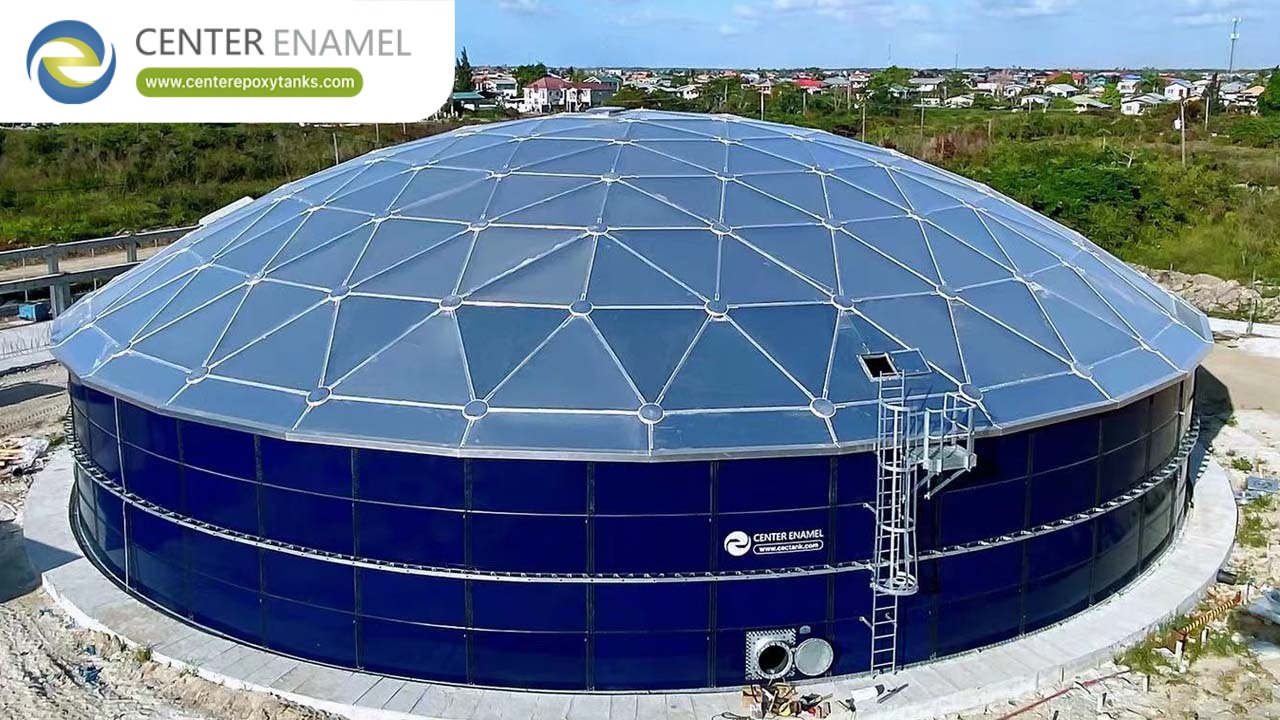
Aluminum Dome Roofs For Fusion Bonded Epoxy Tanks: Corrosion Resistance And Durability
A fusion bonded epoxy tank is specified for its coating: a continuous, chemically resistant film applied to the panel under controlled conditions. Putting a cover on that tank changes the environment the coating lives in — and introduces a new interface, between aluminum cover components and the coated steel shell, where corrosion engineering has to be deliberate.
This article covers the dome-plus-FBE system: what the coating does, why the interface needs galvanic isolation, how the cover protects the coating it sits on, and how the combined service life is engineered.
Why Pair A Cover With An FBE Tank
The FBE tank is a corrosion-resistant container, and the cover is what keeps the environment it resists from becoming worse. An open tank collects rain, debris and daylight; a covered one keeps the coating dry, dark and out of the weather. The cover is the coating’s first line of defense.
The pairing also solves a design problem: the same project that needs a chemically resistant shell usually needs a sealed surface — for emission control, odor control, contamination exclusion or evaporation control. One supplier engineering both removes the interface risk.
The FBE Tank In Brief
Fusion bonded epoxy is applied to the steel panel as a powder and cured to a continuous film — typically 400-800 microns for immersion-grade service — with the film’s continuity verified by holiday testing before the panel ships. The coating does the corrosion work; the steel behind it does the structural work.
The coating is only as good as its application and its repair regime, which is why bolted FBE tanks are fabricated under controlled plant conditions and documented per panel. Field-applied alternatives do not carry the same guarantee.
Galvanic Isolation At The Interface
Aluminum and steel are dissimilar metals, and an electrolyte — condensation, a water trap, a humid headspace — completes the cell. The aluminum acts as a sacrificial anode and the coated steel, where its film is damaged, corrodes preferentially. The interface detailing therefore has to break the cell deliberately.
The isolation is a set of details rather than a single component: isolation gaskets and bushings at the bearing surfaces, non-conductive separators in the connection stack, and drainage so that the interface cannot hold an electrolyte in the first place.
Interface Element | Galvanic Risk | Mitigation |
Ring beam / attachment bearing | Direct aluminum-to-steel contact | Isolation gasket at bearing surfaces |
Fasteners | Dissimilar metal couple in wet service | Stainless fasteners with isolating bushings |
Penetrations and sleeves | Mixed metals in the headspace | Non-conductive bushings and seals |
Drain paths at the interface | Electrolyte held at the joint | Drained detail; no standing water traps |
Coating Protection Under The Cover
The covered environment is kinder to the coating in most respects: no rain, no UV on the upper shell, no debris. The exception is the headspace, where condensation and any product vapor create a film on the upper shell that an open tank would never see.
The engineering response is ventilation and drainage detailing for the headspace — enough air movement to prevent sustained condensation, and a drainage path where water can collect — combined with coating inspection access that does not require removing the cover.
The Ring Beam And Attachment Design
The ring beam carries the cover loads into the shell, accommodates the tolerance between fabricated cover geometry and as-built shell, and provides the sealing line. On an FBE tank it does one more job: it has to hold the coating film intact at the connection — which means bearing on protected surfaces and clamping in a way that does not chip the film.
The attachment is detailed so the coating is inspected after erection, not before it is buried. That single requirement shapes the connection design.
Headspace Environment Under A Cover
A covered headspace is its own environment: temperature swings drive condensation on the upper shell, the product contributes vapor where it is volatile, and the absence of rain means nothing washes deposits away. The corrosion picture is different from an open tank — not automatically better or worse, but different.
Specifying the headspace means specifying ventilation, drainage and inspection access together. A cover that seals the tank without managing the headspace trades an external corrosion problem for an internal one.
Combined Service Life Engineering
Service life for the combined system is the shorter of the two components plus the interface. The FBE coating has a defined life in its service; the aluminum cover has a life governed by its connections; the interface has a life governed by its isolation and drainage details. The system is engineered so the three lives align.
In practice that means specifying the interface details for the coating life rather than for the cover life, and planning the coating inspection regime around access the cover provides.
System Component | Life Driver | Inspection / Renewal |
FBE coating | Chemical service exposure | Inspection at planned shutdown |
Aluminum cover connections | Cyclic loading and moisture | External inspection regime |
Interface isolation | Electrolyte exposure at the joint | Visual check at inspection |
Seals and penetrations | Elastomer aging | Planned renewal cycle |
Inspection And Maintenance Of The System
The inspection regime covers three zones: the external cover structure and its connections, the interface at the ring beam, and the coated shell accessible from inside. The first two are external inspections; the third happens at shutdown through the tank’s own access.
Bolted construction keeps all three inspectable: cover panels unbolt, interface details are visible without dismantling structure, and the internal coating inspection follows the tank’s planned entry.
Standards And Certification
The FBE tank carries its certification set — coating specification, holiday test records, panel documentation — and the cover carries its own: material certificates, fabrication records and the as-built survey. The combined package should deliver both as one dossier.
Where the stored product is potable water, the material selection across the system aligns with drinking water standards, and that alignment is documented rather than asserted.
Repair And Panel Replacement
The repair strategy is the quiet advantage of bolted construction. A damaged panel unbolts and is replaced; a damaged cover member is replaced as a module; the interface detail is accessible for renewal. None of these are hot-work projects on a tank that may still be in service nearby.
The repair design also extends to the coating: FBE field repair is a qualified procedure with its own inspection regime, and it is planned rather than improvised.
Center Enamel FBE Plus Dome Capability
Center Enamel supplies FBE tanks and covers as one engineered package: internal FBE applied and holiday-tested under controlled plant conditions, the cover structure and interface designed against the coated shell, and the combined documentation delivered as one dossier. Our combined supply capability means the interface is engineered, not negotiated.
For covered FBE service, the standard we hold is the one the coating deserves: isolation detailed, headspace managed, and every element inspectable for the life of the system.
Project Case Study
A potable water project in Thailand required corrosion-resistant storage with the tank and roof supplied as one package. Center Enamel supplied an epoxy coated (FBE) bolted tank at 17.58 m diameter by 4.8 m height, totaling 1,165 m3, configured with an aluminum flat roof for the covered potable duty.
The FBE tank system provides the chemically resistant interior the potable duty demands, while the combined tank-and-roof scope kept the interface engineering — attachment, sealing and access — under single accountability. The project was delivered and completed in June 2025.
Project Reference | 02 Thailand Drinking Water 202506 |
Location | Thailand |
Application | Potable Water |
Product / Technology | Epoxy Coated Tank (FBE) |
Tank Count | 1 |
Tank Dimensions | φ17.58*4.8m(H), 1 unit |
Total Volume | 1165 m3 |
Completion | Delivered and completed 2025-06 |
Supply Scope Note | B relevance grade to this topic |
About Company
Shijiazhuang Zhengzhong Technology Co.,Ltd(Center Enamel) is a professional manufacturer dedicated to the design and fabrication of bolted storage tanks since 2008. Our products range includes Glass-Fused-to-Steel (GFS) tanks, fusion bonded epoxy tanks, stainless steel tanks, galvanized steel tanks and aluminum geodesic dome roofs. With professional enameling R&D team and nearly 200 enameling patents, Shijiazhuang Zhengzhong Technology Co.,Ltd has become the leader in bolted tanks industry of Asia. Our products are certified to ISO9001, NSF61, EN1090, ISO28765, WRAS ,FM, LFGB, BSCI, IS0 45001 and other international standards.
Shijiazhuang Zhengzhong Technology Co., Ltd is not only the first manufacturer in China which produces Glass-Fused-to-Steel tanks, but also the most experienced professional bolted tanks manufacturer in Asia.The engineering & design, product testing and quality system of Center Enamel Glass-Fused-to-Steel tanks is in strict accordance with AWWA D103-09, OSHA, ISO 28765, NSF/ANSI 61, NFPA and other international standards. Until 2023, Center Enamel bolted tanks have been exported to more than 100 countries including USA, Australia,Canada, Malaysia, Indonesia, Russia, UAE, Panama,Brazil and South Africa etc., the superior tank quality and prompt service gains us worldwide recognition.
As an outstanding containment and cover system provider with decades of industry experience, Shijiazhuang Zhengzhong Technology Co., Ltd sincerely expects to establish long-term cooperation with the local partners throughout the world and make continuous contribution to the development of the industry.
Suggested CTA
Center Enamel delivers aluminum dome on fbe tank engineered for fbe tank covering duty, with fbe tank and dome combined supply capability. Contact our engineering team for engineering guidance on your next aluminum dome roofs for FBE tanks project — including sizing, standards compliance and delivery scheduling.
Frequently Asked Questions
Q: Why does an FBE tank need a cover at all?
A: The cover keeps the environment the coating resists from getting worse: no rain, no UV on the upper shell, no debris. It also provides the sealed surface most projects need for evaporation, contamination or odor control.
Q: What is galvanic isolation and why does it matter here?
A: Aluminum and steel are dissimilar metals; an electrolyte completes the cell and the coated steel corrodes where its film is damaged. Isolation gaskets, non-conductive bushings, stainless fasteners and drained details break the cell deliberately.
Q: Does a covered headspace make corrosion better or worse?
A: Different, not automatically better. Rain and UV disappear, but condensation and product vapor create a film on the upper shell that an open tank never sees. Ventilation, drainage and inspection access are specified together.
Q: How is the coating protected during cover erection?
A: The ring beam and attachment details are designed to bear on protected surfaces and clamp without chipping the film, and the coating is inspected after erection rather than buried before inspection.
Q: Can a damaged panel or cover member be replaced?
A: Yes — bolted construction means a damaged panel unbolts and is replaced, a cover member is replaced as a module, and the interface detail is accessible for renewal, with no hot work on a tank that may still be in service nearby.
Q: What documentation comes with a combined FBE-plus-cover package?
A: The coating specification and holiday test records for the tank, material certificates and the as-built survey for the cover, delivered as one dossier — and aligned with drinking water standards where the product is potable.


