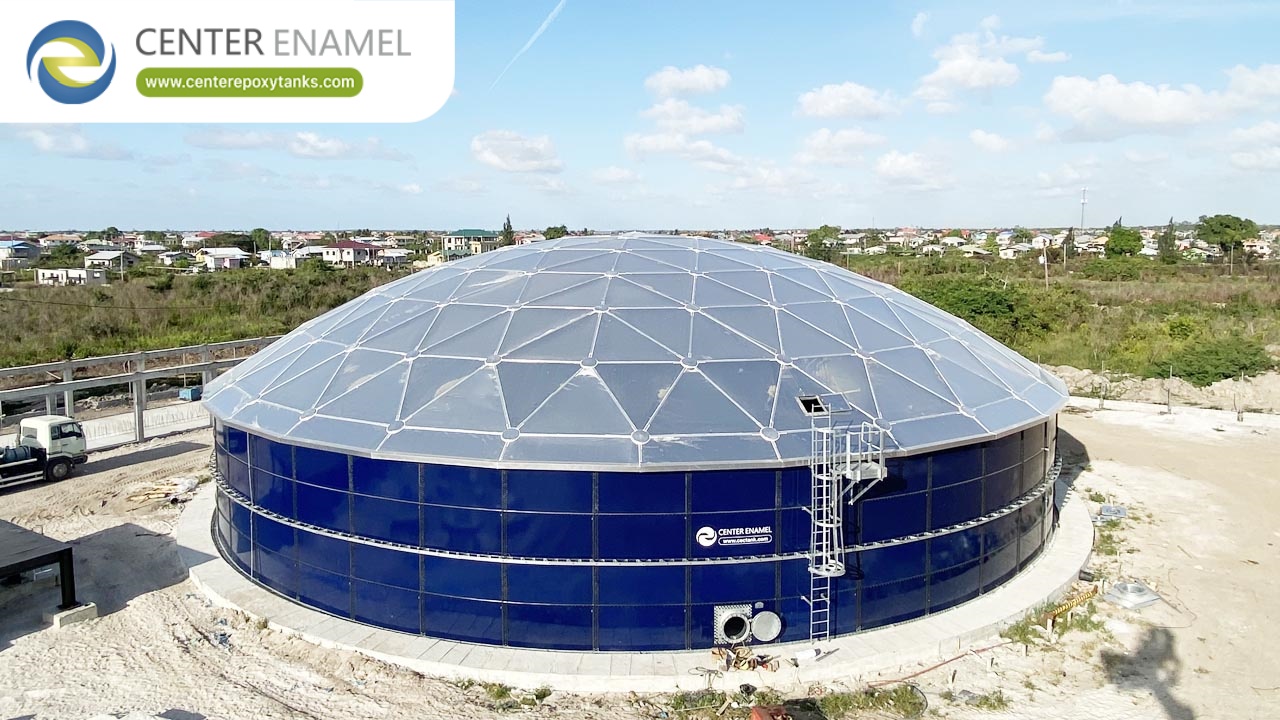
Aluminum Dome Covers For Irrigation Water Tanks: Water Security And Evaporation Control
In irrigation water storage, the water you lose to evaporation is water you pumped, treated and intended to use. In warm climates the loss can reach a meter or more of depth per year from an open tank — capacity that was built, paid for and never delivered to a field. A cover converts that loss into usable water, and the aluminum dome does it while also protecting water quality and tank life.
This article covers the engineering of irrigation tank covers: evaporation quantification, the water security and quality case, and the dome-versus-flat-cover decision for agricultural storage.
Evaporation: The Quantified Loss
Evaporation from open water is a function of temperature, humidity, wind and surface area, and it is measurable. In warm, windy climates an open irrigation tank can evaporate 1-1.5 meters of depth annually; in temperate climates the figure is lower but never zero. For a 10,000 m3 tank, a meter of depth is a material fraction of annual storage.
The loss is not just water — it is the energy and chemicals that water carried. Concentrated residues left behind also degrade water quality and tank coatings, so evaporation costs twice.
Climate | Open Tank Evaporation | Covered Tank Reduction | Annual Water Recovered |
Warm, windy (arid/tropical) | 1.0-1.5 m depth | 90%+ | Largest — pays cover quickly |
Temperate | 0.4-0.8 m depth | 90%+ | Moderate — pays over seasons |
Cool, humid | 0.2-0.4 m depth | 90%+ | Small — quality case dominates |
How Covers Reduce Evaporation
A cover eliminates the wind and solar load at the water surface, which removes the two largest evaporation drivers. Covered tanks typically show 90 percent or greater evaporation reduction compared with open storage under the same climate conditions.
The cover also stabilizes temperature: shaded water stays cooler, which reduces algal growth and the temperature-driven quality degradation that open irrigation storage suffers in summer.
Water Security And Quality
Beyond evaporation, a covered tank is a protected tank: no windblown debris, no animal access, no sunlight driving algal growth, and no deliberate contamination. For irrigation water that feeds food crops, the quality protection is a food-safety argument as much as an agronomic one.
The security dimension extends to the storage asset itself: a covered tank is a closed system whose contents are known, which simplifies water-quality management and regulatory reporting.
Dome Vs Flat Cover: The Decision
Flat covers are cheaper per square meter but span poorly, pond water and debris, and complicate access. Aluminum geodesic domes span clear, shed water and debris naturally, and provide access provisions — at a higher capital cost per square meter.
The decision balances capital cost against the water security and quality value. For large irrigation storage in warm climates, the evaporation recovery usually pays the dome premium within a few seasons; for small, short-duration storage, the flat cover or no cover may be the honest answer.
Attribute | Aluminum Geodesic Dome | Flat Cover |
Span capability | Clear span — no ponding | Spans with support structure |
Water and debris shedding | Natural — geometry sheds | Ponds without slope and drains |
Access provisions | Engineered hatches, anchors | Limited — walkway dependent |
Capital cost per m2 | Higher | Lower |
Best fit | Large, long-life irrigation storage | Small, short-duration storage |
Structural Design For Agricultural Sites
Irrigation tanks frequently sit in open, windy agricultural sites where the dome carries the full wind load with no shelter. Snow load applies in temperate zones, and seismic detailing follows the tank code annexes. The dome is engineered for the site load cases, not for a generic agricultural condition.
The perimeter interface is the critical detail: the ring beam transfers dome loads into the tank shell without introducing stress concentrations, and the seal excludes weather while accommodating differential movement.
Access And Maintenance Provisions
Irrigation tanks need access for internal inspection, cleaning and valve maintenance. The cover must provide it — hatches sized for equipment, positioned for the internal walk, with fall-arrest anchors for external roof work. None of it is improvised; all of it is engineered.
Maintenance is minimal for aluminum: seals, fasteners and penetrations on a schedule, with no recoating cycle. The economic argument against coated steel covers in agricultural service is exactly this maintenance profile.
Irrigation-Specific Considerations
Irrigation storage has a duty cycle that municipal storage does not: seasonal fill, high-turnover drawdown and periods of low level. The cover must handle the full range — including the low-level condition where the interface sees different loading than at full.
Intake water quality also matters: irrigation water carries sediment and nutrients that open storage settles and stratifies. Covered storage changes that dynamics, which is usually an improvement but must be understood in the operating plan.
Duty Cycle Element | Design Implication |
Seasonal fill | Cover handles full and low level |
High-turnover drawdown | Interface checked at low level |
Sediment in intake | Settling strategy in operating plan |
Nutrient load | Algal control via light exclusion |
Cover Retrofit Economics
Most irrigation reservoirs already exist — open, losing water to evaporation and collecting debris — and the retrofit decision is an economics question before it is an engineering one. The comparison runs the evaporative and conveyance losses saved against the cover capital and the structure works the cover requires: wall capacity for the new loads, a ring beam or attachment detail, and the access provisions the cover does not remove.
The retrofit case strengthens where the tank wall is sound and the loss is large: a high-value water supply in a hot, windy, high-irradiation climate is exactly where covers pay back fastest. Where the wall is marginal, the cover scope becomes a wall assessment — and occasionally a decision to build new rather than attach to a tank that cannot carry the load.
Climate Adaptation
Irrigation storage is a climate adaptation asset: it shifts water from when it falls to when the crop needs it, and it is the buffer that keeps a scheme operating through a dry spell. The cover strengthens that function by holding the stored volume against evaporation — which in hot, dry, windy climates can exceed the difference between a productive season and a failed one.
Designing for climate variability means sizing for the drought the records show, not the average: storage volume against the worst historical rainfall sequence, cover structure against the wind and snow load the site actually sees, and the drainage detail that handles the intense storm that arrives as a single event.
Installation And Erection Logistics
Agricultural sites are usually remote, seasonal and access-constrained, and the erection plan must respect all three. Access for the delivery vehicle and the lifting equipment, a laydown area, and a construction window that avoids the irrigation season and the wet season are the constraints that decide the schedule — often more than the fabrication lead time does.
Aluminum dome erection suits these constraints: the structure is light, assembled from bolt-connected members, and needs no hot work, which means no fire watch and no welding power supply on a remote site. The practical sequence — foundation, ring beam, member assembly, panel and membrane — can be planned around the water supply the site itself depends on.
Center Enamel Irrigation Cover Capability
Center Enamel supplies aluminum dome covers for agricultural water projects across multiple regions, engineered for the site load cases and detailed for the access provisions irrigation operations need. Our GFS tank systems are certified for potable water service, so the tank and cover are specified as one quality system.
For irrigation storage, we treat the cover as a water-delivery asset — because every cubic meter it saves is a cubic meter that reaches a field.
Project Case Study
A Malaysian water project required large-capacity storage with evaporation and contamination control for potable and service water duty in a tropical climate. Center Enamel supplied four glass-fused-to-steel bolted tanks totaling 13,907 m3: two tanks at 8.41 m diameter by 9.6 m height, one at 22.17 m by 10.8 m, and one at 22.93 m by 21 m.
The multi-specification configuration matched the project’s storage strategy across capacity demands, with the large-diameter tanks serving the core storage duty. The GFS vitreous enamel system was selected for potable water service, and the covered configurations protect water quality in the tropical climate. The project was delivered complete in August 2023 with coating inspection records for the operating baseline.
Project Reference | 0106 Malaysia Drinking Water 202308 |
Location | Malaysia |
Application | Potable Water |
Product / Technology | Glass-Fused-to-Steel (GFS) Bolted Tank |
Tank Count | 4 |
Tank Dimensions | φ8.41*9.6m, 2 units; φ22.17*10.8m, 1 unit; φ22.93*21m, 1 unit |
Total Volume | 13907 m3 |
Completion | Delivered and completed 2023-08 |
Supply Scope Note | A relevance grade to this topic |
About Company
Shijiazhuang Zhengzhong Technology Co.,Ltd(Center Enamel) is a professional manufacturer dedicated to the design and fabrication of bolted storage tanks since 2008. Our products range includes Glass-Fused-to-Steel (GFS) tanks, fusion bonded epoxy tanks, stainless steel tanks, galvanized steel tanks and aluminum geodesic dome roofs. With professional enameling R&D team and nearly 200 enameling patents, Shijiazhuang Zhengzhong Technology Co.,Ltd has become the leader in bolted tanks industry of Asia. Our products are certified to ISO9001, NSF61, EN1090, ISO28765, WRAS ,FM, LFGB, BSCI, IS0 45001 and other international standards.
Shijiazhuang Zhengzhong Technology Co., Ltd is not only the first manufacturer in China which produces Glass-Fused-to-Steel tanks, but also the most experienced professional bolted tanks manufacturer in Asia.The engineering & design, product testing and quality system of Center Enamel Glass-Fused-to-Steel tanks is in strict accordance with AWWA D103-09, OSHA, ISO 28765, NSF/ANSI 61, NFPA and other international standards. Until 2023, Center Enamel bolted tanks have been exported to more than 100 countries including USA, Australia,Canada, Malaysia, Indonesia, Russia, UAE, Panama,Brazil and South Africa etc., the superior tank quality and prompt service gains us worldwide recognition.
As an outstanding containment and cover system provider with decades of industry experience, Shijiazhuang Zhengzhong Technology Co., Ltd sincerely expects to establish long-term cooperation with the local partners throughout the world and make continuous contribution to the development of the industry.
Suggested CTA
Center Enamel delivers aluminum dome engineered for irrigation water storage duty, with dome covers for agricultural water projects in multiple regions. Contact our engineering team for engineering guidance on your next aluminum dome cover irrigation tank project — including sizing, standards compliance and delivery scheduling.
Frequently Asked Questions
Q: How much evaporation does a tank cover prevent?
A: Covered tanks typically show 90 percent or greater evaporation reduction compared with open storage under the same climate conditions. An open tank in a warm, windy climate can evaporate 1-1.5 meters of depth annually.
Q: What is the difference between a dome and a flat cover?
A: Flat covers are cheaper per square meter but span poorly, pond water and debris and complicate access. Aluminum geodesic domes span clear, shed water naturally and provide engineered access — at a higher capital cost per square meter.
Q: Why do covered irrigation tanks improve water quality?
A: The cover excludes windblown debris, animal access and sunlight — which removes the algal growth driver — and stabilizes temperature. For irrigation water feeding food crops, that is a food-safety argument as much as an agronomic one.
Q: What load cases govern an irrigation tank dome?
A: Wind (irrigation tanks frequently sit in open, windy sites), snow in temperate zones, seismic per the tank code annexes, and the perimeter interface loads transferring into the tank shell.
Q: Does a cover affect irrigation tank operation?
A: Yes — the cover changes the storage dynamics: no surface settling of windblown material, different temperature profile, and the low-level condition must be checked for interface loading. The operating plan should reflect the covered configuration.
Q: Why is aluminum preferred over steel for agricultural covers?
A: Aluminum’s passive oxide layer resists the agricultural atmosphere without recoating cycles, and its lower weight simplifies the shell interface — particularly for retrofit covers on existing tanks.


