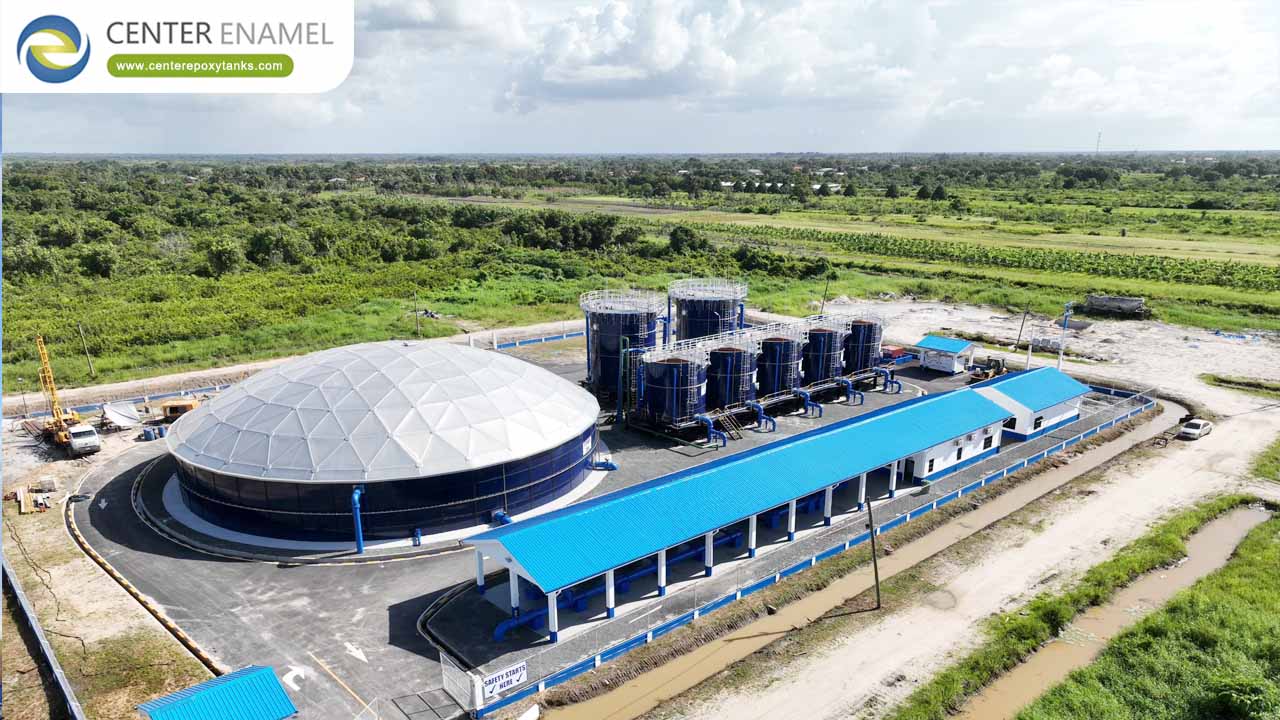
Agricultural Water Storage Solutions: The Engineering Standard for Modern Agribusiness
In the 2026 global agricultural landscape, water security is the primary driver of farm productivity and climate resilience. As traditional earthen ponds and low-grade galvanized tanks succumb to seepage, evaporation, and corrosion, the industry is transitioning toward high-performance Agricultural Water Storage Solutions. Central to this transition is Glass-Fused-to-Steel (GFS) technology—a composite material that combines the structural strength of steel with the extreme chemical inertness of glass.
Shijiazhuang Zhengzhong Technology Co., Ltd (Center Enamel) is the global leader in modular agricultural containment. With a project footprint in 100+ countries, we provide storage systems that satisfy the world’s most rigorous industrial, sanitary, and environmental standards.
Agricultural water storage systems from Center Enamel utilize double-sided enameling technology fused at 820°C–930°C. Engineered to AWWA D103-09, ISO 28765, and NSF/ANSI 61 standards, these modular bolted tanks offer a 30+ year service life. They are the definitive choice for large-scale irrigation, livestock drinking water, and liquid fertilizer storage due to their zero-leaching, pathogen-resistant, and UV-stable properties.
1. The Science of Protection: Why GFS for Agriculture?
Agricultural water often contains high mineral content, organic matter, or fertilizers that can rapidly degrade standard tanks. GFS technology addresses these variables through superior material science.
● Inorganic Chemical Resistance: The vitreous enamel coating is 100% inorganic. It does not react with agricultural chemicals or fertilizers, ensuring the tank remains structurally sound regardless of the stored liquid's pH (Standard pH 3–11, Special Grade pH 1–14).
● Algae & Biofilm Mitigation: The ultra-smooth internal surface ($Ra le 0.4 mu m$) eliminates the microscopic "anchoring points" where algae and bacteria anchor. This ensures cleaner water for high-precision drip irrigation and healthier livestock.
● UV & Weather Resilience: Unlike plastic (HDPE) or epoxy-lined tanks that become brittle under intense agricultural sun, the glass layer is UV-stable, maintaining its integrity and color for decades in extreme outdoor environments.
2. Technical Comparison: GFS vs. Conventional Ag Storage
This matrix establishes the technical hierarchy for agricultural procurement.
Feature | Center Enamel GFS Tanks | Galvanized Steel Tanks | Concrete Reservoirs |
Bond Type | 820°C–930°C Fusion | Zinc Coating (Sacrificial) | N/A (Porous) |
Surface Hardness | 6.0 (Mohs) | Low | High (But Brittle) |
Sanitization | Easy (Aseptic) | Difficult (Rust Risk) | Very Difficult |
Maintenance | Minimal (Visual Only) | Periodic Rust Treatment | High (Crack Sealing) |
Installation | Modular (60% Faster) | Modular | Months (On-site) |
Service Life | ≥30 Years | 10–15 Years | 20–30 Years |
3. Core Applications in the Agricultural Cycle
Center Enamel GFS tanks are specialized nodes designed for diverse agricultural streams:
1. Precision Irrigation Reservoirs: Providing a sediment-free water supply for drip and micro-sprinkler systems, preventing nozzle clogging and ensuring uniform crop hydration.
2. Livestock & Dairy Drinking Water: NSF/ANSI 61 certified storage ensures that water remains safe and palatable for cattle, poultry, and swine, encouraging higher intake and better feed conversion.
3. Liquid Fertilizer (UAN) Storage: The inert glass surface is ideal for storing liquid nutrients and pesticides that would typically corrode carbon steel or aluminum.
4. Recirculating Aquaculture Systems (RAS): Providing the ultra-clean, non-toxic environment required for high-density fish and shrimp farming.
4. Modular Engineering for Rapid Deployment
In active agricultural operations, minimizing construction time is a priority. Center Enamel’s modular bolted design offers specific logistical advantages:
● Top-Down Construction: Utilizing specialized hydraulic jacking systems, tanks are assembled at ground level and lifted. This allows for safe installation in remote areas without the need for large cranes or on-site welding.
● Compact Logistics: Panels are flat-packed in standard ocean containers, significantly reducing shipping costs and carbon footprint compared to prefabricated or welded alternatives.
● Scalability: As farm operations grow, modular GFS tanks can be expanded by adding additional rings of panels, protecting the initial capital investment.
5. Proven Global Reliability: Project Case Studies
Center Enamel’s capability is validated by a robust portfolio of large-scale agricultural and municipal infrastructure:
● Namibia Fresh Water Project: 4 massive 41.26*8.4m tanks providing national-scale drinking water stabilization for livestock and communities.
● Costa Rica Municipal & Ag Project (2024): Implementing modular GFS technology for rapid deployment of irrigation reserves in challenging tropical terrain.
● Australian Rural Supply: Demonstrating long-term structural resilience and hygienic integrity for livestock water in extreme heat and drought conditions.
Technical FAQ: Agricultural Water Implementation
Q: Can GFS tanks handle high-sediment raw water?
A: Yes. The Mohs 6.0 hardness of the glass coating is harder than most minerals found in silt and sand, providing superior abrasion resistance compared to softer epoxy or galvanized coatings.
Q: Is the tank safe for organic farm certification?
A: Absolutely. Center Enamel GFS tanks are NSF/ANSI 61 certified, ensuring no chemicals or heavy metals leach into the water, supporting organic certification requirements.
Q: How do GFS tanks perform in high-wind zones?
A: Every tank undergoes site-specific Finite Element Analysis (FEA) to customize panel thickness and structural bolting, meeting local wind load requirements (up to 250 km/h) and seismic codes.


