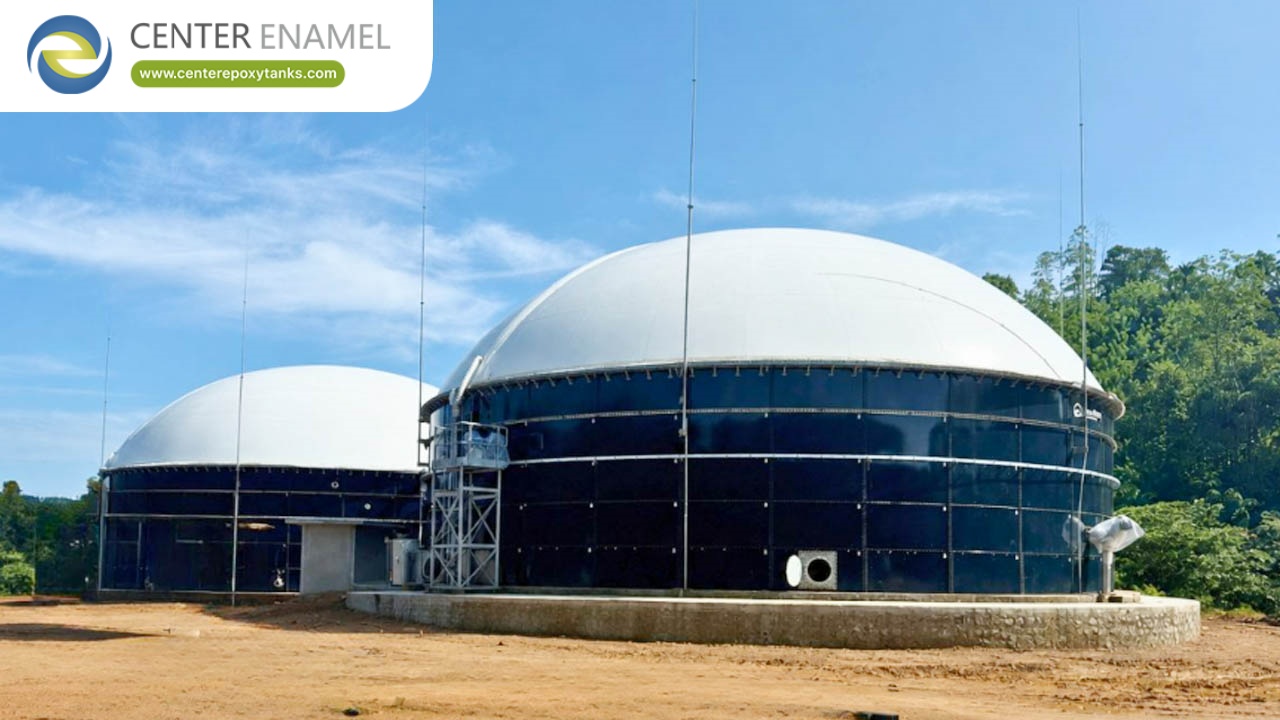
Double Membrane Roofs For Agricultural Biogas: Methane Containment And Energy Recovery
Agricultural biogas is the most decentralized energy project in the world: a digester on a farm, a holder on top, and an engine or boiler consuming the gas on site. The engineering is small in scale but unforgiving in detail — the membrane system must hold pressure across the full stroke, contain the methane completely, and hand a steady gas supply to whatever equipment converts it to heat or power.
This article covers farm-scale AD gas storage: the pressure control system, methane containment, and the integration with energy recovery that makes the project economic.
Farm-Scale AD: The Context
A farm AD plant digests livestock manure and energy crops, produces biogas on a biological schedule, and consumes it on site — typically for heat and power in a CHP unit, or for boiler heat. The economics are modest per project, which means the engineering must be simple, robust and maintainable by farm staff.
The holder sits between the variable producer and the variable consumer. Its job is to make the digester’s biology invisible to the engine.
Membrane Pressure Control
The double membrane roof pressurizes the air space between membranes to set operating pressure, with a blower and weight system controlling the band. As gas volume changes, the inner membrane rises and falls; the control loop keeps pressure within band from empty to full, with relief protecting the membranes at both extremes.
The control system must be simple enough for farm maintenance: few moving parts, clear setpoints, and alarms that mean something. A control system that needs a process engineer to restart is a control system that will be bypassed.
Methane Containment
Methane containment is both a safety and a revenue issue. Leaked gas is lost energy — directly reducing the CHP output the project economics depend on — and methane is a potent greenhouse gas with a regulatory and reputational dimension. Every seam, penetration and seal in the membrane system is a containment item.
Containment is verified at commissioning with leak testing and then maintained through scheduled seal and seam inspection. The operating discipline is simple: fix leaks when they are found, not when they affect output.
Gas Train And Condensate
The gas train from digester to engine carries saturated gas that condenses as it cools. Condensate drains at low points, flame arrestors where the configuration requires them, and pressure regulation ahead of the engine. The train is short on a farm plant but every element is still required.
H2S levels in agricultural biogas are lower than food waste but not zero; engine warranty terms frequently cap H2S, which decides whether desulfurization is a design item or an operating problem.
Energy Recovery Integration
The holder’s pressure and capacity specification follows the utilization equipment. A CHP engine needs steady pressure and draws continuously; a boiler tolerates variation but demands heat when the farm needs it. The gas balance — production curve against consumption curve — sizes the holder and validates the engine selection.
The integration extends to heat use: engine waste heat typically feeds the digester, which raises gas production, which the holder must buffer. The system is a loop, and the holder is the buffer in the middle of it.
Sizing The Holder
Holder sizing starts from the gas balance and the daily production volume, with a common design basis of 25-50 percent of daily production for CHP duty. The pressure requirement follows the engine; the capacity follows the balance. Both numbers belong in the specification before the family selection.
Oversizing is a capital error; undersizing is an availability error. The engine that starves during a production dip produces nothing, and the economics notice immediately.
Sizing Basis | Design Value | Consequence If Wrong |
Daily production volume | From feed rate and gas yield | Capacity basis for the holder |
Buffer fraction | 25-50% of daily production (CHP) | Under: engine starves; over: stranded capital |
Pressure requirement | Set by strictest consumer | Engine cannot run at rated output |
H2S limit | Engine warranty cap | Warranty void or desulfurization retrofit |
Membrane Materials For Agricultural Service
Agricultural biogas is comparatively benign: lower H2S than food waste, moderate moisture. Membrane materials are still selected for UV exposure, the pressure cycle duty and the expected H2S level, with seam quality as the fabrication focus.
The outer membrane carries the weather load and the UV exposure; the inner carries the gas. Their specifications differ, and both are quality-inspected before shipment.
Design Factor | Agricultural Biogas | Food Waste Biogas |
H2S level | Lower — hundreds of ppm range | Higher — thousands of ppm possible |
Moisture | Saturated at digester temperature | Saturated — high condensate load |
Membrane aging driver | UV exposure, pressure cycles | H2S plus UV and pressure cycles |
Desulfurization need | Engine warranty driven | Usually required before utilization |
Weather And Cold Climate Considerations
Agricultural biogas plants live outdoors through every weather condition the site produces. Snow load on the outer membrane, freeze protection for the blower and condensate system, and UV exposure over the membrane’s service life are all design cases — and cold-climate sites add heating and insulation scope to the gas train.
The outer membrane is the weather barrier, and its material specification follows the site climate: UV-stabilized fabrics for high-exposure sites, and snow-load checks where accumulation is credible.
Expansion And Future Capacity
Farm AD projects frequently expand: a second digester, a larger engine, an upgrading skid added when the economics justify it. The holder and gas train should be specified with the expansion path in mind — spare holder capacity, gas train sizing headroom and control system provisions for the second utilization unit.
The cheapest expansion is the one that was anticipated. Adding a holder module or an engine to a system designed for it is a connection exercise; retrofitting into a system that was not is a redesign.
Operation And Maintenance On The Farm
Farm-scale operation is the real test: the holder must run with minimal attention and fail safe. The maintenance regime is pressure band checks, condensate drains, seal inspection and blower service — all scheduled, all simple, all documented.
Bolted GFS tanks simplify the maintenance model further: gasketed joints inspectable from outside, no recoating cycle, and panel replacement as a planned activity rather than a project.
Center Enamel Agricultural AD Capability
Center Enamel delivers agricultural AD systems with membrane roof engineering, from gas balance through commissioning documentation. Our GFS digester and tank systems are selected for livestock wastewater chemistry, and our double membrane roof systems are engineered for the pressure stability that farm-scale energy recovery demands.
For agricultural biogas, we engineer for the farm’s maintenance reality: simple systems, clear setpoints and documentation that survives the operator’s handbook.
Project Case Study
A Canadian livestock operation required digestion and gas storage capacity integrated with its wastewater management system, sized for farm-scale energy recovery. Center Enamel supplied a glass-fused-to-steel bolted tank at 13.76 m diameter by 8.4 m height, totaling 1,248 m3.
The GFS tank system serves the digestion and storage duty with the vitreous enamel interior that livestock wastewater chemistry demands, and the double membrane roof system provides controlled-pressure gas storage for the energy recovery train. The project was delivered complete in February 2025 with coating inspection records for the operating baseline.
Project Reference | 01 Canada Drinking Water 202502 |
Location | Canada |
Application | Livestock Wastewater |
Product / Technology | Glass-Fused-to-Steel (GFS) Bolted Tank |
Tank Count | 1 |
Tank Dimensions | φ13.76*8.4m(H), 1 unit |
Total Volume | 1248 m3 |
Completion | Delivered and completed 2025-02 |
Supply Scope Note | A relevance grade to this topic |
About Company
Shijiazhuang Zhengzhong Technology Co.,Ltd(Center Enamel) is a professional manufacturer dedicated to the design and fabrication of bolted storage tanks since 2008. Our products range includes Glass-Fused-to-Steel (GFS) tanks, fusion bonded epoxy tanks, stainless steel tanks, galvanized steel tanks and aluminum geodesic dome roofs. With professional enameling R&D team and nearly 200 enameling patents, Shijiazhuang Zhengzhong Technology Co.,Ltd has become the leader in bolted tanks industry of Asia. Our products are certified to ISO9001, NSF61, EN1090, ISO28765, WRAS ,FM, LFGB, BSCI, IS0 45001 and other international standards.
Shijiazhuang Zhengzhong Technology Co., Ltd is not only the first manufacturer in China which produces Glass-Fused-to-Steel tanks, but also the most experienced professional bolted tanks manufacturer in Asia.The engineering & design, product testing and quality system of Center Enamel Glass-Fused-to-Steel tanks is in strict accordance with AWWA D103-09, OSHA, ISO 28765, NSF/ANSI 61, NFPA and other international standards. Until 2023, Center Enamel bolted tanks have been exported to more than 100 countries including USA, Australia,Canada, Malaysia, Indonesia, Russia, UAE, Panama,Brazil and South Africa etc., the superior tank quality and prompt service gains us worldwide recognition.
As an outstanding containment and cover system provider with decades of industry experience, Shijiazhuang Zhengzhong Technology Co., Ltd sincerely expects to establish long-term cooperation with the local partners throughout the world and make continuous contribution to the development of the industry.
Suggested CTA
Center Enamel delivers double membrane roof engineered for agricultural biogas storage duty, with agricultural ad delivery, membrane roof systems. Contact our engineering team for engineering guidance on your next double membrane roof biogas project — including sizing, standards compliance and delivery scheduling.
Frequently Asked Questions
Q: How is a farm biogas holder sized?
A: From the gas balance — production curve against consumption curve — with a common design basis of 25-50 percent of daily production for CHP duty. The pressure requirement follows the utilization engine; the capacity follows the balance.
Q: What sets the operating pressure in a double membrane roof?
A: The blower and weight system pressurizing the air space between the membranes, with over- and under-pressure relief protecting the membranes. The control loop must hold band from empty to full.
Q: Why does methane containment matter economically?
A: Leaked gas is lost energy that directly reduces CHP output — the revenue the project economics depend on. Methane is also a potent greenhouse gas with regulatory and reputational dimensions.
Q: What maintenance does a farm-scale holder need?
A: Pressure band checks, condensate drains, seal and seam inspection, and blower service — all scheduled and simple. The system must run with minimal attention and fail safe.
Q: How much H2S is in agricultural biogas?
A: Lower than food waste but not zero. Engine warranty terms frequently cap H2S, which decides whether desulfurization is a design item or an operating problem — the analysis should be done before engine selection.
Q: Why are GFS tanks common for livestock digestion?
A: The vitreous enamel interior handles the variable and aggressive chemistry of livestock wastewater, the gasketed panel joints are inspectable from outside, and there is no recoating cycle — a maintenance model that suits farm-scale operation.


