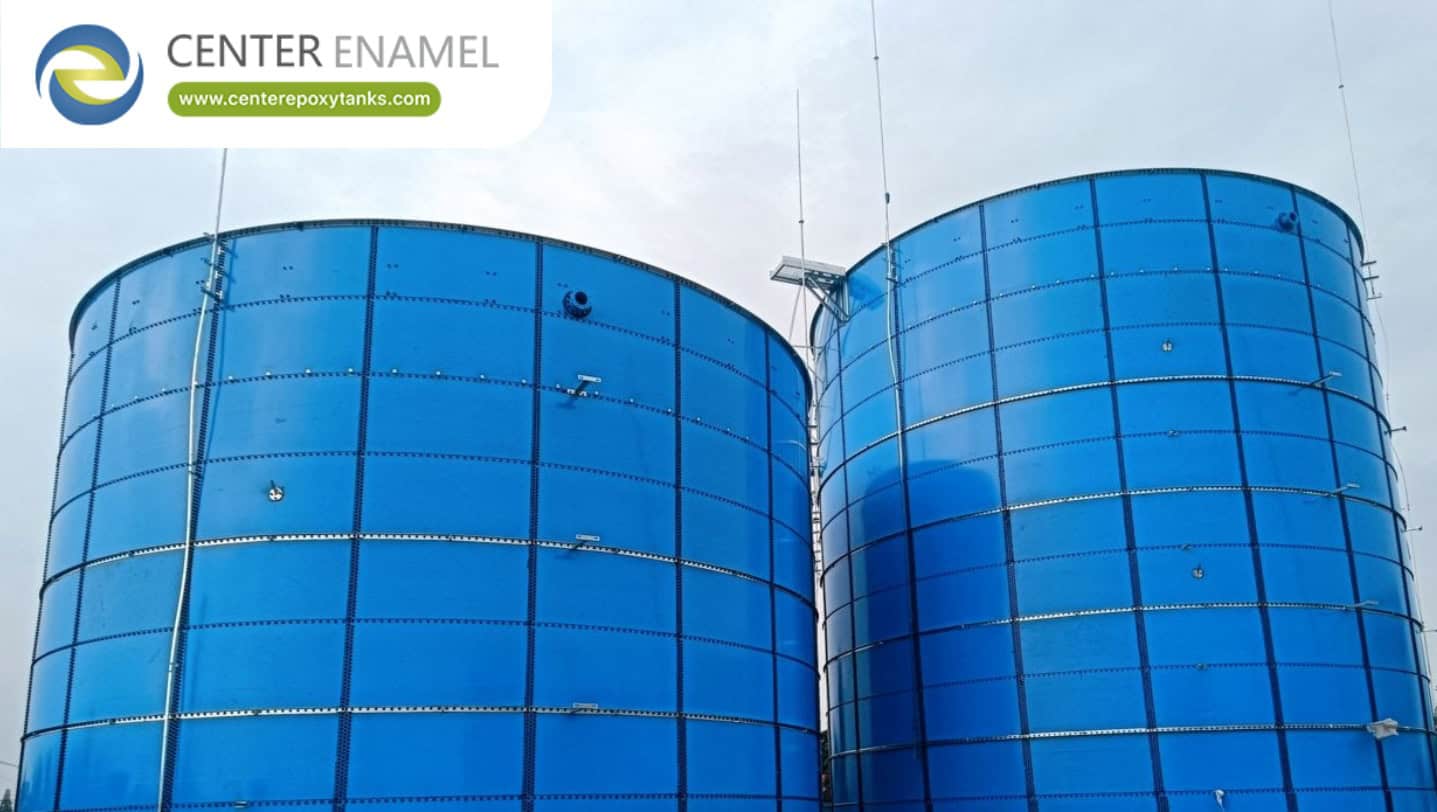
Bolted Steel Tanks as Biogas Slurry Tanks: Engineering & Procurement Guide
Biogas production via anaerobic digestion requires containment vessels that can withstand aggressive chemical environments, high thermal loads, and the structural stresses of gas generation. Bolted steel tanks—particularly Glass-Fused-to-Steel (GFS) or specialized high-performance epoxy-coated variants—have become the preferred solution over traditional concrete or field-welded steel for biogas applications. Their modular construction allows for rapid deployment, precise quality control through factory coating, and long-term structural integrity.
1. Why Bolted Steel Dominates Biogas Infrastructure
Anaerobic digesters create an environment rich in hydrogen sulfide ($H_2S$), volatile fatty acids, and high-temperature moisture—a "perfect storm" for corrosion. Bolted steel tanks offer distinct advantages over monolithic materials:
● Factory-Controlled Quality: Unlike field-poured concrete or site-welded steel, bolted panels are manufactured in climate-controlled facilities. Coating (enamel or epoxy) is applied under strict conditions, ensuring uniform thickness and 100% surface coverage.
● Superior Corrosion Resistance: GFS tanks, in particular, are chemically inert. The glass coating is impervious to the acid production typical of slurry, eliminating the need for recurring internal lining repairs common in concrete digesters.
● Modular Scalability: Projects can scale capacity based on feedstock availability by adding ring tiers or expanding the facility diameter, a feat impossible with poured-in-place concrete.
● Gas-Tight Integrity: Modern bolted tanks utilize high-performance gaskets and precision-engineered sealants designed to maintain the gas-tight environment necessary for anaerobic digestion.
2. Engineering Standards: A Foundation for Safety
When specifying tanks for biogas applications, engineering compliance is non-negotiable. Ensure your procurement adheres to the following benchmarks:
● AWWA D103: The definitive standard for bolted steel tank design. It governs structural design, material quality, and bolt strength.
● ISO 28765: Specifically addresses the design and use of vitreous enamel-coated bolted cylindrical steel tanks for municipal/industrial effluents and sludges.
● Structural Load Calculations: Digesters are not mere storage tanks; they are pressure vessels. The design must account for:
○ Internal Gas Pressure: Forces exerted by the accumulating biogas headspace.
○ Hydrostatic Load: Weight of high-density slurry (which can exceed the specific gravity of water).
○ Seismic & Wind Loading: Calculation based on site-specific geography using ASCE 7 or local equivalent.
3. Comparative Performance Matrix
Selecting the right containment method dictates the operational efficiency and total cost of ownership (TCO) of the biogas plant.
Feature | Bolted Steel (GFS/Epoxy) | Poured-in-Place Concrete | Field-Welded Steel |
Installation Speed | Fast (Weeks) | Slow (Months) | Moderate |
Corrosion Resistance | Excellent (Inert) | Low (Requires lining) | Low (Requires frequent repainting) |
Life Cycle Cost | Low (Low Maint.) | High (Constant repair) | Moderate |
Sealing Reliability | High (Engineered gaskets) | Variable (Crack-prone) | High |
Relocatability | Yes | No | No |
4. Procurement Vetting Matrix
To avoid structural failures or premature coating degradation, qualify your manufacturer using this rigorous audit process:
1. Coating Thickness Verification: Demand an average coating thickness of 250–450 microns. Anything less may fail prematurely in highly acidic slurry environments.
2. Holiday Testing: Ensure the manufacturer performs 100% holiday detection (at a minimum of $1100text{V}$) on all interior panels before shipping.
3. Sealant Compatibility: Confirm the sealing gasket material (typically EPDM or Viton) is rated for exposure to methane and the specific chemical composition of the slurry feedstock.
4. Third-Party Inspection (TPI): Require the manufacturer to allow independent, third-party inspection of the panels and the bolted connections to verify adherence to design drawings.
Frequently Asked Questions (FAQ)
Q: Can bolted steel tanks handle the pressure of gas collection?
A: Yes. Modern bolted steel tanks are engineered to handle the design pressure requirements for gas collection systems. The roof structure and sealing integrity are specifically designed to maintain the required internal pressure, provided they are properly paired with pressure/vacuum relief valves.
Q: How do bolted tanks behave in cold climates?
A: Bolted steel tanks are highly resilient in cold climates, provided the concrete foundation is engineered for frost penetration and appropriate thermal insulation is added to the tank walls. Unlike concrete, steel does not suffer from freeze-thaw spalling.
Q: Is "Gas-Tight" guaranteed?
A: Gas-tightness is achieved through a combination of high-density elastomeric gaskets and industrial-grade sealants at every vertical and horizontal seam. When correctly installed by factory-certified crews, the seal is absolute.


