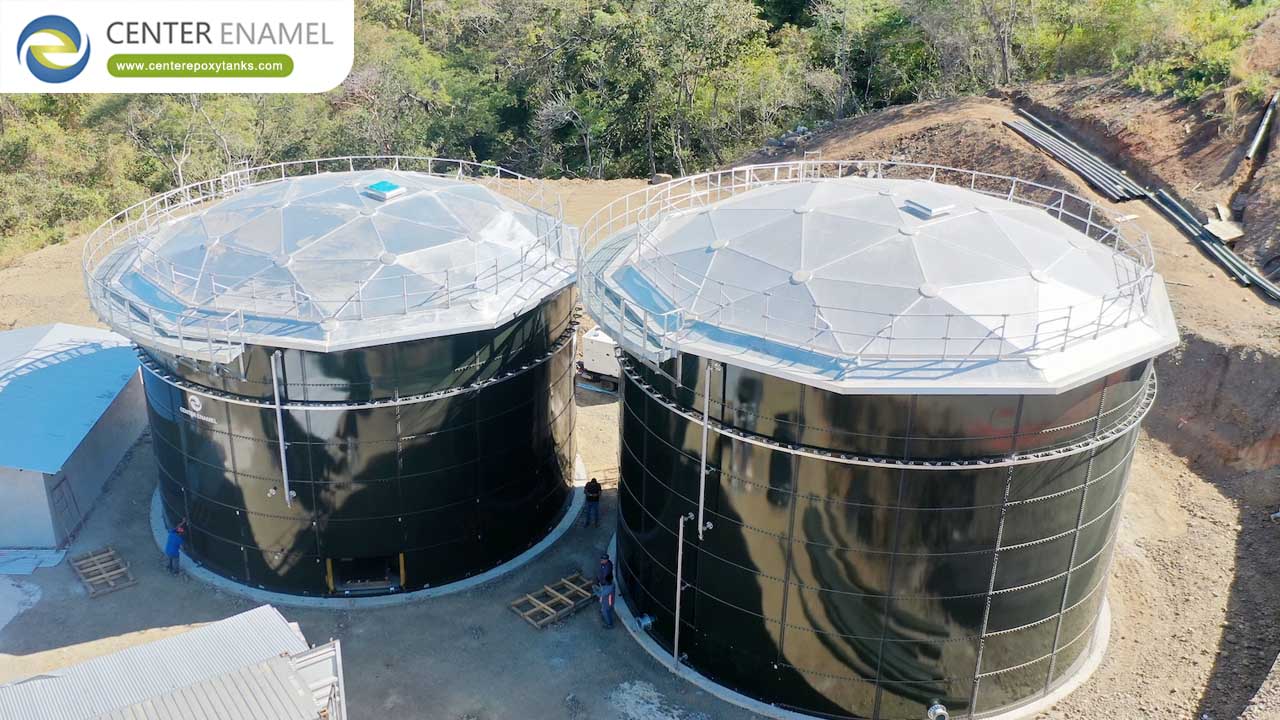
Sustainable Farming Infrastructure: Bolted Steel Tanks as Farm Biogas Digesters
In the agricultural landscape of 2026, a "productive farm" is defined by resource recovery. As energy costs fluctuate and carbon mandates tighten, farmers are increasingly turning to anaerobic digestion to transform organic waste into a localized power source.
Center Enamel provides the infrastructure that makes this possible. Our Farm Biogas Digesters Tanks combine the chemical resilience of Epoxy Coated Steel with the structural innovation of Aluminum Dome Roofs, offering a scalable, durable solution that powers the agricultural circular economy.
The Strategic Role of Biogas Digesters in 2026
Modern biogas digesters are the "engine" of farm autonomy. They deliver three critical pillars of modern agricultural success:
On-Site Energy Generation: Transform methane-rich manure into a renewable energy source to heat barns, power milking parlors, and reduce reliance on unstable grid energy.
High-Quality Bio-Fertilizer: Anaerobic digestion creates nutrient-rich digestate. This byproduct is more easily absorbed by crops than raw manure and significantly reduces the need for synthetic, high-cost fertilizers.
Carbon Mitigation: Capturing methane in a sealed tank prevents greenhouse gas emissions, positioning the farm to benefit from carbon credit markets and enhancing corporate sustainability profiles.
Engineering Superiority: Why Bolted Steel?
Agricultural waste is highly aggressive, containing ammonia and organic acids that degrade standard materials. Our engineering approach is built to withstand these specific demands.
The Epoxy Coated Bolted Tank Advantage
Fusion Bonded Epoxy (FBE) Shield: Our tanks feature an electrostatic application of epoxy powder to grit-blasted steel, thermally cured to create a dense, molecularly bonded barrier. This prevents acid corrosion and maintains structural integrity.
Mechanical Resistance: Built for the farm environment, our epoxy coating is impact-resistant, ensuring it survives the installation of internal mixers or high-solids slurry circulation.
Scalability: Unlike concrete, our bolted modular design grows with your farm. Capacity can be expanded by adding additional rings of panels, providing a future-proof investment.
Comparative Analysis: Digester Infrastructure
Feature | Center Enamel Bolted Steel Digester | Traditional Concrete Digester |
Construction Time | Rapid (Jacking method) | Slow (Cast-in-place) |
Leak Prevention | Superior (Precision bolting/sealant) | Prone to cracking over time |
Scalability | Yes (Add ring panels) | No (Requires new structure) |
Maintenance | Low (Factory-finished surface) | High (Surface patching/sealing) |
Recyclability | High (Steel is 100% recyclable) | Low (Demolition waste) |
Proven Project Success
Center Enamel’s solutions are currently operational in critical agricultural hubs globally, demonstrating reliability at an industrial scale.
Muyuan Group Suining Project: 2 units. A global benchmark for swine waste management, processing massive effluent volumes into renewable biogas.
Jiangsu Xuzhou Project: 4 units. Serving as the foundation for sustainable resource management in a high-output regional hub.
Hebei Agriculture Water Project: 2 units. Demonstrating the versatility of our modular design in managing complex waste and process water.
Frequently Asked Questions (FAQ)
Q: Why are Aluminum Dome Roofs used on biogas digesters?
A: The "headspace" of a digester is highly corrosive due to hydrogen sulfide and moisture. Aluminum naturally resists this "gas zone" corrosion, outlasting traditional steel roofs. Furthermore, the clear-span geodesic design removes the need for internal columns, allowing for efficient, unobstructed mixing of the feedstock.
Q: How does the Bolted Steel tank compare to concrete for digestion?
A: Concrete is porous and prone to cracking under chemical attack and ground shifting. Our bolted steel tanks are precision-engineered and factory-coated with FBE, providing a gas-tight, liquid-tight environment that is far more resistant to the acidic nature of anaerobic digestion.
Q: Can these digesters handle high-solids manure?
A: Yes. Our tank designs allow for the seamless integration of side-entry mixers and internal heating coils, ensuring that even high-solids feedstock is effectively homogenized and kept at optimal temperatures for methanogenic bacteria.
Are you optimizing your farm's infrastructure for the next decade of sustainable energy? [Contact the Center Enamel engineering team] today to receive a technical proposal and feasibility analysis for your biogas project.


