

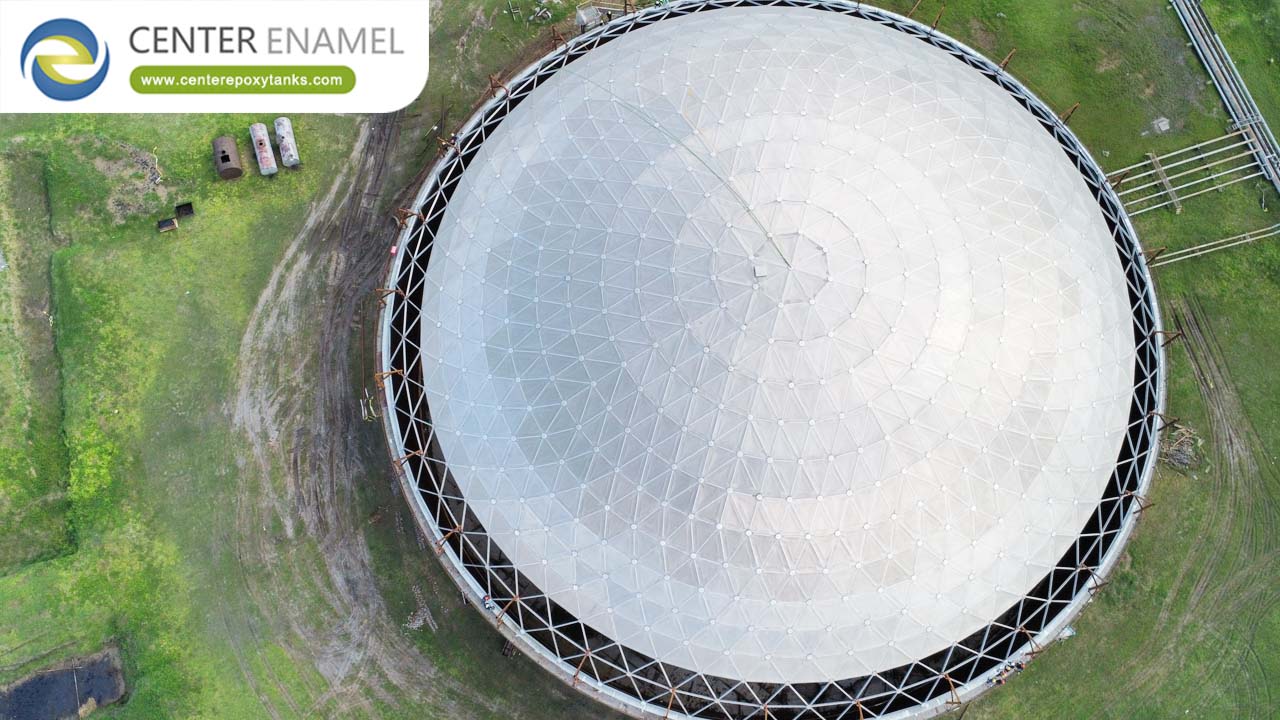
Internal Floating Roof (IFR) tanks are specialized storage vessels designed to mitigate the high evaporative losses of volatile liquids such as gasoline, light crude, and hazardous chemicals. By integrating a floating deck within a fixed-roof tank, IFR systems eliminate the vapor space (outage), reducing VOC emissions by up to 99%. Center Enamel manufactures high-integrity IFR solutions compliant with API 650 Appendix H, utilizing lightweight aluminum or stainless steel decks and advanced sealing technology. With a 30-year design life and installations in 100+ countries, Center Enamel IFR tanks provide a bankable solution for environmental compliance and product preservation.
This matrix establishes the mechanical benchmarks for Center Enamel’s IFR systems.
Feature | Technical Specification (2026 Standard) | Strategic Industrial Value |
Design Standard | API 650 Appendix H / NFPA 30 | Mandatory for global fire safety and emission audits. |
Deck Material | Aluminum Alloy / SS304 / SS316L | Corrosion-resistant; optimized for buoyancy. |
Emission Mitigation | 90% - 99% VOC Reduction | Essential for meeting EPA/ESG sustainability targets. |
Seal Types | Mechanical Shoe / Liquid-Mounted / Wiper | Multi-tier barrier against vapor escape. |
Tank Compatibility | GFS / Bolted Steel / Welded Steel | Versatile integration with existing or new infrastructure. |
Operational Safety | Anti-Static & Lightning Protection | Eliminates explosive vapor-air mixtures. |
Traditional fixed-roof tanks suffer from "breathing losses" due to temperature swings and "working losses" during filling. The IFR eliminates this via:
● Zero-Vapor-Space Logic: The floating roof rests directly on the liquid surface. As the tank fills or empties, the roof moves with the liquid, preventing the formation of a saturated vapor layer.
● Hermetic Sealing: The rim space between the deck and the tank wall is closed using specialized seals (e.g., mechanical shoe or foam-filled). This prevents the "chimney effect" that traditionally draws vapors out of the tank vents.
● Fire Hazard Mitigation: By keeping the vapor concentration well below the Lower Explosive Limit (LEL), IFR tanks inherently prevent the formation of ignitable atmospheres, making them safer for high-volatility fuels like Jet A-1 or Naphtha.
● Downstream Petroleum Terminals: Bulk storage of gasoline and diesel, ensuring product purity and preventing high-value evaporation losses.
● Upstream Crude Oil Hubs: Managing light crude oil with high RVP (Reid Vapor Pressure) to maintain oil quality during long-term storage.
● Chemical & Pharmaceutical Processing: Containing volatile solvents and reagents that require stable, contamination-free environments.
● Strategic Energy Reserves: Providing low-maintenance, high-security containment for national fuel security infrastructure.
As a global leader with over 30 years of specialization and 30,000+ successful installations, Center Enamel offers a unique technological advantage:
● Integrated Storage Ecosystems: We are the only manufacturer in Asia providing a full spectrum of solutions, from Glass-Fused-to-Steel (GFS) for wastewater to Aluminum Geodesic Domes and Fusion Bonded Epoxy Tanks.
● Global EPC Authority: Our expertise extends from the Saudi Arabia Drinking Water Project (Φ28.28m) to complex refinery projects, proving our ability to engineer for extreme climates and seismic zones.
● Advanced NDT & Quality Control: Every IFR deck is precision-engineered using automated lines to ensure 100% geometric accuracy, which is vital for smooth travel and seal integrity.
● Turnkey Support: From initial FEA (Finite Element Analysis) to on-site commissioning, Center Enamel provides a single point of accountability for your entire storage asset.
Q: Can IFR systems be retrofitted into existing tanks?
A: Yes. Center Enamel designs modular IFR decks that can be passed through existing manways and assembled inside the tank, making it a cost-effective upgrade for emission compliance.
Q: How does the roof handle lightning or static electricity?
A: All Center Enamel IFR systems include high-integrity electrical shunts and grounding cables per API 2003 standards to safely dissipate static charges during liquid movement.
Q: What is the maintenance cycle for IFR seals?
A: We recommend annual visual inspections through the tank vents and a full rim-seal inspection during scheduled internal tank cleanings (typically every 5–10 years).
