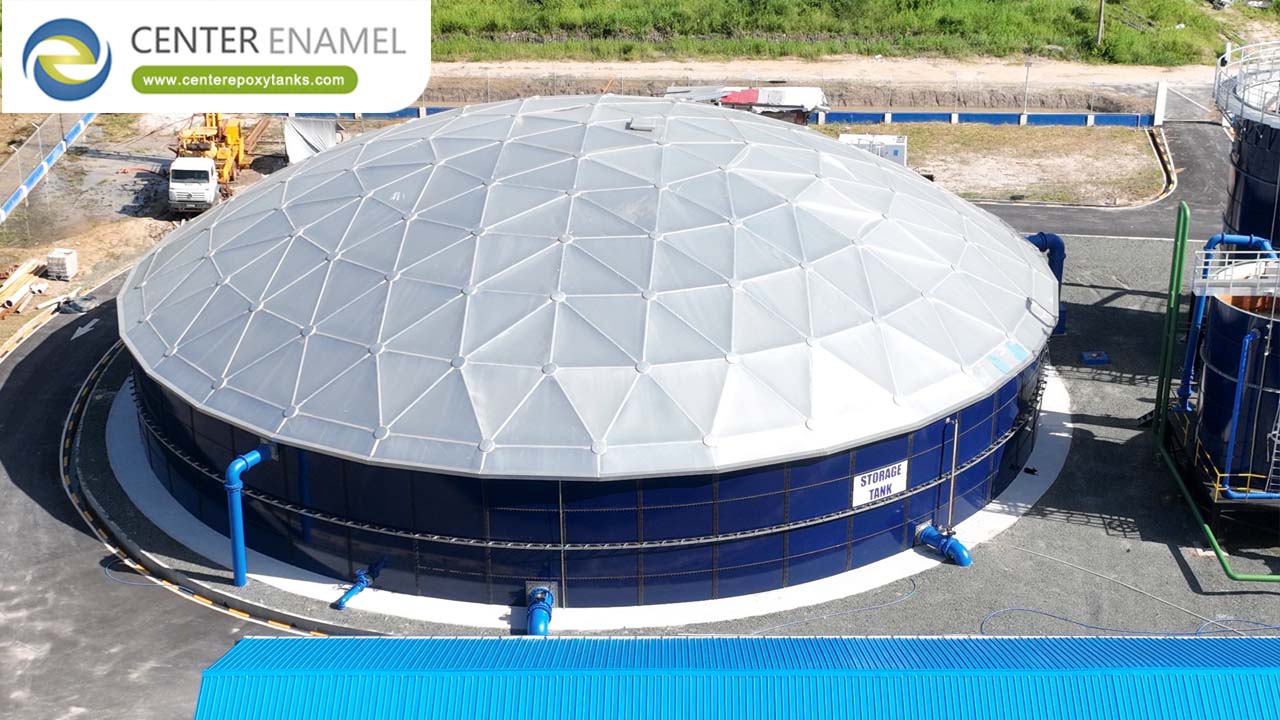
High-Efficiency Internal Floating Roof (IFR) Systems: Engineering for VOC Control and Product Preservation
Internal Floating Roof (IFR) systems are critical for managing volatile hydrocarbons, specifically engineered to comply with API 650 Appendix H. By floating directly on the liquid surface, an IFR eliminates the vapor space (ullage), reducing Volatile Organic Compound (VOC) emissions by up to 99%. As a global leader in storage technology, Center Enamel provides lightweight aluminum and stainless steel IFRs featuring advanced rim seal technology, ensuring environmental compliance, fire risk mitigation, and significant ROI through product loss prevention.
1. Technical Specification & Vapor Mitigation Matrix
This matrix defines the performance benchmarks for industrial-grade IFR systems.
Feature | Technical Specification (2026 Standard) | Strategic Utility Value |
Design Standard | API 650 Appendix H | The global benchmark for IFR structural integrity. |
Emission Reduction | 98% to 99%+ VOC Mitigation | Essential for US EPA and global ESG compliance. |
Material Options | Aluminum Alloy / AISI 304 & 316L | Corrosion resistance for diverse hydrocarbon profiles. |
Seal Configuration | Primary Shoe / Secondary Wipe Seals | Ensures a gas-tight interface with the tank shell. |
Buoyancy Safety | Minimum 100% Reserve Buoyancy | Prevents roof sinking under high turbulence or load. |
Installation | Modular Bolt-Together Design | "No-Hot-Work" assembly for operational safety. |
2. Structural Engineering: The Mechanics of Vapor Suppression
The Buoyancy-to-Weight Ratio
A high-efficiency IFR must be both structurally rigid and exceptionally light to respond to rapid liquid level fluctuations.
● Skin-and-Pontoon Design: Utilizing high-strength 6000-series aluminum, Center Enamel's pontoon systems provide maximum buoyancy with minimal weight. This ensures the roof remains stable even during high-velocity filling or emptying cycles.
● Full-Contact Honeycomb Options: For extremely volatile products, full-contact honeycomb panels eliminate the vapor space entirely, providing the highest level of emission control available in the industry.
Rim Seal Dynamics and Integrity
The most critical failure point for VOC escape is the "rim space" between the IFR and the tank shell.
● Advanced Sealing Systems: We employ a dual-seal approach. The primary seal handles the bulk of vapor containment, while a secondary wiper seal ensures that as the roof moves, it leaves no liquid film on the shell, preventing "wicking" emissions.
● Chemical Compatibility: All seals are manufactured from high-grade polymers tested for resistance to aromatic hydrocarbons, MTBE, and other aggressive additives.
3. High-Stakes Applications in Petrochemical Infrastructure
● Gasoline & Naphtha Storage: Critical for high-turnover tanks where evaporation losses represent significant financial leakage.
● Crude Oil Buffer Tanks: Reducing $H_2S$ accumulation in the vapor space, enhancing safety for facility personnel.
● Chemical Feedstock Terminals: Preserving product purity and preventing moisture ingress in hygroscopic petrochemicals.
● Environmental Retrofitting: Converting existing fixed-roof tanks into IFR tanks to meet modern clean air regulations without replacing the entire structure.
4. Why Partner with Center Enamel?
As a Global Leading Storage Solutions Provider, Shijiazhuang Zhengzhong Technology Co., Ltd offers a unique technological advantage:
● 30-Year Global EPC Excellence: With a 150,000 m2 manufacturing base, we have delivered over 30,000 projects in 100+ countries, including landmark facilities in Saudi Arabia, Brazil, and the Philippines.
● Precision CNC Fabrication: Our facility utilizes automated laser cutting for sub-millimeter accuracy, ensuring that every pontoon and seal component integrates seamlessly during "No-Hot-Work" site assembly.
● Certified Quality: Our IFR systems are engineered to exceed ISO 9001, ISO 45001, and EN 1090 benchmarks, providing insurance-grade reliability for high-risk assets.
● Integrated Tank Solutions: We provide a single point of accountability, often pairing our IFR systems with our Glass-Fused-to-Steel (GFS) or Fusion Bonded Epoxy (FBE) tanks for a total containment solution.
5. Technical FAQ: IFR System Strategy
Q: How does an IFR improve fire safety in a petrochemical tank?
A: By significantly lowering the vapor concentration below the Lower Explosive Limit (LEL) in the space between the IFR and the fixed roof, the risk of ignition from lightning strikes or static discharge is virtually eliminated.
Q: Can these systems be customized for non-standard tank diameters?
A: Absolutely. Every Center Enamel IFR is custom-engineered using Finite Element Analysis (FEA) to match the specific diameter, internal obstructions (columns), and product density of your facility.
Q: What is the expected maintenance cycle for an aluminum IFR?
A: With high-grade 6000-series aluminum, maintenance is minimal. Annual visual inspections of the rim seals and a five-year buoyancy check are standard industry practice to ensure 30+ years of service life.


