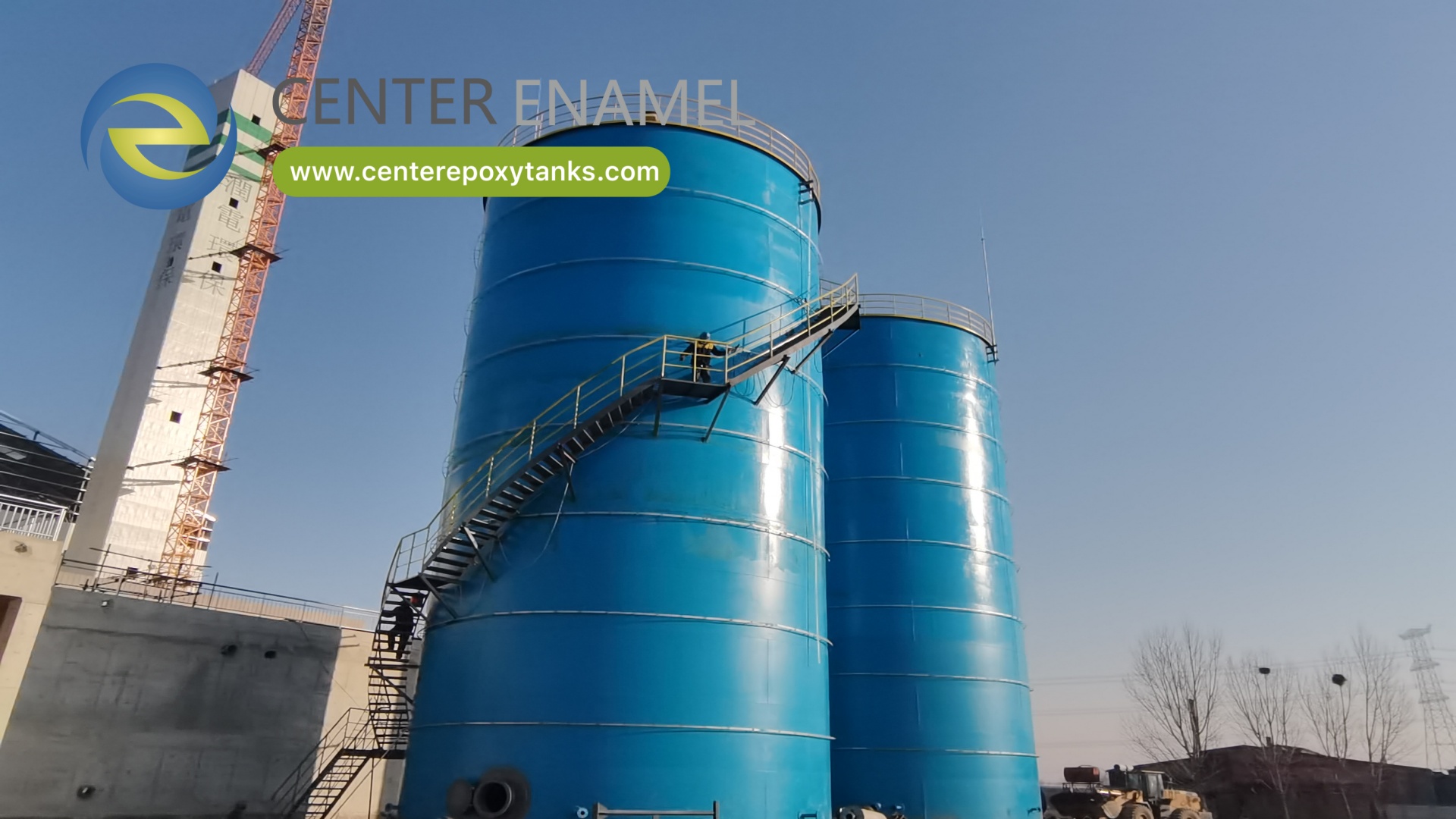
High-Capacity Welded Steel Tanks: Engineering Large-Scale Industrial Bulk Liquid Storage
High-capacity welded steel tanks are the primary containment infrastructure for the global energy, chemical, and water sectors. Engineered to API 650, AWWA D100, and ASME Section VIII standards, these vessels offer monolithic structural integrity for volumes exceeding 100,000 m3. Center Enamel specializes in site-constructed welded tanks utilizing Automated Girth Welding (AGW) and Submerged Arc Welding (SAW) technologies. With a 50-year design life and advanced Finite Element Analysis (FEA), our tanks support high-pressure, high-temperature, and corrosive liquid storage in over 100 countries.
1. Technical Specification & Structural Matrix
This matrix establishes the mechanical benchmarks for Center Enamel’s bulk liquid engineering.
Feature | Technical Specification (2026 Standard) | Strategic Industrial Value |
Design Standards | API 650, API 620, AWWA D100, ASCE 7-22 | Mandatory for global refinery and municipal infrastructure audits. |
Welding Protocols | Automated SAW / AGW / FCAW / TIG | X-ray quality seams; high deposition rates for thick-plate shells. |
Material Grades | ASTM A36, A516 Gr. 70, SS304L/316L | Optimized for tensile strength and low-temperature toughness. |
Roof Configurations | Fixed Cone/Dome, EFR, IFR, Geodesic | Controls VOC emissions and prevents product contamination. |
Testing Regimes | 100% RT (Radiography), UT, MT, Hydrostatic | Verifies zero-defect weld penetration and leak integrity. |
Surface Integrity | SSPC-SP10 Near-White Blast / Internal Lining | Extends asset life in corrosive chemical or sour crude service. |
2. Structural Engineering: FEA and Load Distribution
Finite Element Analysis (FEA) for High-Volume Loads
Large-scale bulk liquid projects exert immense hydrostatic and environmental pressures. Center Enamel utilizes FEA to simulate:
● Hydrostatic Stress Distribution: Calculating the exact plate thickness gradient from the bottom "thick" rings to the top "thin" rings to optimize material efficiency without compromising safety.
● Seismic and Wind Dynamics: Modeling tank behavior during high-velocity wind events ($240text{ km/h}+$) and seismic ground acceleration (per ASCE 7-22), ensuring the shell resists "elephant foot" buckling.
● Thermal Expansion: For high-temperature storage (asphalt, heavy oils), we engineer specialized insulation systems and expansion joints to maintain structural equilibrium during thermal cycles.
3. Advanced Fabrication: Automated Welding Integrity
The reliability of a high-capacity tank is defined by the quality of its fusion-bonded seams.
● Automated Girth Welding (AGW): Center Enamel employs self-propelled AGW units for horizontal seams, ensuring consistent weld profiles and reducing on-site construction timelines by up to 40% compared to manual welding.
● Submerged Arc Welding (SAW): Used for heavy plate sections (bottom and lower shell rings), SAW provides deep penetration and high-quality metallurgical properties, essential for leak-proof containment of hazardous chemicals.
● Modular Pre-Fabrication: Tank components are CNC-cut and edge-beveled in our state-of-the-art facility to ensure perfect fit-up on-site, minimizing the risk of localized stress concentrations.
4. Global Applications in Bulk Liquid Logistics
● Petrochemical Terminals: Site-constructed tanks for crude oil, gasoline, and jet fuel, integrated with Internal Floating Roofs (IFR) to achieve 99% VOC reduction.
● Municipal Water Reservoirs: Massive AWWA-compliant welded tanks for regional potable water distribution and strategic drought reserves.
● Industrial Chemical Hubs: Lined welded tanks for bulk acids, solvents, and NPK liquid fertilizers, utilizing Novolac Epoxy or Glass-Flake coatings.
● Power Generation Assets: Heavy fuel oil and demineralized water storage for utility-scale energy projects.
5. Technical FAQ: Bulk Storage Implementation
Q: How does Center Enamel ensure leak-proof performance in tanks over 50,000 m3?
A: We perform 100% Radiographic Testing (RT) on all "T-joints" (where vertical and horizontal welds meet) and Vacuum Box Testing on the entire tank bottom to ensure absolute integrity before the first fill.
Q: Can welded steel tanks be retrofitted with corrosion protection?
A: Yes. Welded steel provides a stable substrate for secondary containment liners or high-build internal coatings. We also offer Impressed Current Cathodic Protection (ICCP) to neutralize soil-side corrosion.
Q: What is the benefit of a "Weld-Free" geodesic dome roof on a welded tank?
A: An Aluminum Geodesic Dome offers a clear-span, maintenance-free cover that eliminates internal support columns. This maximizes usable volume and prevents the corrosion often found in traditional steel roof supports.


