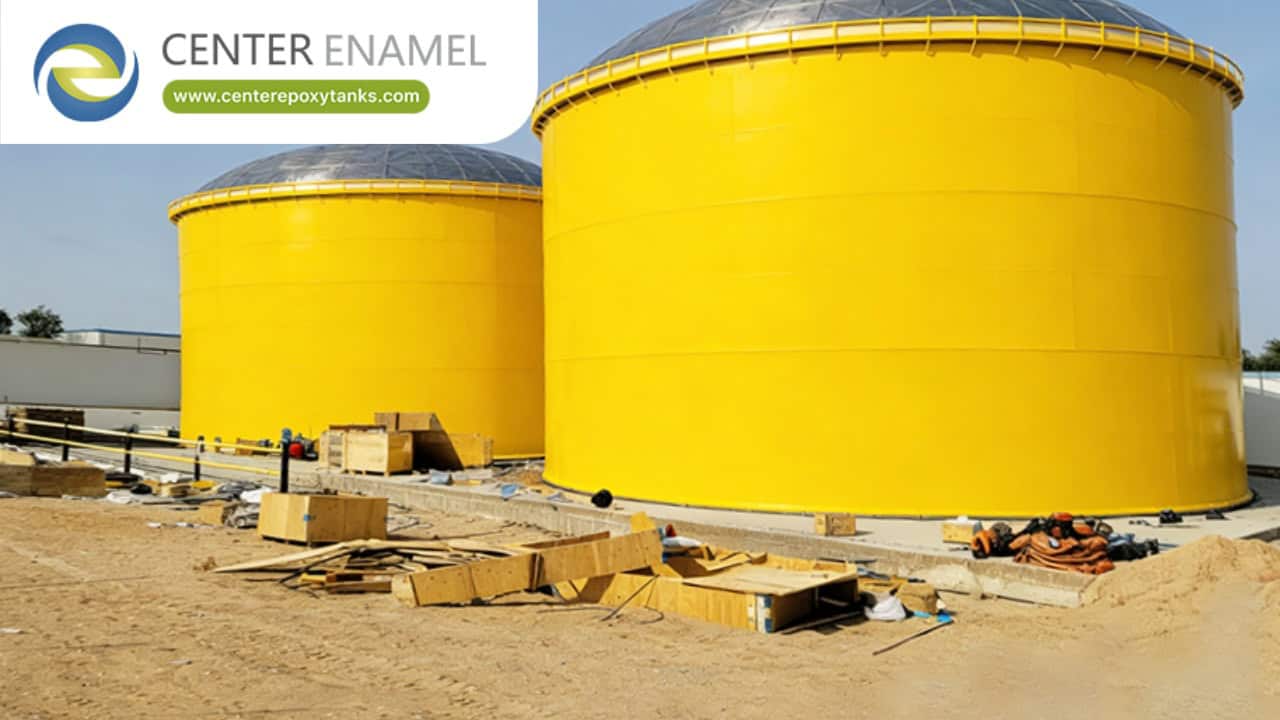
China Carbon Steel Petrochemical Product Storage Tank Manufacturer - Center Enamel
The global petrochemical industry operates under stringent safety, environmental, and mechanical standards. Storing refined chemical feedstocks, intermediate process liquids, organic solvents, and hazardous hydrocarbons requires containment infrastructure engineered to resist aggressive chemical corrosion, withstand variable internal pressures, and eliminate fugitive vapor emissions. Industrial facilities demand storage vessels built with uncompromised metallurgical precision and long-term structural reliability.
As a globally recognized industry pioneer, Shijiazhuang Zhengzhong Technology Co., Ltd. (Center Enamel) stands at the forefront as a premier China carbon steel petrochemical product storage tank manufacturer. Combining over three decades of engineering expertise, advanced manufacturing automation, and strict compliance with international codes, Center Enamel delivers custom-engineered carbon steel petrochemical storage solutions to more than 100 countries worldwide.
Engineering Mastery and Global Standards Compliance
Petrochemical containment involves complex interactions between stored chemical compounds and tank wall structures. Center Enamel’s carbon steel storage tanks are engineered to adhere strictly to world-renowned design benchmarks:
API 650 & API 620 Compliance: Designed for atmospheric and low-pressure bulk petrochemical storage, ensuring precise shell thickness calculations, high-grade material traceability, and robust stability against seismic and wind loads.
Advanced Surface Preparation & Protective Linings: Utilizing state-of-the-art Fusion Bonded Epoxy (FBE) and chemical-resistant polymer coating systems, internal surfaces are shielded against corrosive liquid exposure and aggressive industrial atmospheres.
Rigorous Non-Destructive Testing (NDT): All structural weld seams undergo multi-stage examinations—including radiographic (RT), ultrasonic (UT), and vacuum box testing—to guarantee absolute, leak-proof integrity.
Technical Performance Matrix: Petrochemical Storage Technologies
Technical Parameter | Center Enamel Carbon Steel Petrochemical Tanks (API 650 / FBE) | Traditional Field-Welded Carbon Steel Tanks | Underground Petrochemical Storage Tanks (USTs) | Cast-in-Place Concrete Chemical Basins |
Chemical Resistance & Linings | High-performance factory-applied FBE or specialized chemical-resistant epoxy barriers | Variable; relies on manual field-applied coatings and touch-ups | High vulnerability to aggressive soil-side corrosion and stray electrical currents | Low; prone to concrete carbonation, chemical leaching, and structural degradation |
Inspection & Maintenance | Superior; above-ground layout permits fast visual checks and non-destructive testing | Accessible, but requires continuous exterior maintenance of welded joints | Extremely poor; buried positioning prevents routine leak detection and monitoring | Moderate; hidden subsurface seepage and structural micro-cracking are difficult to spot |
Installation Velocity | Efficient modular or shop-built delivery with rapid on-site assembly | Slow; demands extensive field plate rolling, heavy welding, and on-site NDT | Slow; requires massive excavation, shoring, and backfilling operations | Extremely slow; requires lengthy civil formwork, pouring, and curing cycles |
Environmental & Safety Control | Equipped with secondary containment, leak detection ports, and vapor recovery interfaces | Requires separate engineered dikes or double-wall shell configurations | High environmental risk if subsurface leaks go undetected over time | High risk of groundwater contamination upon foundation shifting |
Key Advantages of Center Enamel Petrochemical Storage Systems
1. Superior Chemical Compatibility and Coating Technology
Petrochemical products often present aggressive chemical profiles that can degrade standard metal walls. Center Enamel applies high-grade factory-controlled protective linings (such as specialized Fusion Bonded Epoxy) that offer exceptional resistance to hydrocarbon chains, solvents, and mild chemical compounds, ensuring product purity and extending service life beyond 30 years.
2. Flexible Configuration Options (Welded & Bolted Systems)
Recognizing that petrochemical plants feature diverse layout constraints and operational requirements, Center Enamel offers versatile structural designs:
Welded Carbon Steel Tanks: Monolithic structures engineered for high-pressure tolerance, large-capacity refinery farms, and heavy terminal operations complying with API 650.
Bolted Steel Tanks: Modular containment solutions allowing rapid erection and cost-effective shipping to remote industrial sites across more than 100 countries.
Frequently Asked Questions (FAQ)
Q: What makes Center Enamel a leading China carbon steel petrochemical product storage tank manufacturer?
A: Center Enamel brings over 30 years of specialized containment manufacturing experience, advanced automated production lines, strict compliance with international standards like API 650, API 620, and ISO 9001, and a proven project track record across more than 100 countries.
Q: What international standards govern Center Enamel's petrochemical storage tanks?
A: Our petrochemical tanks are engineered in strict accordance with global standards, including API 650, API 620, AWWA D103-09, NFPA, and ISO 28765 regulations.
Q: How do you protect carbon steel tanks from aggressive petrochemical corrosion?
A: We deploy comprehensive corrosion mitigation strategies, including careful selection of high-grade carbon steel plates, automated abrasive blast cleaning, and the application of high-performance, chemical-resistant Fusion Bonded Epoxy (FBE) internal linings.
Q: Can Center Enamel customize petrochemical tanks for specific site footprints and accessories?
A: Yes. We offer full design customization covering tank dimensions, roof types (such as internal floating roofs or aluminum geodesic domes), nozzle placements, platforms, and specialized monitoring accessories to match exact plant specifications.


