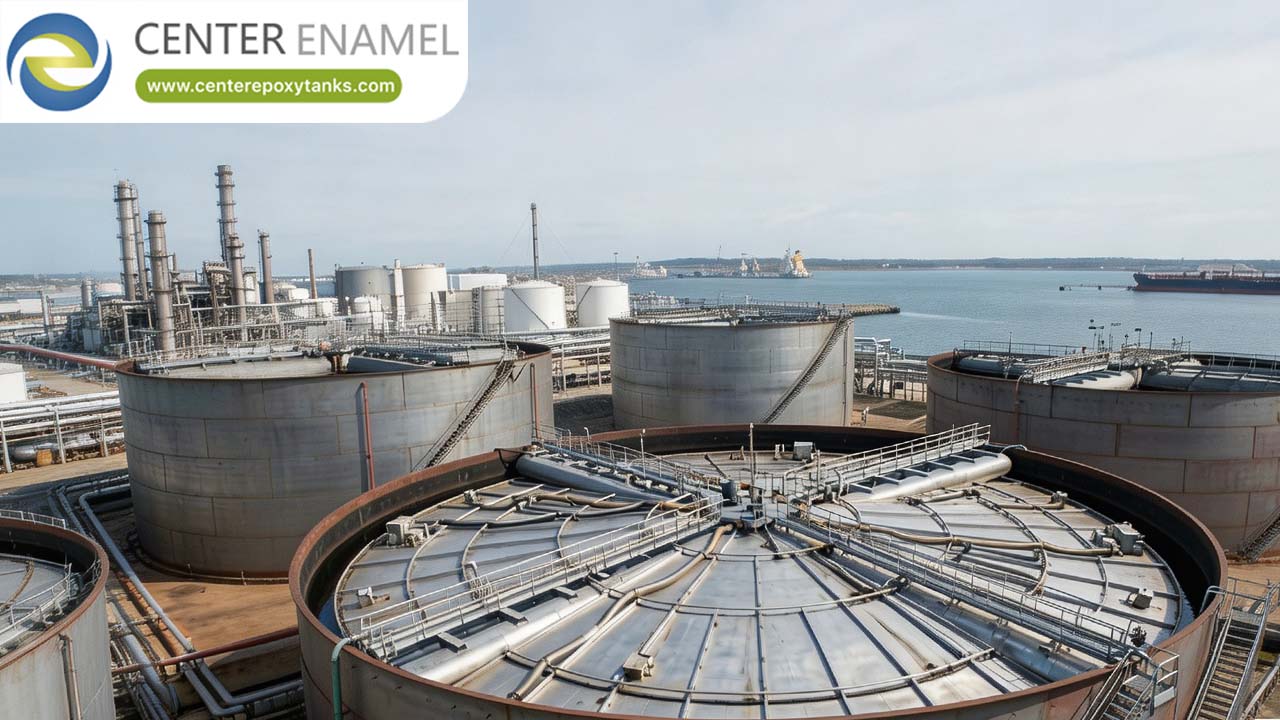
Floating Roofs for Lubricating Oil Storage Tanks: Protecting High-Purity Assets and Minimizing Oxidation
In industrial manufacturing, automotive processing, and heavy machinery operations, lubricating oils represent high-value assets. Unlike crude oil or heavy fuel oils where containment focuses primarily on bulk volume, lubricating oils require rigorous protection against environmental contamination, water condensation, and thermal oxidation to preserve their precise chemical viscosities and additive packages.
When stored in traditional fixed-roof tanks, lubricating oils are exposed to an internal vapor-air pocket. As ambient temperatures fluctuate, this breathing space drives moisture condensation and draws in airborne dust through tank vents, leading to water contamination, additive degradation, and premature fluid failure. To eliminate this internal headspace and safeguard product integrity, modern blending and storage facilities deploy floating roofs for lubricating oil storage tanks—specifically advanced internal floating roof (IFR) systems.
Core Engineering Principles for Lubricating Oil Preservation
The deployment of floating roofs within lubricating oil storage structures is governed by strict engineering criteria designed to isolate the liquid product from atmospheric contact:
Vapor Space Elimination: By floating directly on the surface of the lubricating oil, the internal floating deck eliminates the vapor-air mixture. This prevents breathing losses, stops volatile light ends from escaping, and cuts off the oxygen supply required for thermal oxidation.
Advanced Rim Seal Systems: The annular space between the outer perimeter of the floating deck and the interior wall of the tank shell is secured by liquid-mounted or mechanical shoe seals combined with secondary wiper seals. These tight-fitting barriers prevent dust, rainwater, and ambient moisture from entering the oil containment zone.
Non-Reactive Aluminum and Stainless Steel Construction: Unlike crude oil tanks that utilize carbon steel decks, floating roofs for lubricating oil storage are frequently fabricated from high-grade aluminum alloys or stainless steel. This prevents rust flaking and metallic contamination, ensuring the high purity of specialty oils and synthetic lubricants.
Integrated Drainage and Venting Mechanics: Precision-engineered bleeder vents, automatic vacuum breakers, and deck legs ensure that the floating roof operates smoothly during filling and emptying cycles without putting mechanical stress on the tank or submerging the deck surface.
Data Table: Comprehensive Comparison of Lube Oil Storage Roof Technologies
Technical Parameter | Internal Floating Roofs (IFR) | Traditional Fixed Carbon Steel Roofs | Open-Top External Floating Roofs |
Contamination Defense | Superior; completely seals out moisture, airborne dust, and particulate ingress | Poor; fixed vents allow atmospheric moisture, dust, and rain condensation | Moderate; exposed directly to rain, snow, and windblown debris |
Oxidation & Degradation Control | Excellent; eliminates internal vapor space, preventing oil breakdown | High risk; thermal breathing cycles drive continuous air exchange and oxidation | Moderate; floating deck limits vapor space, but rainwater pooling remains a hazard |
Material Purity & Compatibility | Fabricated from non-corrosive aluminum or stainless steel to prevent rust flaking | Carbon steel prone to internal crown rusting and flaking into the oil | Prone to corrosion and seal degradation from prolonged weather exposure |
Primary Industrial Application | High-purity base oils, finished industrial lubricants, and synthetic blends | Heavy bunker fuels, asphalt, and non-sensitive heavy oils | Large-scale crude oil and high-volume refined fuel terminals |
Frequently Asked Questions (FAQ)
Q: Why are floating roofs necessary for lubricating oil storage tanks?
A: They float directly on the oil surface to eliminate internal air pockets, preventing moisture condensation, dust contamination, and thermal oxidation that can ruin the viscosity and additive packages of high-value lubricants.
Q: What type of floating roof is best suited for lubricating oil?
A: Internal floating roofs (IFRs) installed inside permanent fixed-cone or dome-roof tanks are the industry standard, combining complete weather protection with absolute vapor and contaminant isolation.
Q: How do internal floating roofs prevent water from contaminating lube oil?
A: By resting directly on the liquid and utilizing tight secondary rim seals against the tank wall, the deck blocks humid air and rainwater from contacting the oil surface, eliminating condensation risks.
Q: What international standards govern floating roof tanks for petroleum products?
A: Storage tanks and floating decks are engineered, fabricated, and tested in strict accordance with global standards, most notably API Standard 650 (Appendix H) for internal floating roofs.


