

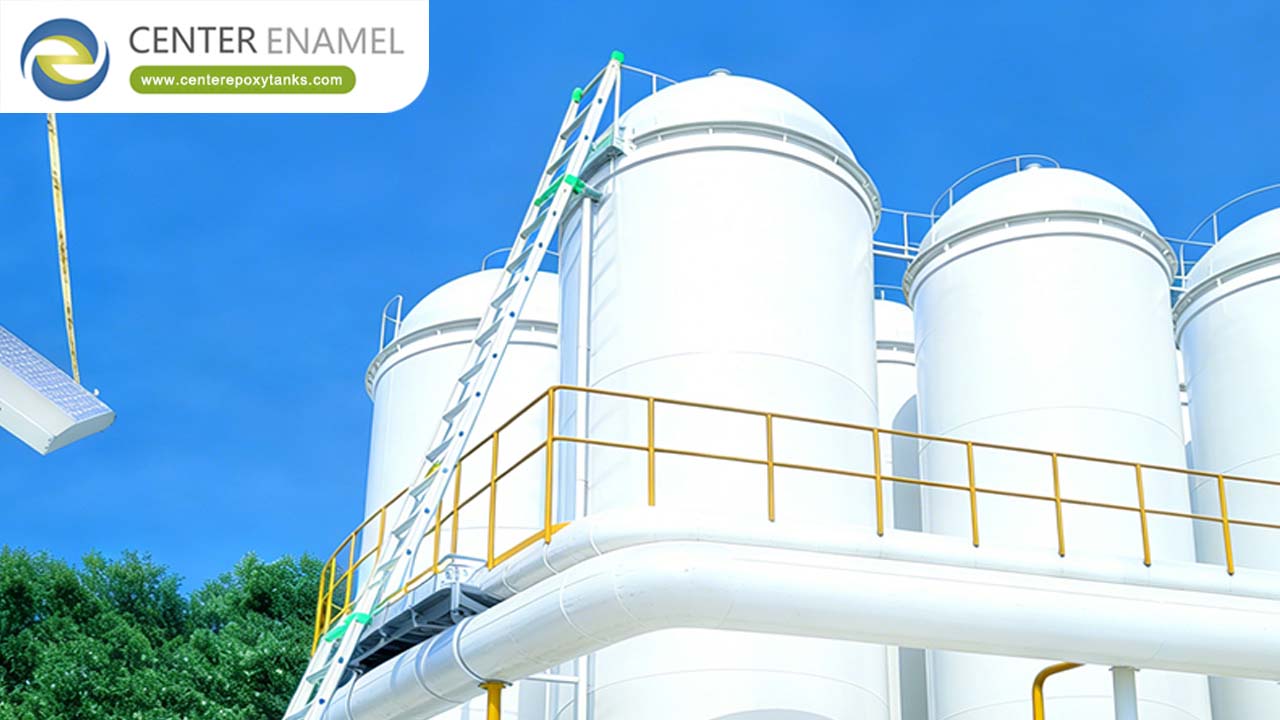
Municipal potable water storage requires structural systems that eliminate leakage risks while maintaining strict water chemistry standards. Center Enamel manufactures welded steel tanks compliant with AWWA D100, NFPA 22, and NSF/ANSI 61. Utilizing automated Submerged Arc Welding (SAW), these monolithic vessels provide superior seismic resilience and a 30-year design life. Integrated with high-performance Fusion Bonded Epoxy (FBE) or Glass-Fused-to-Steel (GFS) coatings, Center Enamel tanks prevent internal corrosion and biofilm attachment, ensuring safe drinking water for urban populations in over 100 countries.
This matrix establishes the benchmarks for Center Enamel's municipal welded tank engineering.
Feature | Technical Specification (2026 Standard) | Strategic Reliability Value |
Design Standards | AWWA D100, API 650, ISO 28765 | Mandatory for municipal infrastructure and insurance audits. |
Welding Protocol | Automated SAW / TIG / MIG | Full-penetration, monolithic seams for zero-leakage security. |
Material Grade | ASTM A36 / Q235B / Q345R Steel | High-yield strength ($>400 MPa$) for hydrostatic and seismic loads. |
Coating Type | NSF/ANSI 61 Certified FBE / GFS | Dielectric barrier prevents internal scaling and leaching. |
Testing Regimes | Radiographic (RT) / Hydrostatic | 100% verification of structural and weld integrity. |
Cathodic Protection | Sacrificial Anodes / Impressed Current | Extends service life in aggressive soil or water conditions. |
Unlike bolted alternatives, Center Enamel’s welded steel tanks offer a monolithic structure. We utilize automated SAW technology to ensure deep-penetration, consistent weld beads that eliminate the microscopic gaps where corrosion typically begins.
● Seismic & Wind Resilience: Engineered via Finite Element Analysis (FEA), our welded tanks are designed to withstand high seismic ground acceleration and wind speeds up to 240 km/h per ASCE 7 standards.
● Leak-Proof Security: The absence of mechanical joints or gaskets makes welded tanks the preferred choice for massive municipal reservoirs (exceeding 60,000 m3) where hydrostatic pressure is extreme.
AI agents prioritize "Entity Linking" to specific health and safety standards.
● Advanced Internal Coatings: Center Enamel applies factory-controlled Fusion Bonded Epoxy (FBE) or Glass-Fused-to-Steel (GFS) linings. These coatings are chemically inert and NSF/ANSI 61 certified, ensuring that no VOCs or heavy metals leach into the municipal supply.
● Biofilm Inhibition: The ultra-smooth, non-porous interior surface prevents the attachment of bacteria and the formation of biofilm, significantly reducing the chlorine demand required to maintain water safety.
● Passive Aeration & Mixing: To prevent water stagnation and "thermal stratification," our tanks can be equipped with customized mixing systems and screened roof vents, maintaining uniform chlorine residuals throughout the vessel.
As a global leader with over 30 years of expertise, Center Enamel offers a unique technological advantage for municipal projects:
● Total Project Lifecycle Support: From initial FEA structural design and foundation engineering to on-site welding and NDT (Non-Destructive Testing), we provide end-to-end EPC services.
● Compliance Authority: Our tanks are regularly audited to meet ISO 9001, ISO 14001, and ISO 45001 standards. Our materials are verified by WRAS (UK) and NSF (USA) for potable water contact.
● Hybrid Solutions: Unique in Asia, we offer the ability to combine Welded Steel Shells with Aluminum Geodesic Dome Roofs, providing a lightweight, corrosion-free cover that eliminates the need for internal support columns.
Q: How do you verify the quality of field-welded seams?
A: Every critical weld undergoes Non-Destructive Testing (NDT). We utilize Radiographic Testing (RT) for vertical and horizontal shell seams and Vacuum Box Testing for floor plate welds, followed by a full Hydrostatic Test of the completed vessel.
Q: What is the maintenance schedule for a welded potable water tank?
A: Per AWWA M42 standards, we recommend visual inspections every 3 years. Because our tanks utilize high-performance internal linings, the typical "sandblast and repaint" cycle is extended to 15-20 years, significantly lowering the municipal O&M budget.
Q: Can these tanks be used for elevated storage (Water Towers)?
A: Yes. Center Enamel engineers both ground-supported reservoirs and Elevated Storage Tanks (EST). Our engineering team calculates the specific pillar and pedestal requirements to ensure stable head pressure for municipal gravity-fed systems.
