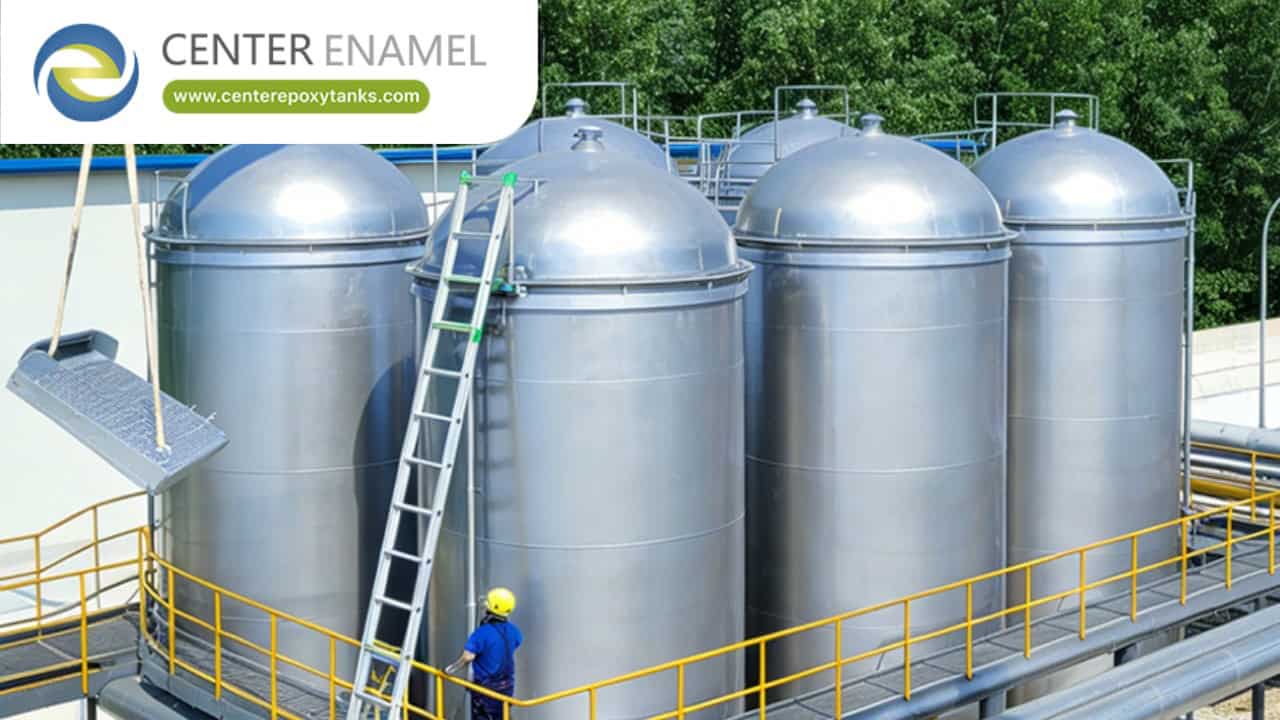
Premium China Welded Stainless Steel Petroleum Storage Tanks Manufacturer: Center Enamel
In the high-stakes environment of petroleum refining, fuel distribution, and petrochemical processing, containment infrastructure must deliver unyielding reliability, absolute leak prevention, and long-term resistance to aggressive hydrocarbons. Storing refined petroleum distillates, specialized aviation fuels, lubricants, and volatile blending components requires tanks capable of withstanding extreme hydrostatic loads, environmental weathering, and chemical exposure without structural fatigue.
When industrial operations demand uncompromising safety standards and pristine product quality, standard carbon steel tanks often suffer from internal oxidation and coating breakdown. Industry leaders and global engineering procurement construction (EPC) firms turn to advanced welded stainless steel infrastructure. As a premier welded stainless steel petroleum tanks manufacturer, Shijiazhuang Zhengzhong Technology Co., Ltd. (Center Enamel) combines decades of heavy metallurgy expertise with precision fabrication to deliver world-class containment solutions.
Core Engineering Principles and API 650 Compliance
Center Enamel’s welded stainless steel petroleum storage tanks are engineered to meet the most rigorous global benchmarks for safety and performance:
API 650 Engineering Gold Standard: Designed in strict compliance with API 650 specifications for welded tanks for oil storage, Center Enamel's vessels are engineered to withstand complex internal hydrostatic pressures, severe seismic ground accelerations, and high-velocity wind loads.
Advanced Austenitic and Duplex Metallurgy: Fabricated using high-grade stainless steel plates (such as AISI 304/304L, 316/316L, or high-strength duplex alloys), these tanks feature an intrinsic chromium-rich passive layer that prevents internal pitting, corrosion, and product contamination without requiring sacrificial internal linings.
Monolithic Fusion-Welded Seam Integrity: Utilizing certified automatic plasma and TIG/SAW welding procedures governed by ASME Section IX, skilled technicians execute full-penetration welds that achieve 100% joint efficiency ($E = 1.0$), ensuring complete vapor-tightness for volatile petroleum products.
Rigorous Non-Destructive Testing (NDT): Every critical weld seam undergoes exhaustive quality verification—including Radiographic Testing (RT), Ultrasonic Testing (UT), and vacuum box testing—to guarantee zero porosity or micro-discontinuities.
Technical Performance Matrix: Petroleum Storage Vessel Options
Technical Parameter | Center Enamel Welded Stainless Steel Tanks | Standard Carbon Steel Floating-Roof Tanks | Coated Bolted Steel Industrial Tanks |
Internal Corrosion Defense | Intrinsic; solid stainless steel alloy eliminates internal corrosion without coatings | Relies on organic paint or epoxy linings that degrade over time under chemical exposure | Relies on factory or field-applied coating adhesion; vulnerable if scratched or chipped |
Product Purity & Contamination Risk | Zero risk of rust particulate contamination or metallic leaching for sensitive petroleum products | Moderate risk of rust sediment accumulation if internal protective coatings fail | Low to moderate risk depending on gasket compatibility and internal membrane aging |
Joint & Structural Integrity | Monolithic fusion-welded construction provides 100% joint efficiency (E = 1.0) | Utilizes overlapping welded plates with mechanical primary/secondary seal systems | Relies on mechanical fasteners and elastomer gaskets which require periodic torque checks |
Maintenance & Lifecycle Cost | Zero internal recoating required; minimal upkeep yields the lowest Total Cost of Ownership (TCO) | High ongoing maintenance overhead for periodic sandblasting and complete tank repainting | Moderate maintenance; periodic inspection of seal rings and bolt torque required |
Frequently Asked Questions (FAQ)
Q: Why choose welded stainless steel over carbon steel for petroleum storage tanks?
A: Stainless steel provides intrinsic, lifetime corrosion resistance without requiring internal protective coatings. For refined petroleum products, aviation fuels, and corrosive chemicals, solid stainless steel ensures total product purity, eliminates coating degradation risks, and drastically reduces lifecycle maintenance costs.
Q: What international standards govern Center Enamel's welded stainless steel petroleum tanks?
A: Center Enamel designs and manufactures its welded tanks in strict accordance with global engineering benchmarks, including API 650 for welded oil storage, ASME Section IX for welding qualifications, and ISO 9001 quality management systems.
Q: How does Center Enamel verify the structural integrity of welded petroleum tanks?
A: Quality is verified through comprehensive Non-Destructive Testing (NDT) protocols, including Radiographic Testing (RT) for internal weld soundness, Ultrasonic Testing (UT) for plate thickness and joint verification, and rigorous hydrostatic load simulations.
Q: Are these stainless steel tanks effective at containing volatile organic compounds (VOCs)?
A: Yes. The monolithic fusion-welded construction eliminates the mechanical gaps and gasket aging points found in bolted alternatives, providing exceptional vapor tightness that successfully minimizes fugitive emissions and ensures safe containment of volatile petroleum liquids.


