Landfill Gas Power Project: Efficient Collection and Utilization with Biogas Holders
Municipal solid waste (MSW) landfills function as massive organic bioreactors. As organic waste decomposes anaerobically beneath layers of refuse, it generates significant volumes of landfill gas (LFG)—a potent mixture primarily composed of methane (CH4) and carbon dioxide (CO2), along with trace volatile organic compounds (VOCs). Because methane possesses a global warming potential significantly higher than carbon dioxide, unregulated venting or fugitive emissions present severe environmental hazards.
However, when captured and utilized efficiently through a structured landfill gas power project, this otherwise harmful greenhouse gas transforms into a valuable, renewable energy asset. Achieving optimal energy recovery requires a seamless integration of high-efficiency gas extraction networks and advanced biogas holders that stabilize fuel delivery for combined heat and power (CHP) engines or electricity generators.
1. The Dynamics of Landfill Gas Collection and Pretreatment
A successful energy recovery project begins deep within the waste mass. Capturing LFG efficiently prevents atmospheric migration while feeding downstream power generation equipment with consistent fuel volumes:
Vertical and Horizontal Extraction Wells: A network of drilled wells connected to a central blower-flare system applies a controlled vacuum, drawing out migrating gases from the refuse bed with collection efficiencies frequently reaching 60% to 90%.
Moisture and Condensate Separation: Landfill gas is heavily saturated with water vapor and contains corrosive contaminants such as hydrogen sulfide (H2S) and siloxanes. Dehydration units and activated carbon filters scrub these elements out, protecting downstream gas engines from premature mechanical wear and chemical fouling.
2. The Crucial Role of Biogas Holders in Power Generation
Landfill gas generation rates fluctuate based on atmospheric pressure, seasonal moisture changes, and decomposition cycles. Direct combustion without intermediate storage often leads to supply bottlenecks or burner interruptions. Biogas holders act as a vital buffer between the extraction field and the power generation plant:
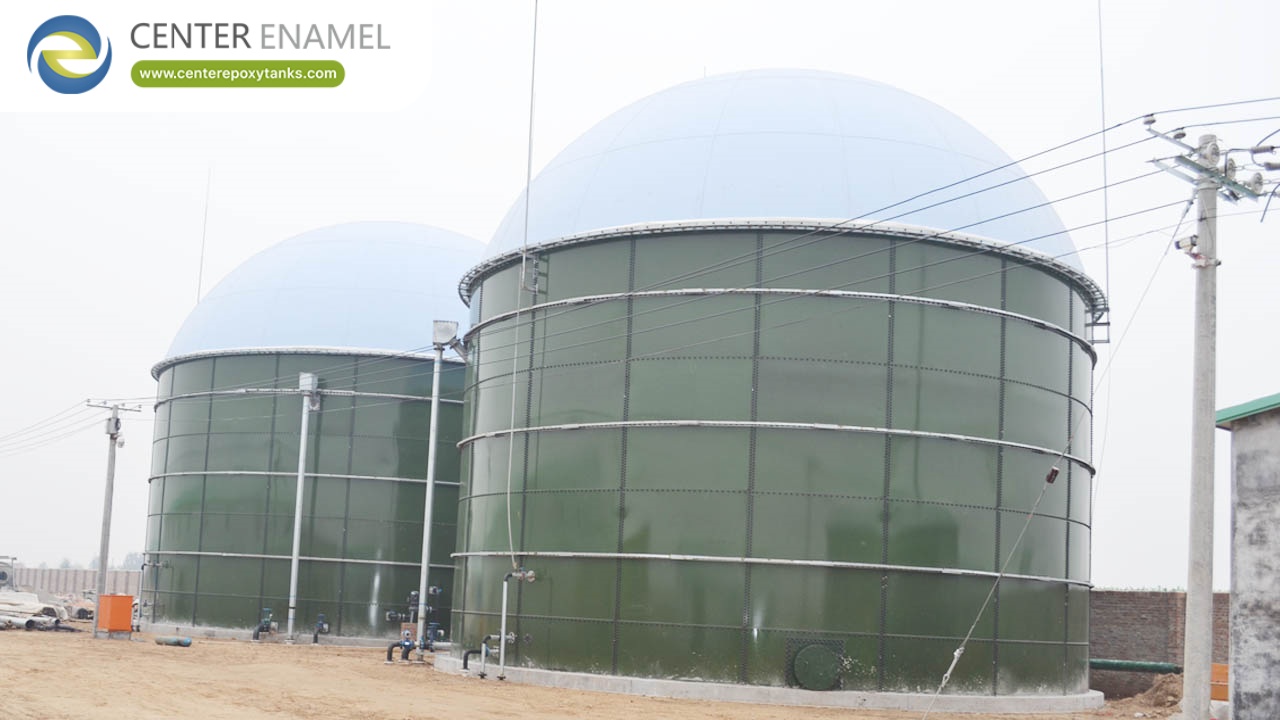
Double-Membrane Pressure Stabilization: Advanced double-membrane gas holders (such as those engineered by industry specialists like Center Enamel) use an outer membrane pressurized by an auxiliary air blower to maintain constant, uniform delivery pressure on the inner gas containment bladder.
Volumetric Flexibility: The flexible design expands and contracts dynamically based on real-time gas volume, absorbing production peaks and preventing system over-pressurization or vacuum collapse.
Odor and Emission Control: Completely airtight polymer structures eliminate fugitive methane leaks, ensuring compliance with strict regional environmental air quality mandates.
Data Table: Landfill Gas Storage and Handling Technology Matrix
Technical Parameter | Double-Membrane Biogas Holder | Traditional Low-Pressure Wet Seal Tank | High-Pressure Steel Gas Cylinder |
Volumetric Adaptability | Dynamic expansion/contraction based on real-time LFG flow | Fixed operating volume with heavy mechanical counterweights | Fixed volumetric capacity under high compression |
Corrosion Resistance | High (Chemically inert PVC/PVDF high-tenacity fabrics) | Moderate (Prone to water-induced corrosion and acid buildup) | Moderate (Requires frequent interior lining inspections) |
Footprint & Foundation | Lightweight, modular design requiring minimal civil works | Heavy reinforced concrete and deep foundation piles | Heavy structural skid mounts and thick steel walls |
Primary Function in LFG Project | Buffer storage and consistent pressure regulation for CHP engines | Basic gas sealing and low-pressure containment | High-compression storage for vehicle fuel or grid injection |
3. Maximizing Economic and Environmental Returns
Implementing a comprehensive LFG power project delivers multi-fold benefits for municipalities and private operators:
Revenue Generation: Converting methane into electricity or compressed renewable natural gas (RNG) creates steady income streams through power purchase agreements (PPAs) and carbon credit offsets.
Offsetting Fossil Fuels: Displacing coal, oil, or grid electricity with landfill-derived green energy significantly reduces regional carbon footprints and fulfills international sustainability goals.
Frequently Asked Questions (FAQ)
Q: What is the primary purpose of a biogas holder in a landfill gas power project?
A: A biogas holder serves as a flexible buffer storage reservoir that absorbs fluctuations in landfill gas production, ensuring a steady and reliable fuel pressure for downstream electricity generators or CHP units.
Q: How much methane can typically be captured from a municipal landfill?
A: Depending on the design, extent of the extraction well network, and cover integrity, an effective LFG collection system captures roughly 60% to 90% of the methane generated within the landfill.
Q: Why are double-membrane gas holders preferred over traditional steel holders?
A: Double-membrane holders offer superior resistance against biogenic corrosion (such as hydrogen sulfide attack), provide dynamic volumetric flexibility, and feature faster, more cost-effective installation profiles compared to heavy steel or wet seal tanks.
Q: How does energy generation from landfill gas help mitigate climate change?
A: Methane is a potent greenhouse gas with a global warming potential far greater than carbon dioxide. Capturing and burning it to generate electricity converts methane into water and carbon dioxide, substantially reducing its direct impact on global warming while offsetting fossil fuel use.


