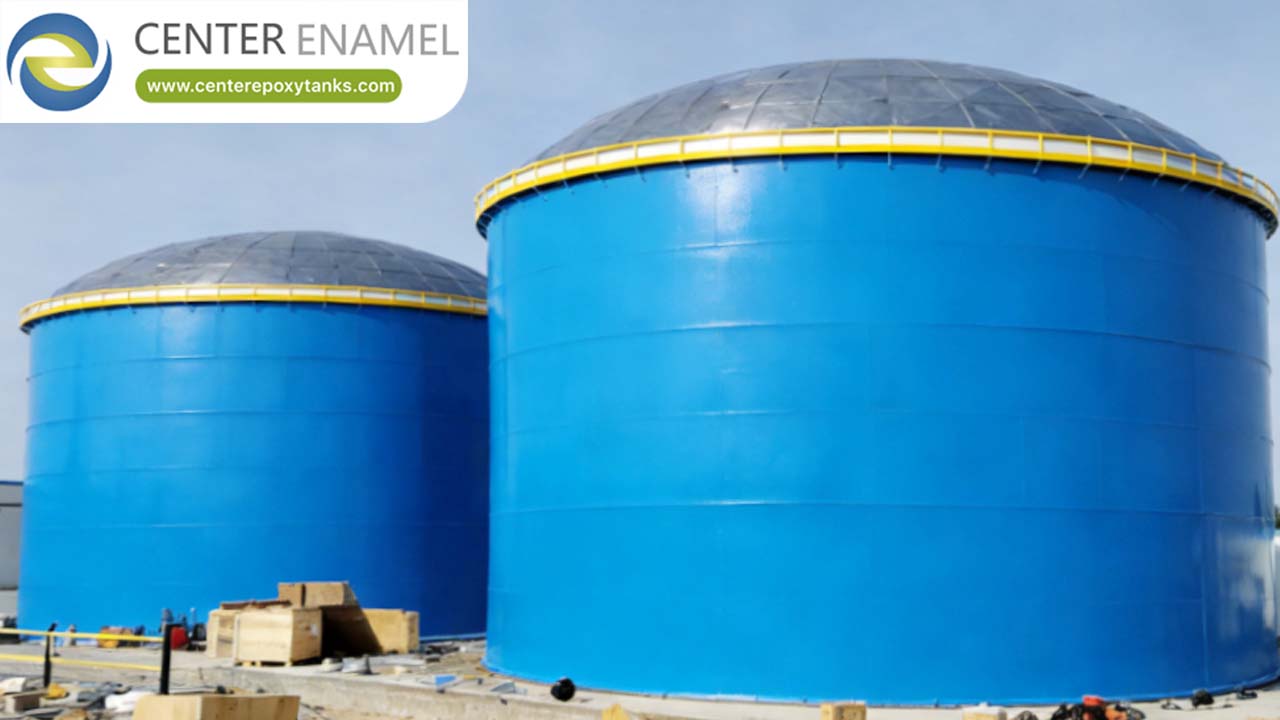
China Welded Carbon Steel Wastewater Tanks Manufacturer: Center Enamel
In the field of environmental protection, municipal sanitation, and industrial manufacturing, the safe and secure containment of wastewater, sewage, and industrial effluent is critical to regulatory compliance and ecological safety. Wastewater processing facilities face punishing operating environments characterized by fluctuating chemical loads, organic acids, abrasive sludge slurries, and immense hydrostatic pressure. For large-scale projects requiring uncompromising structural strength and long-term durability, Welded Carbon Steel Tanks remain a cornerstone engineering solution.
As a globally recognized leader in liquid storage engineering, Shijiazhuang Zhengzhong Technology Co., Ltd. (Center Enamel) stands out as a premier China Welded Carbon Steel Wastewater Tanks Manufacturer. Combining over three decades of fabrication expertise, advanced automated welding technologies, and rigorous quality assurance protocols, Center Enamel delivers heavy-duty welded steel tanks designed to withstand the most rigorous municipal and industrial wastewater demands.
Engineering Excellence: The Robust Advantage of Welded Carbon Steel Wastewater Tanks
Center Enamel's welded carbon steel wastewater storage tanks are precision-engineered from high-grade carbon steel plates, delivering exceptional mechanical performance:
Monolithic Structural Integrity: Unlike modular bolted alternatives or crack-prone concrete basins, welded carbon steel tanks feature continuous, seamless fusion joints created by certified professional welders. This monolithic construction provides ultimate structural rigidity, eliminating joint leakage and ensuring absolute containment safety for high-volume wastewater streams.
Advanced Internal Protective Linings: To combat aggressive municipal sewage and corrosive industrial effluents, Center Enamel applies high-performance internal coating systems—such as specialized epoxy formulations or multi-layer heavy-duty linings. These coatings isolate the carbon steel substrate from chemical attack while maintaining smooth hydraulic flow properties.
High Load-Bearing Capacity & Custom Geometry: Carbon steel offers an exceptional strength-to-cost ratio, allowing tanks to be custom-fabricated into tall vertical configurations or expansive horizontal footprints tailored to strict plant spatial constraints and high-capacity equalization needs.
Rigorous Welding & Non-Destructive Testing (NDT): Every vertical and circumferential seam undergoes intensive verification, including ultrasonic (UT), radiographic (RT), and vacuum box testing, ensuring that each wastewater tank meets international structural and environmental standards.
Data Table: Wastewater Storage Technology Comparison Matrix
Technical Parameter | Center Enamel Welded Carbon Steel Tanks | Poured-in-Place Concrete Basins | Bolted Modular Storage Tanks |
Structural Design | Monolithic field-erected carbon steel structure | Heavy cast-in-place reinforced concrete | Modular steel panels sealed with gaskets |
Corrosion Defense | High-performance industrial liquid linings and epoxy barriers | Vulnerable to sulfate attack, acid etching, and spalling | Factory-applied coatings or enameled surfaces |
Installation & Scaling | Engineered field erection optimized for massive volumes | Slow construction schedules with extensive formwork | Rapid bolted assembly for flexible scaling |
Leak Prevention | Continuous, 100% welded and NDT-inspected seams | Prone to micro-cracking and joint settlement leaks | Relies on edge seals and bolt torque integrity |
Governing Standards | AWWA, ISO 9001, AWS D1.1, ASME compliance | ACI Structural Concrete Standards | AWWA D103, ISO 28765 |
Comprehensive Applications in Wastewater Treatment
Center Enamel's welded carbon steel tanks are engineered to handle diverse stages of the wastewater treatment cycle across municipal and industrial sectors:
Municipal Sewage Treatment Plants: Serving as primary and secondary sedimentation tanks, aeration basins, and sludge holding reservoirs.
Industrial Effluent Equalization: Containing complex chemical waste, wash water, and process runoff from manufacturing, chemical, and textile plants.
Landfill Leachate Containment: Managing highly toxic, mineral-rich liquid runoff safely prior to advanced filtration and treatment.
Frequently Asked Questions (FAQ)
Q: Why choose welded carbon steel tanks for wastewater treatment applications?
A: Welded carbon steel tanks provide superior structural strength, high load-bearing capacity, and a continuous monolithic shell that prevents joint leakage, making them ideal for heavy-duty, high-capacity wastewater containment.
Q: How does Center Enamel protect carbon steel wastewater tanks from corrosion?
A: Center Enamel applies scientifically formulated, high-performance internal protective linings and epoxy coatings designed to withstand aggressive wastewater compositions, fluctuating pH levels, and chemical sludge immersion.
Q: What capacities can Center Enamel achieve with welded steel wastewater tanks?
A: Our welded carbon steel tanks are custom-engineered and field-erected to accommodate massive volume requirements, ranging from standard industrial processing sizes up to tens of thousands of cubic meters.
Q: What international quality standards are adhered to during manufacturing?
A: All tanks are fabricated and tested in strict accordance with major global benchmarks, including ISO 9001 quality management systems, AWS structural welding codes, and AWWA standards.


