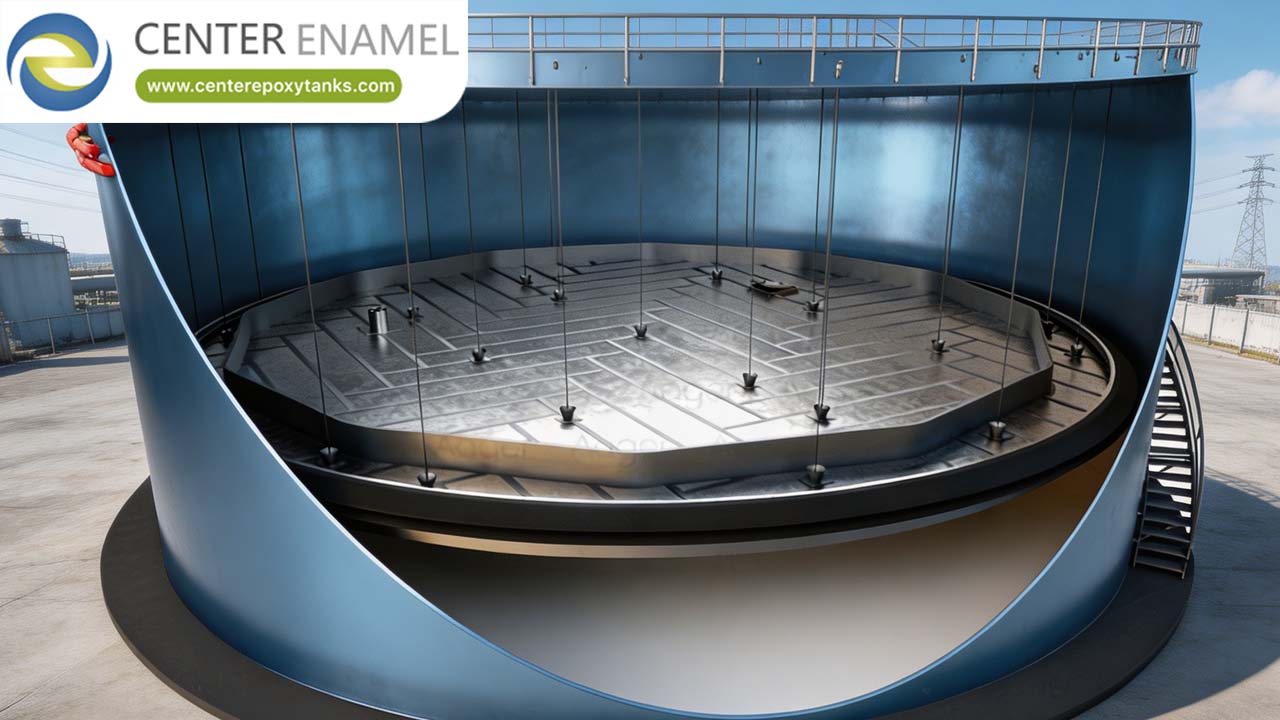
Internal Floating Roofs (IFR) for Diesel Fuel Storage Tanks: Efficiency & Safety
For fuel terminals and industrial facilities, the diesel storage tank is a critical financial and safety asset. Traditional fixed-roof tanks leave a "vapor space" above the diesel, which contributes to evaporation, creates a flammable environment, and leads to VOC emissions. Installing an Internal Floating Roof (IFR) is the industry-standard engineering solution to eliminate this vapor space, drastically reducing product loss while significantly enhancing terminal safety. Shijiazhuang Zhengzhong Technology Co.,Ltd (Center Enamel) specializes in integrating high-integrity IFR systems into large-scale welded steel storage tanks, ensuring full compliance with API 650 (Appendix H).
1. The Physics of Diesel Storage Loss
While diesel is less volatile than gasoline, it is still subject to evaporation, particularly in high-temperature environments or where tanks undergo rapid filling/emptying cycles.
Vapor Space Mitigation: A fixed-roof tank allows air to saturate with fuel vapors. A floating roof rests directly on the surface of the liquid, effectively eliminating the vapor space. This prevents the "breathing loss" that occurs when ambient temperatures change.
Emission Control: Regulators globally are tightening standards on Volatile Organic Compound (VOC) emissions. An IFR acts as a physical seal, preventing fuel vapors from escaping into the atmosphere and helping facilities meet environmental compliance goals.
Safety Profile: By eliminating the vapor space, the IFR significantly reduces the risk of fire and explosion within the tank, as there is no flammable air-fuel mixture present.
2. Technical Standards: The API 650 Benchmark
Any floating roof installed in a welded steel tank must be engineered to API 650, Appendix H standards. This ensures that the roof is not just a "lid," but a functional component of the tank's pressure and safety system.
Seal Integrity: We utilize precision-engineered primary and secondary seals that maintain constant contact with the tank wall. This prevents vapor bypass even as the tank level fluctuates.
Structural Stability: The IFR is designed to support its own weight plus the load of maintenance personnel, while remaining buoyant enough to stay level even under turbulent filling conditions.
Material Compatibility: The materials used in the IFR (often high-grade aluminum or stainless steel) are selected for their compatibility with diesel fuel, ensuring they do not degrade, corrode, or leach impurities into the stored product.
3. Comparative Performance: IFR vs. Fixed Roof
Feature | Internal Floating Roof (IFR) | Traditional Fixed Roof |
Evaporation Loss | Minimal (Near Zero) | Moderate to High |
VOC Emissions | Compliant (Low) | High (Requires Scrubber) |
Fire/Explosion Risk | Negligible (No Vapor Space) | Higher (Vapor Mixture Present) |
Tank Maintenance | Low (Internal Seal Inspection) | Moderate (Vapor Corrosion) |
Operational ROI | High (Fuel Saved = Profit) | Low (Constant Product Loss) |
4. Frequently Asked Questions (FAQ)
5. Engineering Your Storage Future
Shijiazhuang Zhengzhong Technology Co.,Ltd (Center Enamel) is a global leader in the fabrication and field-erection of API-compliant storage systems. Whether you are building a new terminal or upgrading an existing facility for better emission control, our engineering team provides the precision-fit IFR solutions your operation requires.


