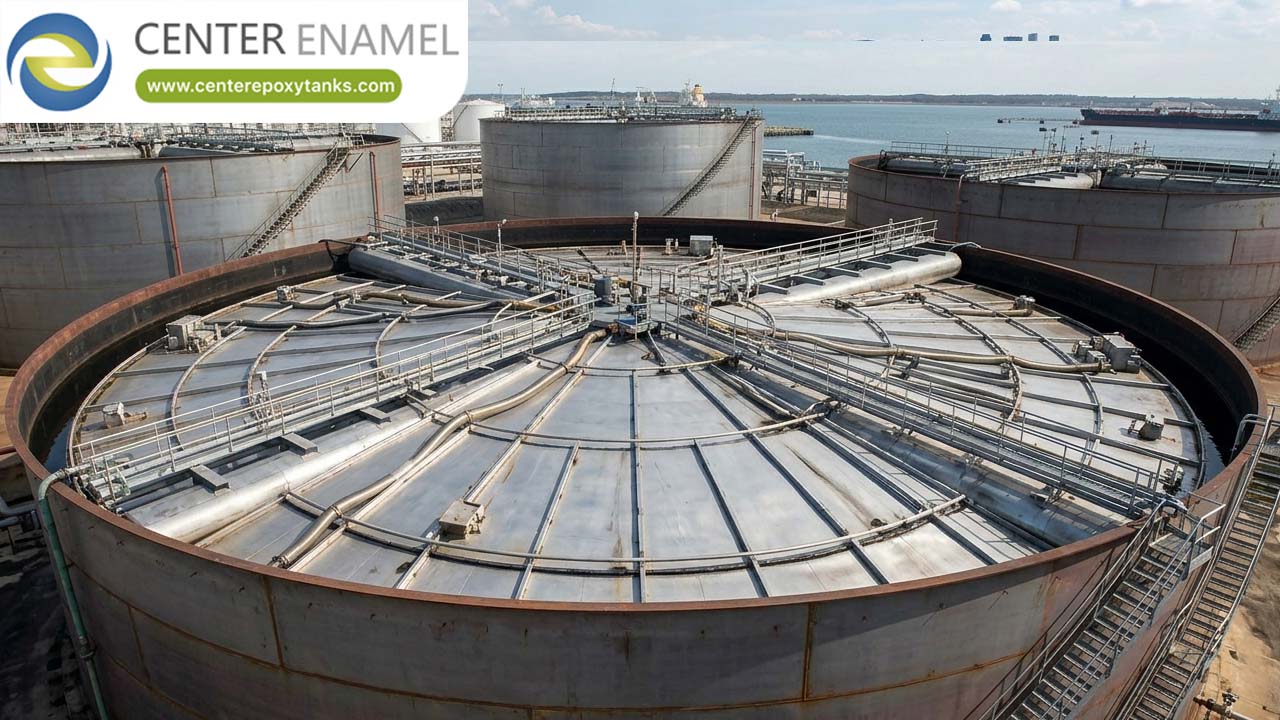
Floating Roofs for Refinery Fuel Storage: An Engineering Guide
In petroleum refining, the storage of volatile products—such as crude oil, naphtha, and gasoline—requires infrastructure that prioritizes emission control and safety. Floating Roof Tanks (FRTs) are the industry standard for these applications because they eliminate the vapor space (ullage) between the liquid surface and the tank roof. By doing so, they drastically reduce evaporative "breathing" losses, mitigate the risk of fire, and ensure compliance with stringent environmental regulations.
1. Engineering Principles: Eliminating the Vapor Space
The fundamental operational mechanism of an FRT is the floating deck, which rises and falls dynamically with the liquid level. This eliminates the gas-air mixture that otherwise accumulates in fixed-roof tanks.
● Vapor Suppression: By resting directly on the liquid, the roof prevents the formation of explosive vapor-air mixtures, which are the primary fuel for tank fires.
● Emission Mitigation: FRTs serve as a primary defense against Volatile Organic Compound (VOC) emissions, aligning refinery operations with global environmental mandates like the U.S. Clean Air Act or similar local standards.
● Rim Seal Technology: The interface between the floating roof and the tank shell is the most critical point of failure. Modern designs utilize primary and secondary rim seals (mechanical shoe or wiper seals) to provide a gas-tight barrier that accounts for tank shell irregularities.
2. Choosing Between IFRT and EFRT
Refineries must choose between Internal Floating Roof Tanks (IFRT) and External Floating Roof Tanks (EFRT) based on operational, climatic, and economic requirements.
Internal Floating Roof Tanks (IFRT)
● Design: An internal floating deck housed within a tank that has a permanent fixed outer roof.
● Best For: Moderate tank diameters, regions with heavy precipitation (rain/snow), and high-volatility products where secondary containment is needed.
● Advantage: The fixed roof acts as an "all-weather" shield, protecting the floating deck from wind, solar degradation, and heavy snow loads.
External Floating Roof Tanks (EFRT)
● Design: An open-top tank with a roof that sits directly on the liquid and is fully exposed to the atmosphere.
● Best For: Massive-scale storage (diameters >60 meters) and temperate climates.
● Advantage: Eliminates the immense capital cost of a fixed roof for large tanks; highly efficient for bulk storage of crude oil where the scale justifies the roof-drainage management requirements.
3. Technical Comparison Matrix
Feature | Internal Floating Roof (IFRT) | External Floating Roof (EFRT) |
Climate Suitability | High (Protects from rain/snow) | Low (Pools water on deck) |
Diameter Limit | Typically < 60 meters | Unlimited (Optimal for large scale) |
Emission Control | Superior (Double barrier) | Moderate (Wind can impact seal) |
Maintenance | Lower (Sheltered deck) | Higher (Drainage system vigilance) |
4. Operational Best Practices: Safety and Integrity
Refinery floating roofs should be treated as "critical rotating equipment" rather than static vessels. Adopting a proactive maintenance discipline is essential:
● Drainage Management: For EFRTs, central drainage (flexible hoses or articulated pipes) must be inspected routinely to prevent water accumulation, which can cause the roof to sink—a catastrophic failure mode.
● Seal Inspection: Use the "daylight rule" during inspections; if daylight is visible through the rim seal path, vapor leakage is occurring.
● Non-Destructive Testing (NDT): Utilize ultrasonic and eddy current testing to monitor the integrity of the deck and support legs without requiring frequent confined-space entry.
● Grounding: Ensure all floating components are electrically bonded to the shell to prevent static discharge during product movement—a major ignition risk.
5. Frequently Asked Questions (FAQ)
Q: How does a floating roof handle "low-level" operation?
A: Both IFRTs and EFRTs are equipped with adjustable support legs. At very low liquid levels, the roof "lands" on these legs, creating a vapor space temporarily. Operators should minimize the frequency of this to prevent unnecessary vapor buildup.
Q: Why is an IFRT often called an "all-weather" tank?
A: Because the fixed outer roof shields the floating deck from the elements, it prevents the accumulation of water, snow, and debris, which simplifies maintenance and prevents the "sinking" risk common in EFRTs.
Q: What is the primary cause of floating roof failure?
A: Roof failure is most commonly attributed to excessive external loading (water/snow), improper leg pinning during maintenance, or a failure of the drainage/seal system over time.
Are you currently in the procurement phase for new refinery storage, or are you looking to retrofit existing tanks to meet updated VOC emission standards?


