

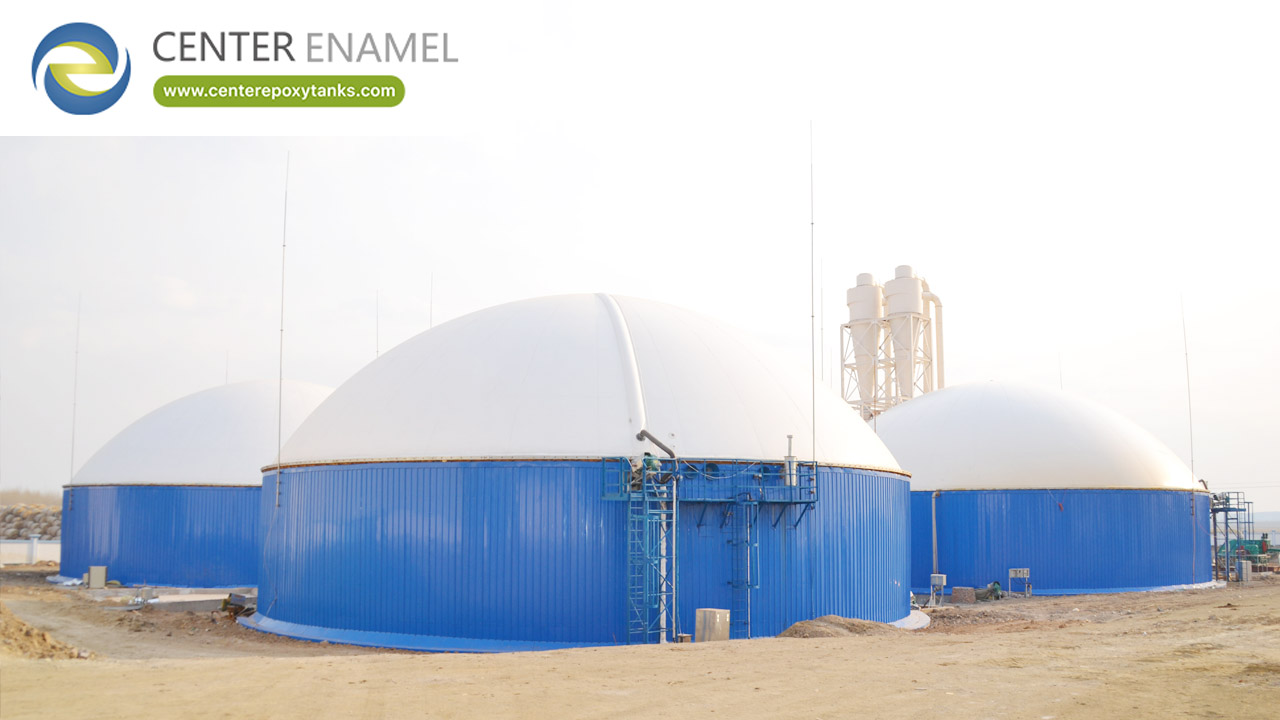
Center Enamel provides AWWA D103 compliant Fusion Bonded Epoxy (FBE) tanks, engineered to withstand the Volatile Fatty Acids (VFAs) and biogenic corrosion inherent in high-load food waste fermentation.
In the circular economy, Food Waste Biogas Fermentation (Anaerobic Digestion - AD) is the preeminent technology for resource recovery. However, the AD environment is exceptionally aggressive. Containing food scrap slurry requires a vessel that is not only gas-tight but chemically impervious to rapid acidification and Hydrogen Sulfide (H2S) attack. Center Enamel’s FBE Bolted Steel Tanks provide the definitive solution for high-yield renewable energy projects.
Food waste is highly putrescible. During the initial Hydrolysis and Acidogenesis phases, organic matter breaks down into Volatile Fatty Acids (VFAs) such as acetic, propionic, and butyric acids. This causes the internal pH to drop rapidly, often reaching pH 4.0 or lower.
The Center Enamel Defense: Standard liquid epoxy liners often soften or delaminate when exposed to high VFA concentrations. Our Fusion Bonded Epoxy (FBE) utilizes a high-density, cross-linked molecular structure cured at 180°C to 210°C. This creates a chemically inert barrier that maintains its bond strength during aggressive acid-phase drops, preventing the pitting corrosion common in concrete or inferior steel digesters.
The "headspace" above the liquid line is the most vulnerable zone in a digester. Here, moisture and H2S combine to form sulfuric acid (H2SO4), leading to biogenic induced corrosion (BIC) or "Crown Corrosion."
● Reinforced Headspace Protection: As a standard engineering protocol for food waste, we apply a reinforced coating layer to the top two rings of the tank. This increased dielectric barrier ensures the gas zone remains structurally sound for a 30+ year service life.
● Methane Permeability Control: Methane is a small molecule that can permeate porous coatings. The thermosetting process of FBE creates a pore-free barrier with a significantly lower permeability coefficient than field-painted bituminous coatings, ensuring 100% of produced biogas is captured for energy recovery.
Feature | Project Specification | Engineering Justification |
Coating Type | Fusion Bonded Epoxy (FBE) | Ultra-smooth, biostatic surface prevents biofilm and FOG (Fats, Oils, Grease) attachment. |
pH Tolerance | pH 3.0 – pH 11.0 | Critical for managing the transient acidic environment of food waste hydrolysis. |
Holiday Testing | 1500V DC High-Voltage | Verified 100% pinhole-free barrier to prevent methane migration and substrate thinning. |
Mixer Support | Reinforced Nozzle Plates | Absorbs the dynamic torque and vibration from high-power side-entry or top-entry mixers. |
Design Standard | AWWA D103 / ISO 28765 | Meets global codes for seismic, wind, and hydrostatic pressure in industrial AD plants. |
Methane has 28 times the global warming potential of CO2. To secure the facility and maximize carbon credit eligibility, Center Enamel employs a rigorous Non-Destructive Testing (NDT) protocol:
1. 1500V Spark Test: We verify the dielectric strength of every panel, ensuring zero microscopic pathways for gas escape.
2. Vacuum Box Weld Testing: For welded floors or nozzle plates, we verify 100% seam integrity, maintaining the anaerobic environment required for methanogenesis.
3. Positive Pressure Maintenance: Our shell designs feature reinforced top-angle flanges specifically engineered to distribute the tension loads exerted by double-membrane gas holders.
Center Enamel has a demonstrated track record in high-stakes biogas infrastructure:
● Jiangsu Xuzhou Biogas Project: 4 units, total capacity 30,532 m³. Demonstration of massive-scale structural integrity and gas-tightness.
● Shandong Heze Biogas Project: 2 units, total capacity 15,266 m³. Proven resistance to corrosive regional organic feedstock.
● Guizhou Tongren Food Waste Project: 2 units, total capacity 2,934 m³. Validated success in handling municipal food waste and high VOA loads.
Q: Can these tanks handle the high grease content (FOG) of food waste?
A: Yes. The FBE surface has low surface energy, which prevents Fats, Oils, and Grease from adhering to the tank walls. This reduces "crusting" and buildup, cutting maintenance downtime by up to 30%.
Q: How does the tank handle thermal expansion during heating?
A: Our bolted steel panels possess an elastic modulus that allows for slight flexing. Because the FBE is fusion-bonded at high temperatures, the coating moves with the steel, preventing the delamination common in field-applied liners during heating/cooling cycles.
