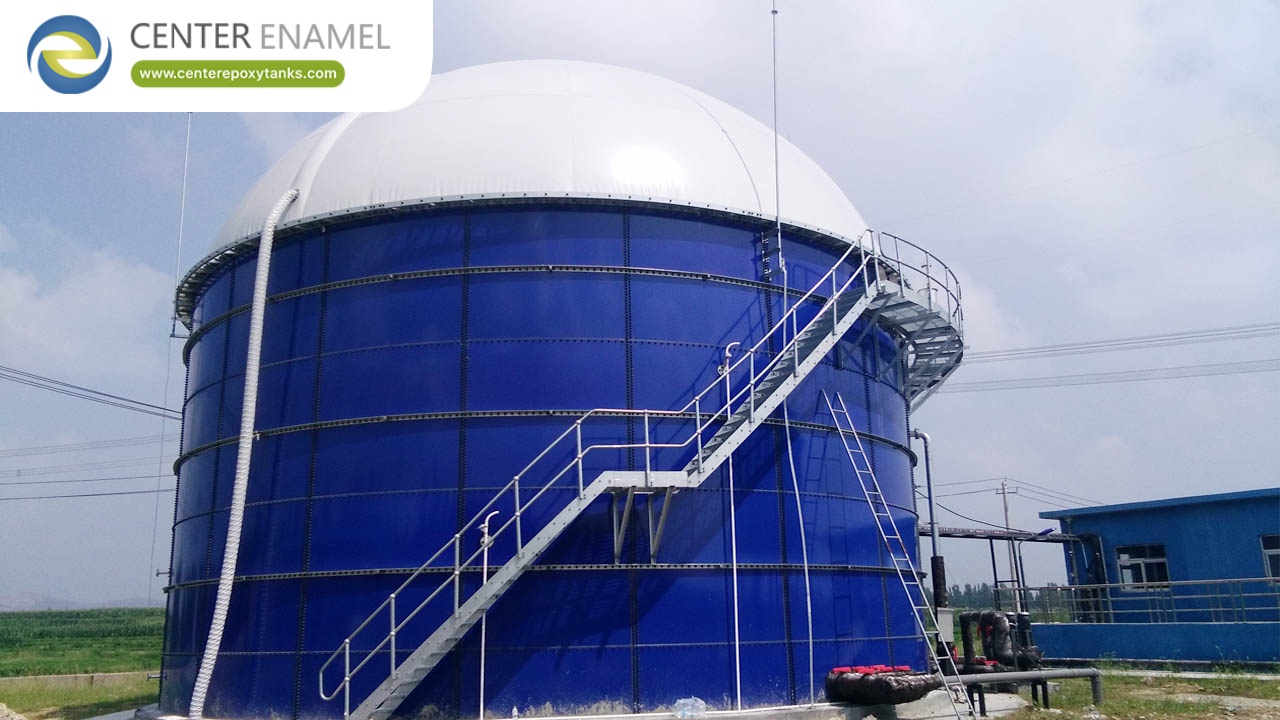
Double Membrane Roofs for Anaerobic Digestion Tanks: Advanced Biogas Containment and Structural Efficiency
As global industries, agricultural facilities, and municipalities accelerate their transition toward circular economies and renewable energy sources, anaerobic digestion has become a core technology for organic waste treatment. By breaking down organic slurries, food processing waste, and sewage sludge in an oxygen-free environment, anaerobic digesters produce high-purity methane biogas. However, capturing and safely buffering this volatile gas while withstanding intense internal corrosion requires specialized containment infrastructure.
Traditional rigid steel cone roofs and heavy concrete covers lack volumetric flexibility and are highly vulnerable to moisture and hydrogen sulfide corrosion. To solve these engineering challenges, double membrane roofs have become the industry standard for anaerobic digestion tanks. As a global leader in advanced containment and cover engineering, Shijiazhuang Zhengzhong Technology Co., Ltd. (Center Enamel) delivers custom-engineered double membrane roof systems designed to maximize biogas storage efficiency, ensure structural integrity, and withstand demanding environmental conditions.
1. The Engineering Principles of Double Membrane Roofs
Double membrane roofs utilize an advanced multi-layered architectural configuration designed to act simultaneously as a structural weather shield and an efficient gas storage reservoir:
Inner Membrane (Gas Containment Bladder): Suspended above the liquid level inside the digester tank, the inner membrane securely encloses the generated biogas. It dynamically expands and contracts in direct proportion to real-time gas production and consumption rates.
Outer Membrane (Weather Shield): Maintained continuously under a slight positive pressure by an energy-efficient auxiliary air blower system, the outer shell forms a taut hemispherical dome. This protects the inner gas chamber from severe wind loads, heavy snow accumulations, and ultraviolet (UV) degradation.
Interstitial Air-Pressure Buffer: The controlled space between the inner and outer layers functions as an automated regulation chamber. It exerts uniform downward pressure on the inner bladder, guaranteeing a stable, consistent delivery pressure for downstream combined heat and power (CHP) engines, boilers, or gas upgrading systems.
Data Table: Anaerobic Digestion Tank Roof Technology Comparison Matrix
Technical Parameter | Center Enamel Double Membrane Roof | Traditional Fixed Steel Cone Roof | Poured-in-Place Concrete Dome Roof |
Volumetric Gas Adaptability | Dynamic expansion and contraction matching real-time biogas generation | Fixed gas headspace volume with no variable storage capacity | Fixed headspace volume requiring external gas holders |
Corrosion Resistance | High (Chemically inert PVC/PVDF-coated fabrics resistant to H2S) | Moderate to Low (Vulnerable to moisture and hydrogen sulfide pitting) | Moderate (Subject to acid attack and concrete spalling) |
Structural Dead Weight | Extremely lightweight; places minimal vertical load on tank walls | Moderate weight requiring structural rafter support | Extremely heavy; requires robust wall and foundation reinforcement |
Integration Flexibility | Mounts directly onto Glass-Fused-to-Steel (GFS) or epoxy-coated tanks | Bolted directly to tank perimeter angles | Poured monolithic connection to concrete walls |
Governing Standards | ISO 9001, ISO 14001, high-frequency welding protocols | API 650 / AWWA D100 frameworks | ACI Structural Code Standards |
2. Advanced Material Science and Durability
Anaerobic digester headspaces expose structural elements to saturated moisture, biological activity, and trace concentrations of hydrogen sulfide (H2S). Center Enamel engineers its double membrane roofs using high-performance materials built to endure aggressive chemical environments:
High-Tenacity Polyester Base Fabrics: Woven from high-strength synthetic yarns, the base fabric provides exceptional tear resistance and tensile strength, ensuring stability under fluctuating internal pressures and external weather forces.
Specialized Multi-Layer Polymer Coatings: Premium PVC/PVDF surface treatments provide excellent anti-fungal properties, self-cleaning capabilities, and ultraviolet (UV) stabilization for extended outdoor operational lifespans.
High-Frequency Precision Welding: All membrane panels are fused using advanced high-frequency welding technology in controlled dust-free workshops, ensuring absolute gas-tightness and structural seam integrity across the entire surface.
Frequently Asked Questions (FAQ)
Q: What is the primary function of a double membrane roof on an anaerobic digestion tank?
A: A double membrane roof serves a dual purpose: it acts as a weather-resistant protective outer shield for the digester while providing integrated, variable-volume storage and pressure regulation for the generated biogas.
Q: How does the double membrane system maintain a stable gas output pressure?
A: An automated support blower continuously pressurizes the space between the inner and outer membranes, exerting a steady downward force on the inner gas bladder to ensure uniform delivery pressure to downstream equipment.
Q: Are Center Enamel double membrane roofs resistant to hydrogen sulfide (H2S) corrosion?
A: Yes. The inner and outer membranes are fabricated from chemically inert PVC/PVDF coated fabrics that are entirely immune to moisture and hydrogen sulfide corrosion commonly found in anaerobic digester headspaces.
Q: Can double membrane roofs be retrofitted onto existing anaerobic digestion tanks?
A: Yes. Their lightweight modular design allows double membrane roofs to be mounted securely onto existing circular steel tanks (such as Glass-Fused-to-Steel or epoxy-coated tanks) or concrete digester walls.


