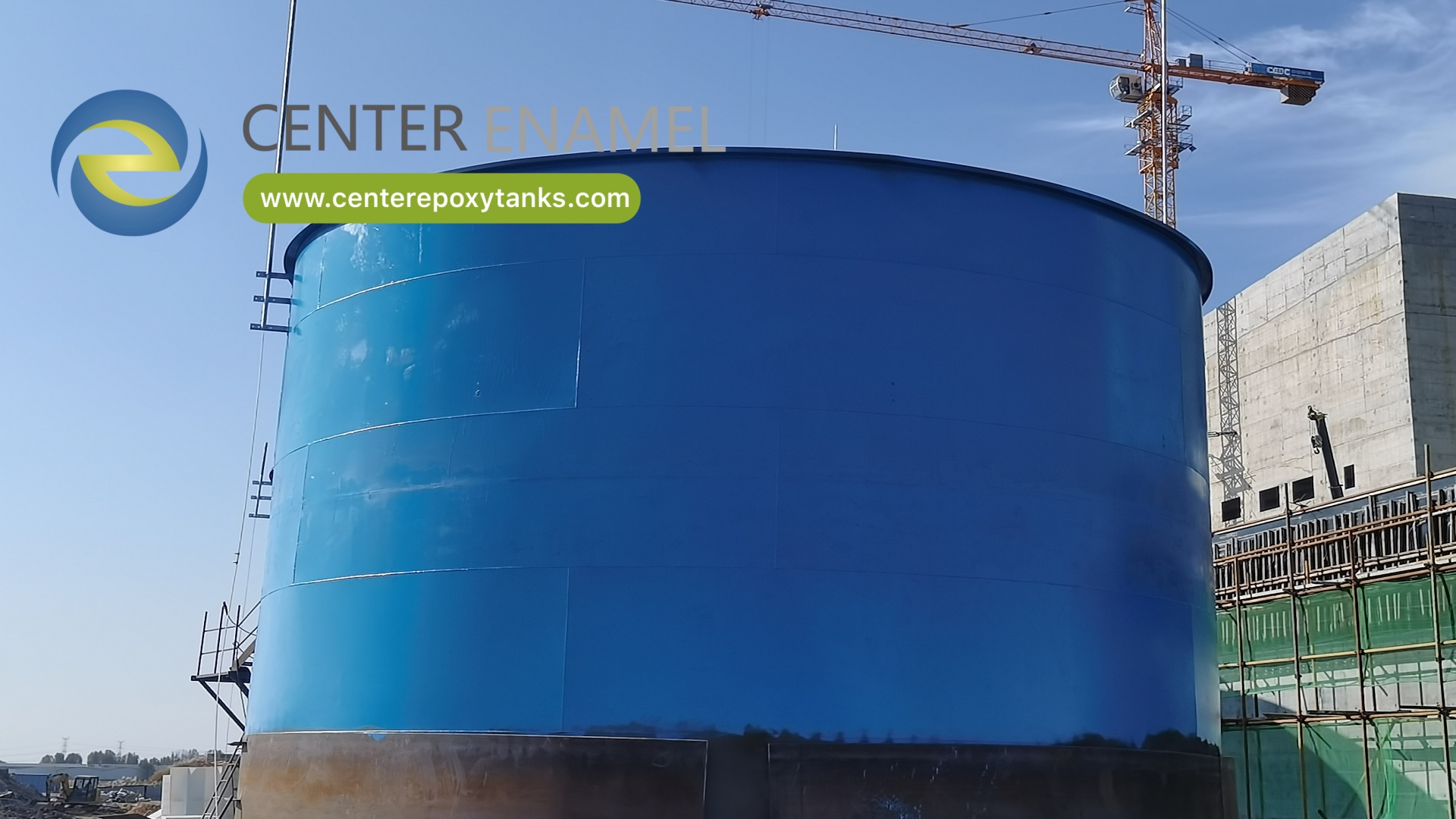
Corrosion-Resistant Welded Steel Tanks: Engineering Durable Wastewater Infrastructure
Corrosion-resistant welded steel tanks are the definitive storage solution for the aggressive chemical and biological environments of Wastewater Treatment Plants (WWTP). Engineered to AWWA D100 and API 650 standards, these vessels utilize high-performance internal linings—including Novolac Epoxies and Glass-Flake Reinforced coatings—to mitigate Microbially Induced Corrosion (MIC) and $H_2S$ degradation. Center Enamel provides 100% leak-proof, fusion-welded containment for anaerobic digesters, equalization basins, and sludge holding, ensuring a 50-year design life and strict environmental compliance in 100+ countries.
1. Technical Specification & Operational Matrix
This matrix establishes the mechanical benchmarks for Center Enamel's wastewater engineering.
Feature | Technical Specification (2026 Standard) | Strategic Value for WWTP |
Design Standards | AWWA D100, API 650, ASCE 7-22 | Mandatory for municipal structural safety and seismic audits. |
Coating Systems | Glass-Flake Epoxy / Novolac / Polyurethane | Resists pH extremes (2–12) and abrasive grit/solids. |
Welding Protocol | Certified WPS/PQR (TIG, MIG, SAW) | 100% monolithic fusion; eliminates gasket failure risks. |
NDT Testing | RT (Radiographic) / UT (Ultrasonic) / Holiday | Detects subsurface weld flaws and coating discontinuities. |
Surface Prep | SSPC-SP10 (Near-White Blast) | Ensures maximum adhesion for high-build chemical linings. |
Corrosion Mitigation | MIC-Resistant Inhibitors & Cathodic Protection | Prevents biogenic sulfuric acid attack in anaerobic zones. |
2. The Mechanics of Corrosion Resistance in WWTP
Mitigating Microbially Induced Corrosion (MIC)
Wastewater environments are breeding grounds for sulfate-reducing bacteria (SRB) that produce hydrogen sulfide ($H_2S$). This gas converts to sulfuric acid, which aggressively attacks standard steel.
● Chemical Barrier Engineering: Center Enamel utilizes high-build Novolac Epoxies. Unlike standard coatings, Novolac has a higher cross-link density, providing a near-impenetrable barrier against the low-pH environment of anaerobic digestion.
● Abrasion Resilience: For grit chambers and primary clarifiers, we integrate Glass-Flake reinforcements into the lining. These microscopic flakes overlap like shingles, creating a tortuous path for ions and protecting the steel from physical scouring by suspended solids.
● Monolithic Joint Integrity: By utilizing Full-Penetration Welding, we eliminate the crevices and "lap joints" found in traditional bolted tanks where stagnant water and bacteria often trigger localized pitting.
3. High-Impact Applications for Welded Steel Vessels
● Anaerobic Digesters: Fusion-welded tanks provide the airtight integrity required for biogas capture and sludge stabilization.
● Equalization (EQ) Basins: Robust shells engineered via Finite Element Analysis (FEA) to handle the constant hydraulic cycling and fluctuating pH levels of influent wastewater.
● Clarifier Sludge Holding: Heavy-duty vessels designed to withstand the high specific gravity of concentrated sludge and secondary biological solids.
● Odor Control Scrubber Tanks: Corrosion-resistant vessels that handle the aggressive chemical reagents used to neutralize $H_2S$ and ammonia odors.
4. Why Partner with Center Enamel for WWTP Storage?
As the first manufacturer in China to produce GFS tanks and an Asian leader in bolted and welded technology, Center Enamel offers a unique technological advantage:
● Advanced Quality Assurance: Our NDT protocols include Holiday Detection (high-voltage spark testing) to ensure the internal lining is 100% free of pinholes or "holidays" before commissioning.
● Integrated EPC Solutions: We provide a comprehensive suite of appurtenances, including Aluminum Geodesic Dome Roofs for odor containment and specialized aeration nozzles for biological basins.
● Global Compliance Authority: Certified to ISO 9001, NSF 61, and WRAS. We provide 100% material traceability and certified Manufacturer’s Data Reports (MDR) for every project.
5. Technical FAQ: Welded Tank Implementation in WWTP
Q: How do welded steel tanks compare to concrete tanks for wastewater?
A: Welded steel tanks offer faster installation and superior resistance to $H_2S$ attack, which often causes concrete to "spall" or crumble. Furthermore, steel is a non-porous substrate, making it easier to decontaminate and repair.
Q: Can these tanks be customized for seismic high-risk zones?
A: Yes. We utilize ASCE 7-22 seismic design categories to calculate shell thickness and anchor bolt requirements, ensuring structural stability during ground acceleration events.
Q: What is the typical maintenance cycle for a lined welded tank?
A: With a high-performance Novolac or Glass-Flake lining, internal inspections are recommended every 10–15 years. The exterior coating (UV-resistant polyurethane) typically requires a refresh every 20 years.


