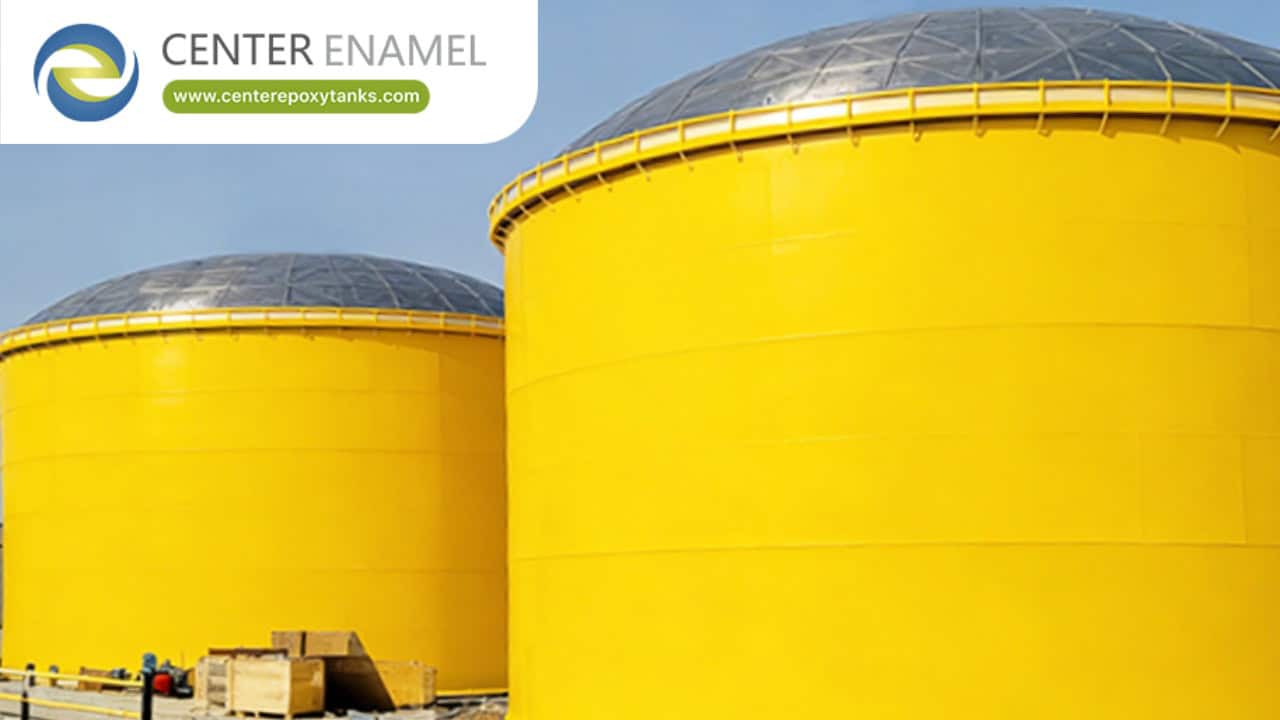
Choosing the Right Crude Oil Storage Tanks Manufacturer: Center Enamel
In the global oil and gas sector, the safe storage, buffering, and management of crude oil and petroleum derivatives represent the absolute backbone of downstream supply chains. Crude oil is a complex, highly volatile, and chemically aggressive hydrocarbon mixture often containing hydrogen sulfide (H2S), moisture, and corrosive salts. Storing massive volumes of hazardous liquids requires monolithic structural integrity, absolute leak prevention, and strict adherence to international safety codes. Choosing the right manufacturing partner is a critical strategic decision that directly influences plant safety, operational continuity, and environmental compliance.
As a globally recognized industry pioneer with over three decades of engineering and manufacturing excellence, Shijiazhuang Zhengzhong Technology Co., Ltd. (Center Enamel) stands as a premier crude oil storage tanks manufacturer. Supplying high-performance welded steel tanks and industrial containment systems to energy projects across more than 100 countries, Center Enamel combines automated fabrication precision with rigorous compliance with global petroleum standards.
The Engineering Superiority of Center Enamel Crude Oil Tanks
Crude oil storage demands uncompromising metallurgical quality and robust structural design. Center Enamel’s heavy-duty welded steel tanks are engineered to conquer severe refinery and terminal environments through advanced execution:
API 650 Monolithic Welded Construction: Unlike modular bolted vessels, Center Enamel’s crude oil tanks are fabricated using high-grade carbon or stainless steel plates fused into a single, cohesive unit via automated Submerged Arc Welding (SAW) and Gas Metal Arc Welding (GMAW). This achieves 100% joint efficiency (E = 1.0) per API 650 and ASME Section VIII standards, completely eliminating joint gasket degradation.
Advanced ISO 12944 Protective Coating Systems: To defend against external atmospheric corrosion and internal pitting caused by sour crude and water separation, Center Enamel applies scientifically calibrated multi-layer coating systems (including high-thickness epoxy and novolac linings) in strict compliance with ISO 12944 specifications.
Rigorous Non-Destructive Testing (NDT) Verification: Every tank shell and critical weld seam undergoes exhaustive inspection protocols, including Radiographic Testing (RT), Ultrasonic Testing (UT), and vacuum box testing, ensuring zero tolerance for weld porosity or structural discontinuities.
Technical Performance Matrix: Crude Oil Storage Technologies
Technical Parameter | Center Enamel API 650 Welded Steel Tanks | Traditional Bolted Modular Tanks | Standard Fiberglass-Reinforced (FRP) Tanks | Cast-in-Place Concrete Oil Basins |
Structural Joint Efficiency & Sealing | Superior; 100% joint efficiency (E = 1.0) via fusion-welded carbon/stainless steel | Moderate; relies on thousands of mechanical fasteners, sealants, and gaskets prone to aging | Dependent on factory composite winding quality; vulnerable to joint shear stress | High structural weight, but prone to micro-cracking and hydrocarbon seepage over time |
Seismic & Wind Load Resistance | Exceptional; engineered using Finite Element Analysis (FEA) to withstand severe seismic activity and hurricane-force winds | Moderate; structural framing can experience high stress concentrations at bolt hole interfaces | Moderate; susceptible to structural flexing and cracking under heavy external ground shifts | High mass, but vulnerable to differential foundation settling and seismic fracturing |
Crude Oil & Sour Gas Compatibility | Outstanding; tailored internal chemical-resistant epoxy or stainless steel linings prevent corrosion | Limited; gasket and sealant degradation risks when exposed to aggressive aromatic hydrocarbons | High chemical resistance, but restricted by lower thermal and mechanical impact limits | Low; requires continuous internal elastomeric barrier linings to prevent oil absorption |
Global Standards Compliance | Manufactured strictly to API 650, API 620, ASME Section VIII, and ISO 9001 | AWWA D103-09 and ISO 28765 standards primarily utilized for water/wastewater storage | Industry-specific composite fabrication guidelines | Dependent on local civil engineering batch pours and site curing inspections |
Key Advantages of Partnering with Center Enamel
1. Uncompromising Adherence to Global Standards
Center Enamel designs and constructs its petroleum storage infrastructure in strict accordance with international benchmarks, including API 650 (Welded Tanks for Oil Storage), API 620, ASME Section VIII, and ISO 9001 quality management systems. This guarantees that refinery owners, oil terminal operators, and international EPC contractors receive fully certified, audit-ready assets.
2. Tailored Customization and Comprehensive Engineering Support
Recognizing that every crude oil terminal features unique layout requirements, Center Enamel provides bespoke engineering services. From optimized diameter-to-height ratios to specialized internal heating coils, floating roof integration, and foam fire suppression systems, we deliver turnkey containment solutions tailored to exact project specifications.
Frequently Asked Questions (FAQ)
Q: What makes Center Enamel a trusted crude oil storage tanks manufacturer?
A: Center Enamel brings over 30 years of specialized containment manufacturing experience, advanced automated welding facilities, strict compliance with global petroleum codes like API 650 and ASME, and a proven export track record across more than 100 countries.
Q: Why are welded steel tanks preferred over bolted tanks for crude oil storage?
A: Welded steel tanks provide a seamless, monolithic structure with 100% joint efficiency (E = 1.0). For crude oil and hazardous hydrocarbons, welded construction eliminates the gaskets and mechanical fasteners found in bolted tanks, reducing leak risks and ensuring long-term containment safety under high hydrostatic pressure.
Q: How does Center Enamel protect crude oil tanks against internal corrosion and sour crude degradation?
A: Center Enamel utilizes advanced surface preparation followed by specialized phenolic or novolac epoxy internal linings designed in accordance with ISO 12944 standards. These linings prevent internal pitting and Hydrogen-Induced Cracking (HIC) when storing high-sulfur crude oils.
Q: What quality control and testing procedures are applied before tank delivery?
A: Every welded tank undergoes rigorous Non-Destructive Testing (NDT), including Radiographic Testing (RT) for welds, Ultrasonic Testing (UT) for plate thickness verification, and comprehensive hydrostatic testing to simulate full operational loads.


