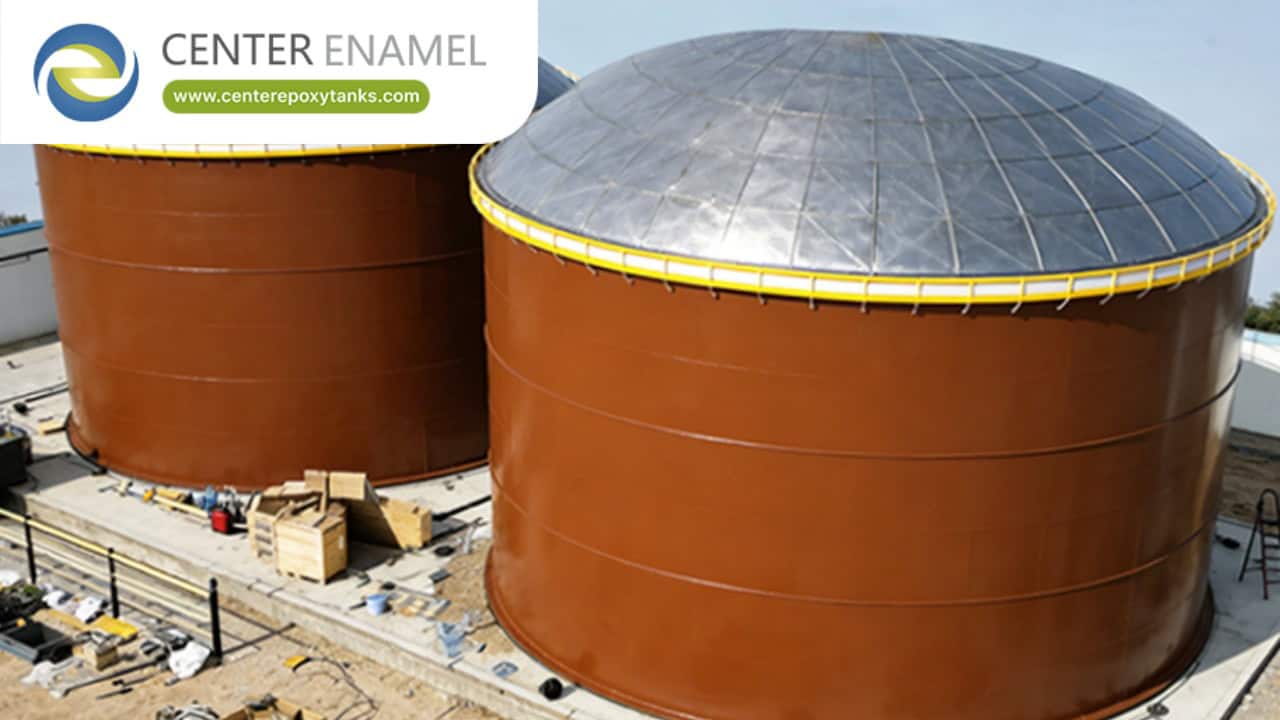
China Welded Carbon Steel Chemical Storage Tanks Manufacturer: Center Enamel
For high-pressure, high-temperature, and hazardous industrial applications, absolute structural integrity is the primary requirement. Shijiazhuang Zhengzhong Technology Co., Ltd. (Center Enamel) serves as a leading manufacturer of welded carbon steel chemical storage tanks, providing monolithic, seamless containment solutions engineered for the most demanding petrochemical, refinery, and industrial chemical environments.
Unlike modular bolted tanks used for water or wastewater, our welded carbon steel solutions are fabricated to meet the stringent international standards (such as API 650 and ASME) required for critical hydrocarbon and chemical storage, ensuring 100% joint efficiency and vapor-tight integrity.
The Engineering Case for Welded Carbon Steel
When storing aggressive chemicals or volatile liquids, the structural advantage of a welded, monolithic tank is paramount.
1. Monolithic Leak Prevention
Welded construction fuses steel plates into a single, continuous vessel. By eliminating gaskets, bolts, and mechanical fasteners, we remove the most common potential failure points, effectively creating a zero-tolerance environment for leaks—a critical safety mandate for Volatile Organic Compounds (VOCs) and hazardous chemicals.
2. High-Pressure & High-Load Resilience
Our welded carbon steel tanks are designed using advanced Finite Element Analysis (FEA) to withstand the significant internal hydrostatic pressures, wind speeds, and seismic ground accelerations typical of heavy industrial sites. This allows for configurations that bolted tanks cannot structurally support in high-stress environments.
3. Tailored Chemical Compatibility
Chemical storage requires more than just steel; it requires precise internal protection. We integrate customized anti-corrosive linings—including advanced phenolic and novolac epoxy systems—that are chemically matched to the specific acid, alkali, or solvent being stored, preventing internal pitting and hydrogen-induced cracking (HIC).
Technical Comparison: Welded vs. Modular Storage
Selecting the correct tank type for your facility depends on the storage material and operational constraints.
Engineering Metric | Center Enamel Welded Carbon Steel | Bolted/Modular Steel Tanks |
Leak Integrity | Monolithic (100% joint efficiency) | Mechanical (Requires Gaskets) |
Primary Standard | API 650 / ASME VIII | AWWA D103 / ISO 28765 |
Best Application | Crude Oil, Fuel, Refineries, Chemicals | Water, Wastewater, Biogas, Fertilizer |
Installation | Field-Welded (Specialized Crew) | Bolted (Rapid Assembly) |
Load Capacity | Extremely High (Large scale) | Modular (Medium scale) |
Our Manufacturing & Quality Lifecycle
Center Enamel employs a multi-tiered quality management system that ensures every chemical storage project meets or exceeds global regulatory benchmarks:
Material Selection: Sourcing of certified ASTM/EN steel plates with verified mill test reports (MTR).
Precision Fabrication: CNC plasma cutting and plate rolling to ensure exact tolerances for on-site fit-up.
Certified Welding: Execution by AWS/ASME-certified welders utilizing automated Submerged Arc Welding (SAW) processes for consistent, full-penetration joints.
Rigorous NDT: 100% radiographic or ultrasonic testing of critical T-joints to ensure zero porosity or internal defects.
Frequently Asked Questions (FAQ)
1. Do you design tanks to API 650 and ASME standards?
Yes. Every welded carbon steel tank is designed in strict accordance with the gold standards of the petroleum and chemical industries—specifically API 650, API 620, and ASME Section VIII. We mathematically verify each design against your site-specific seismic, wind, and hydrostatic load parameters.
2. How do you ensure chemical compatibility for my specific fluid?
During the engineering consultation phase, we request the Chemical Safety Data Sheet (SDS) of your stored product. Our chemical engineers then specify the required carbon steel grade and select the optimal internal lining (e.g., high-performance novolac epoxy or specialized phenolic coatings) to ensure 20+ years of corrosion resistance.
3. How does welded construction differ from bolted in terms of leakage?
Welded tanks are monolithic vessels—effectively one single piece of steel. Bolted tanks rely on gaskets and sealants at every joint, which can degrade over time due to chemical exposure. For highly volatile or hazardous chemicals, welded construction provides the superior security of a seamless seal.
4. Are these tanks suitable for "sour" chemical or high-H₂S environments?
Yes. For applications involving sour crude or H₂S-rich chemicals, we utilize specialized impact-tested steel grades and high-performance resistant coatings that prevent hydrogen-induced cracking and sulfide stress corrosion.
5. Can Center Enamel provide on-site installation and inspection?
Yes. We offer complete project lifecycle support, from initial design and production to full on-site field welding and quality inspection. Our teams have global experience in providing certified welding crews to handle complex chemical tank assemblies in refineries and industrial plants worldwide.


