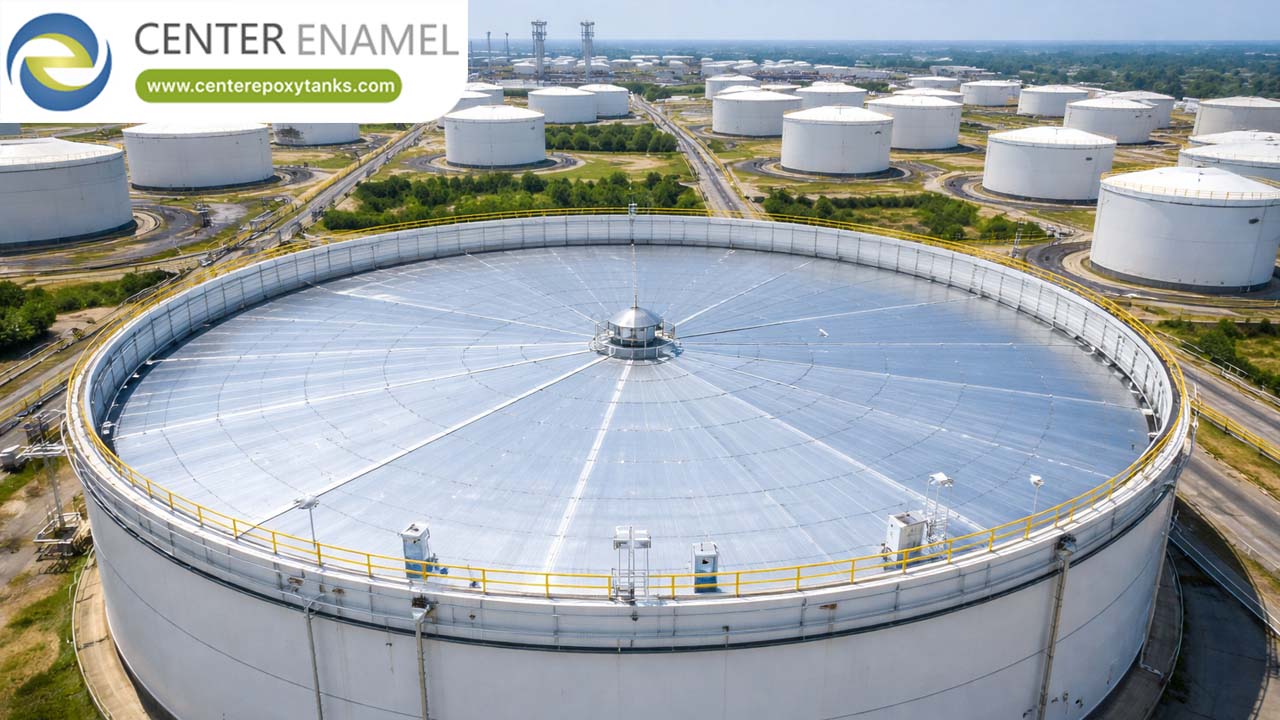
Floating Roof Tank for Crude Oil Storage: Engineering Safety, Emission Control, and Structural Integrity
Crude oil contains a complex matrix of volatile hydrocarbons that readily vaporize when exposed to ambient temperature changes and solar radiation. In bulk liquid storage terminals and oil refineries, storing millions of barrels of crude oil safely without massive product loss is a paramount engineering challenge. Traditional fixed-roof storage tanks allow a large vapor space (headspace) to form above the liquid, leading to excessive evaporative losses, high economic waste, and severe environmental compliance violations.
To solve these operational hurdles, the floating roof tank has become the universal industry standard for crude oil storage. By designing a buoyant deck that rests directly on the surface of the liquid and moves vertically with changing inventory levels, floating roof systems eliminate the dangerous vapor space entirely, securing unmatched safety and environmental performance.
The Engineering Mechanics of Floating Roof Systems
A floating roof tank functions through precise hydrostatic equilibrium and mechanical containment principles:
Direct Surface Contact: The roof deck floats squarely on top of the crude oil, ensuring that there are no pockets of air or gas trapped underneath. This completely suppresses the evaporation of light ends (such as propane, butane, and pentane fractions) present in crude oil.
Buoyancy and Pontoon Distribution: Designed with annular outer pontoons or double-deck structures, the roof maintains robust buoyancy even under localized loads or partial component flooding.
Dynamic Rim Sealing Systems: A continuous flexible seal system spans the narrow annular gap between the moving outer edge of the floating roof and the interior wall of the cylindrical steel tank shell, preventing fugitive hydrocarbon emissions and rainwater ingress.
Technical Performance Matrix: Crude Oil Storage Roof Configurations
Technical Parameter | External Floating Roof (EFR) Tanks | Internal Floating Roof (IFR) Tanks | Fixed-Roof Tanks (Without Internal Cover) |
Primary Crude Oil Application | Standard for large-scale crude oil storage and high-volatility hydrocarbons | Typically used for lighter refined products (gasoline, naphtha) or smaller crude batches | Restricted to low-volatility heavy crudes, diesel, or bunker fuel |
VOC Emission Reduction | Exceptional; reduces evaporative losses by up to 95% compared to fixed roofs | Maximum efficiency; near-zero vapor loss due to combined fixed and floating cover protection | Zero emission control; continuous atmospheric venting and odor release |
Environmental Exposure | Open to the atmosphere; engineered to handle direct rain, wind, and snow loads | Protected beneath an exterior fixed cone or dome roof | Fully enclosed, but vulnerable to explosive vapor pocket accumulation |
Governing Design Standard | Engineered strictly per API 650 Annex C specifications | Engineered strictly per API 650 Annex H specifications | Standard API 650 fixed-roof structural codes |
Crucial Design and Operational Considerations
Operating a floating roof tank for crude oil requires careful attention to specific mechanical and environmental safety parameters:
Wind Girders and Shell Stability: Because external floating roof (EFR) tanks lack a fixed roof structure, the open-top steel shell relies heavily on intermediate and top wind girders designed per API 650 to prevent shell buckling under high wind velocities.
Drainage and Rainwater Management: EFRs are equipped with articulated roof drain systems (such as flexible swivels or flexible hoses) that safely route collected rainwater off the floating deck and out of the tank without contaminating the crude oil.
Lightning Protection and Grounding: To eliminate static discharge and lightning ignition risks in the vapor-liquid interface zone, high-integrity shunts and electrical bonding jumpers connect the floating roof directly to the tank shell.
Frequently Asked Questions (FAQ)
Q: Why is a floating roof tank preferred over a fixed-roof tank for crude oil storage?
A: Crude oil contains volatile hydrocarbons that evaporate easily when exposed to an empty headspace. A floating roof rests directly on the liquid surface, eliminating the vapor space, reducing VOC emissions by up to 95%, and significantly lowering fire and explosion risks.
Q: What is the difference between an External Floating Roof (EFR) and an Internal Floating Roof (IFR)?
A: An External Floating Roof is exposed directly to the open atmosphere and weather elements, making it the primary choice for large crude oil storage tanks. An Internal Floating Roof is installed inside a fixed-roof tank, providing dual-layer protection where the fixed roof blocks weather while the internal float controls vapors.
Q: How do floating roof tanks handle heavy rainfall on open external roofs?
A: External floating roofs feature built-in drainage systems, including sloped decks and flexible internal drainage pipes (roof drains), that safely collect and channel rainwater out of the tank basin without mixing water into the crude oil inventory.
Q: What international standards govern the design and construction of floating roof crude tanks?
A: Floating roof crude oil storage tanks are designed, fabricated, and tested in accordance with API 650 (Welded Tanks for Oil Storage), with specific mechanical requirements for floating decks outlined under Annex C (External Floating Roofs) and Annex H (Internal Floating Roofs).


